Professional standards, training and membership.




Professional standards, training and membership.

Ethics in IEMT Practice: Lesson 4.2
Navigating Ethical Dilemmas and Grey Areas
Welcome
In Lesson 4.2, we explore the complexities of real-world ethical decision-making. Not every situation has a clear-cut answer—ethical dilemmas often emerge in the “grey areas” where multiple principles may conflict. This lesson will give you tools to think critically and act responsibly in these situations.
Learning Objectives
By the end of this lesson, you will be able to:
- Recognise what constitutes an ethical dilemma.
- Apply a step-by-step framework for ethical decision-making.
- Reflect on how personal values interact with professional ethics.
- Use supervision and reflective practice to support ethical outcomes.
What is an Ethical Dilemma?
Ethical dilemmas in IEMT practice often arise from the modality’s unique blend of brevity and emotional intensity, which can amplify the tension between competing principles such as confidentiality and safeguarding or autonomy and beneficence.
The rapid pace at which IEMT facilitates emotional shifts may thrust practitioners into situations where the immediacy of a client’s disclosure—such as a hint of risk or distress—demands swift resolution yet lacks a clear ethical directive.
These grey areas challenge practitioners to move beyond rote application of rules, engaging instead in a deliberative process that weighs the nuances of each case. This complexity underscores the ethical principle of integrity, as practitioners must navigate these conflicts with a commitment to transparency and a willingness to interrogate their own judgement, ensuring that decisions reflect the client’s best interests rather than expedient solutions.
An ethical dilemma occurs when two or more ethical principles are in conflict, and the best course of action is unclear. Examples include:
- Wanting to respect client confidentiality while also having a safeguarding concern.
- Deciding whether to end a session that’s gone off-track emotionally.
- Balancing a client’s autonomy with concerns about their emotional safety.
Dilemmas are not about right vs. wrong but about competing rights and responsibilities.
A Framework for Ethical Decision-Making
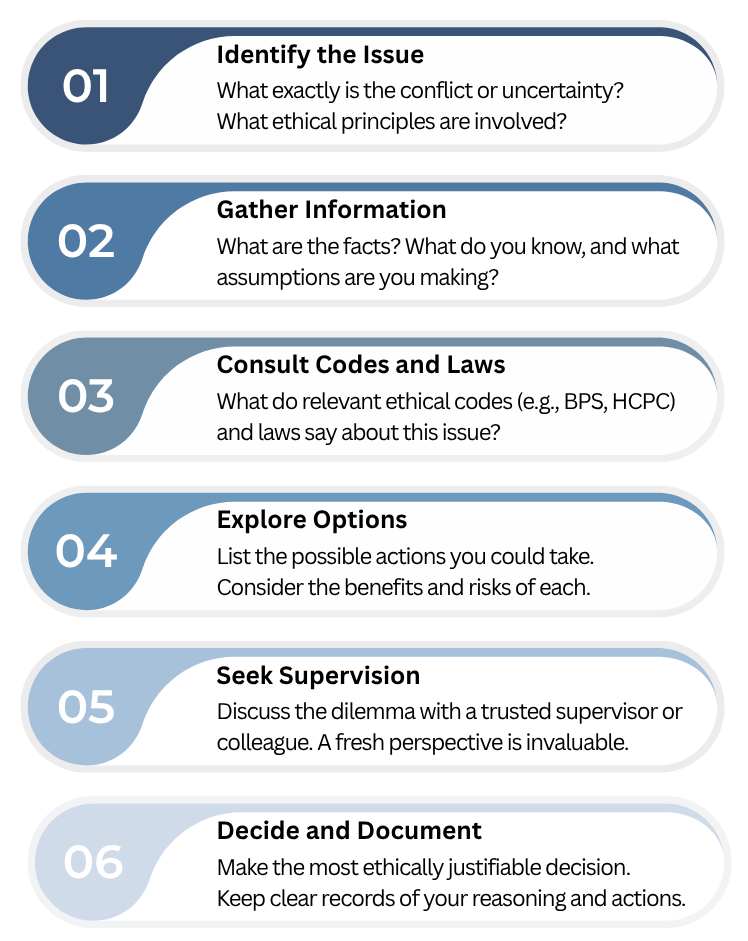
The proposed framework for ethical decision-making in IEMT practice serves as a critical scaffold for resolving dilemmas, offering a structured yet flexible approach that accommodates the therapy’s dynamic nature.
By systematically identifying the conflicting principles and grounding decisions in both factual evidence and professional codes—such as those from the British Psychological Society or Health and Care Professions Council—practitioners can mitigate the risk of impulsive or biased responses.
In IEMT, where emotional content can shift the therapeutic trajectory unexpectedly, the step of gathering information becomes particularly vital, requiring practitioners to discern between observable data and speculative interpretations.
This methodical process not only enhances accountability but also aligns with the principle of justice, ensuring that decisions are equitable and defensible across diverse client scenarios.
When facing an ethical dilemma, consider the following steps:
The Role of Values and Bias
The interplay between personal values and professional ethics in IEMT practice introduces an additional layer of complexity to navigating ethical dilemmas, as practitioners’ subjective beliefs can subtly shape their perception of a situation.
While fostering rapport, the conversational tone of IEMT may blur the boundary between therapeutic neutrality and personal inclination, particularly when a client’s choices challenge the practitioner’s moral framework—such as a refusal to address harmful behaviours.
Self-awareness becomes an ethical imperative in these moments, demanding that practitioners critically examine whether their discomfort or preferences are unduly influencing their stance.
By rooting their decisions in the client’s well-being rather than their own biases, practitioners uphold the principle of non-maleficence, safeguarding the therapeutic process from unintended harm while reinforcing its client-centred ethos.
Supervision and reflective practice emerge as indispensable tools for IEMT practitioners confronting ethical grey areas, providing a mechanism to externalise and refine their decision-making amidst uncertainty.
The brevity of IEMT sessions can limit in-session opportunities for deliberation, making post-session reflection and consultation essential for unpacking complex dilemmas.
Engaging with a supervisor offers not only practical guidance but also a counterbalance to the isolation of independent practice, fostering a collaborative ethic that mirrors the principle of beneficence by prioritising the client’s welfare.
This reliance on external perspectives ensures that ethical resolutions are not only principled but also enriched by diverse insights, a process that is particularly crucial in a field like IEMT, where the lack of statutory regulation places greater responsibility on individual practitioners to self-regulate with rigour and humility.
All practitioners bring their own beliefs and life experiences to the work. Self-awareness is essential:
- Notice when your personal values may be influencing your decisions.
- Check for unconscious bias or assumptions.
- Ask yourself, “Is this decision in the best interest of the client, or is it more about my own comfort?”
Real-Life Scenario Practice
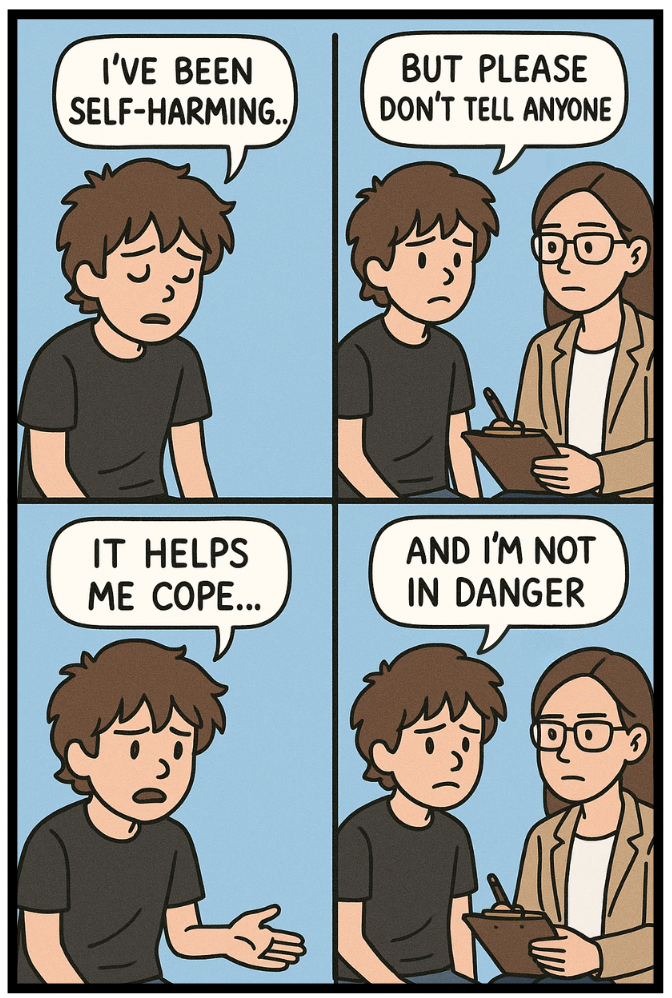
Scenario: A 15-year-old client shares that they are self-harming but asks you not to tell anyone. They say it helps them cope and that they’re not in danger.
- What are your ethical obligations here?
- Which principles are in conflict?
- How would you apply the decision-making framework?
Write a short reflection on how you might handle this situation and what support you would seek.
Key Takeaways
- Ethical dilemmas are part of real-world practice.
- A structured approach helps ensure thoughtful, principled decisions.
- Supervision and reflection are essential tools for navigating uncertainty.
Next Steps
In Lesson 4.3, we’ll examine how to respond ethically and professionally to complaints and the role of supervision and ongoing ethical development in maintaining good practice.
This ethics series is produced by The Association for IEMT Practitioners and is intended for professional development purposes. Always adhere to local laws, safeguarding requirements, and your professional judgement when applying ethical principles in practice.