Professional standards, training and membership.


Professional standards, training and membership.

Ethics in IEMT Practice: Lesson 1.1
Introduction to Ethics in IEMT
Welcome
Welcome to the first lesson in the Ethics in IEMT Practice series, developed for members of The Association for IEMT Practitioners. This lesson introduces the foundational concepts of ethics, why they matter in therapy, and how they apply specifically to Integral Eye Movement Technique (IEMT).
The significance of ethics in therapeutic modalities such as IEMT cannot be overstated, particularly given the intimate and transformative nature of the work involved. IEMT, as a technique designed to facilitate rapid emotional change through eye movement patterns, engages directly with clients’ psychological vulnerabilities.
This engagement places practitioners in a position of considerable influence, necessitating a robust ethical framework to guide their conduct. Beyond merely adhering to procedural norms, ethics in this context serves as a safeguard against the misuse of power and a mechanism for promoting client empowerment.
By embedding ethical considerations into every facet of practice, from initial consultation to post-session follow-up, IEMT practitioners can ensure that their interventions remain both effective and morally sound.
Learning Objectives
By the end of this lesson, you will be able to:
- Understand the role and importance of ethics in therapeutic work.
- Identify the key ethical standards drawn from psychological and medical professions.
- Recognise how these apply to IEMT practice with paying, voluntary clients.
What is Ethics in Therapy?
Ethics refers to a set of moral principles that guide our decisions and actions. In therapy, ethics provide a framework to ensure that practitioners act in the best interests of their clients, maintain professional integrity, and protect vulnerable individuals.
Ethics are especially important in therapies like IEMT, which often work with emotionally sensitive or distressed individuals.
Clear ethical boundaries help foster:
- Trust – Clients feel safe to open up without fear of judgement or harm.
- Safety – Emotional containment and respectful processes are maintained.
- Professionalism – Practitioners uphold consistent standards of conduct.
Professional Codes of Ethics
While statutory healthcare bodies may not regulate IEMT practitioners, many ethical standards from psychological and medical organisations provide excellent guidance.
Key Sources:
- British Psychological Society (BPS)—Code of Ethics and Conduct.
- General Medical Council (GMC)—Good Medical Practice.
- Health and Care Professions Council (HCPC)—Standards of Conduct, Performance, and Ethics.
These codes emphasise:
- Respect for client autonomy.
- The duty to do no harm (non-maleficence).
- The duty to do good (beneficence).
- Fairness and justice.
- Professional integrity.
Ethics in IEMT Context
The absence of statutory regulation for IEMT practitioners underscores the importance of self-imposed ethical accountability within the profession. Unlike psychologists or medical professionals, who operate under the oversight of bodies like the Health and Care Professions Council or General Medical Council, IEMT practitioners rely on voluntary adherence to professional codes and association guidelines.
This self-regulatory approach demands a heightened level of personal responsibility and continuous professional development to maintain ethical competence. It also invites practitioners to critically evaluate their practice through the lens of beneficence and non-maleficence, ensuring that their interventions contribute positively to clients’ well-being without inadvertently causing distress or harm. This proactive stance distinguishes ethical IEMT practice as a model of integrity within the broader landscape of complementary therapies.
In IEMT, ethical practice means:
- Gaining informed consent before sessions begin.
- Working within the limits of your competence.
- Keeping client information confidential and secure.
- Creating a safe and respectful space for change work
 .
.
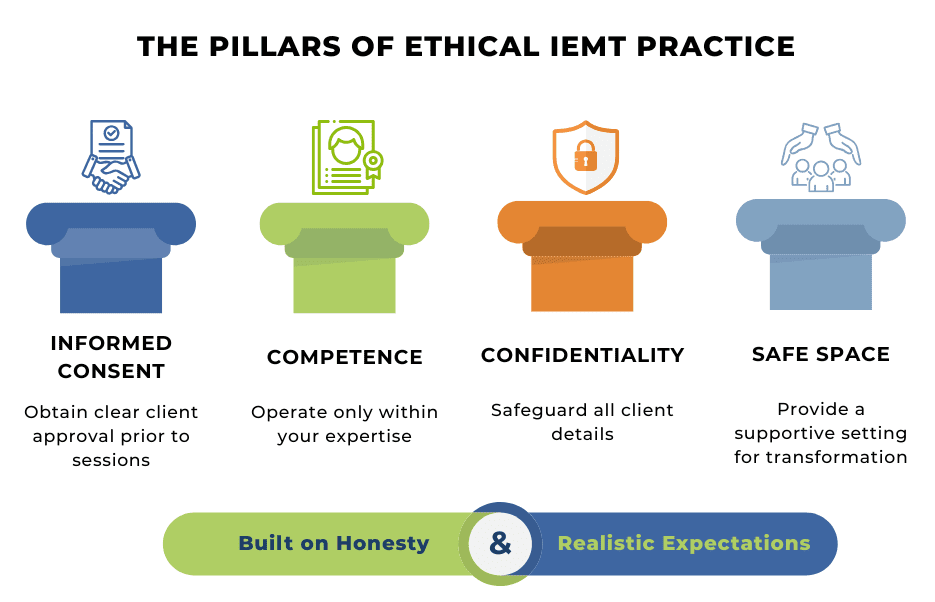
Because IEMT is a brief, change-oriented approach, ethical practice also includes being honest about what IEMT can and cannot achieve and managing expectations responsibly.
Self-Reflection Exercise
Take 5–10 minutes to consider the following questions:
- Why did you choose to become an IEMT practitioner?
- What responsibilities do you feel towards your clients?
- Have you ever faced an ethical dilemma in your work? How did you handle it?
Write your reflections in a journal or workbook.
Key Takeaways
- Ethics are essential in maintaining trust, safety, and professionalism.
- Core principles include autonomy, beneficence, non-maleficence, justice, and integrity.
- Ethical IEMT practice is guided by professional codes, even in the absence of statutory regulation.
Next Steps
In the next lesson (1.2), we will explore each of the five core ethical principles in depth and see how they shape our work as IEMT practitioners.
This ethics series is produced by The Association for IEMT Practitioners and is intended for professional development purposes. Always adhere to local laws, safeguarding requirements, and your professional judgement when applying ethical principles in practice.