![Gillick v West Norfolk and Wisbech Area Health Authority [1985]](https://integraleyemovementtherapy.com/wp-content/uploads/2025/06/Gillick-Case-Cover-e1749636222607.png)
Gillick v West Norfolk and Wisbech Area Health Authority [1985]
Background of the Case
The Gillick case emerged from a deeply personal and socially charged dispute in the United Kingdom during the early 1980s. Victoria Gillick, a Roman Catholic mother of ten children, including five daughters, became alarmed by a Department of Health and Social Security (DHSS) circular issued in 1980. This guidance permitted doctors to provide contraceptive advice and prescriptions to girls under 16 without requiring parental consent or notification. Gillick viewed this policy as a direct threat to parental authority, arguing that it not only undermined her rights as a parent but also risked encouraging underage sexual activity, which she believed conflicted with moral and societal norms.
Her campaign began with a personal plea to her local health authority, West Norfolk and Wisbech, requesting a written assurance that none of her daughters would receive contraception without her explicit knowledge or approval. When the health authority declined, citing the DHSS guidance, Gillick escalated her fight to the courts. Her case wasn’t just a legal challenge—it became a lightning rod for broader debates about parental rights, adolescent autonomy, sexual health, and the role of the state in private family matters.
Social Context: The 1980s saw rising teenage pregnancy rates and growing public health efforts to address sexual health, juxtaposed against conservative values emphasising parental control. Gillick’s stance resonated with traditionalists, while her opponents championed the need to protect vulnerable minors from unintended consequences like pregnancy or disease.
Legal Proceedings
The legal journey of Gillick v West Norfolk and Wisbech Area Health Authority unfolded across multiple courts, reflecting the complexity and controversy of the issue:
- High Court (1983): Gillick’s initial claim was dismissed. The court ruled that the DHSS guidance was lawful, prioritising medical discretion and public health over parental oversight.
- Court of Appeal (1984): On appeal, Gillick won a significant victory. The court sided with her, declaring that providing contraception to minors without parental consent was illegal, as it interfered with parental rights under common law. This decision sparked widespread concern among healthcare providers, who feared it would limit their ability to support young patients confidentially.
- House of Lords (1985): The case reached the House of Lords, the UK’s highest court at the time (now the Supreme Court), in a landmark hearing. In a 3-2 decision, the Lords reversed the Court of Appeal’s ruling, siding with the health authority and establishing a groundbreaking precedent.
The House of Lords Decision (1985)
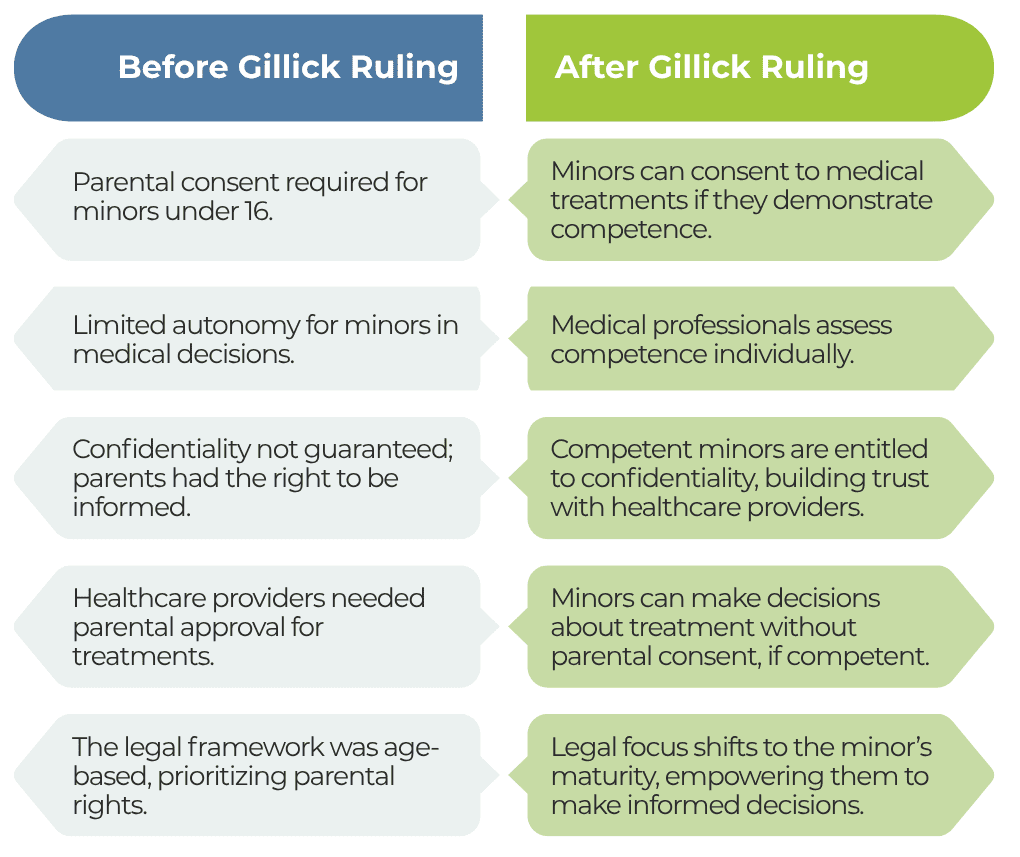
The House of Lords ruled that minors under 16 could consent to medical treatment, including contraception, without parental involvement, provided they demonstrated "Gillick competence". This concept, named after the case, hinges on a minor’s ability to fully comprehend the nature, implications, and consequences of the proposed treatment—shifting the focus from chronological age to individual maturity and understanding.
Lord Scarman, a key voice in the majority opinion, articulated the legal reasoning with clarity:
"The parental right to determine whether or not a minor child below the age of 16 will have medical treatment terminates if and when the child achieves a sufficient understanding and intelligence to enable him or her to understand fully what is proposed."
He emphasised that parental rights are not absolute but diminish as a child’s capacity for self-determination grows, framing this as a natural evolution of responsibility.
The decision rejected a rigid age-based threshold, instead empowering healthcare professionals to assess competence on a case-by-case basis. This marked a seismic shift in how the law viewed minors—not as extensions of their parents but as individuals with emerging rights.
Key Outcomes of the Case
The Gillick ruling reshaped medical, legal, and ethical landscapes in the UK and beyond. Its outcomes include:
- Recognition of Minors’ Autonomy: Minors deemed "Gillick competent" gained the legal right to make their own medical decisions, from contraception to other treatments, without parental veto. This empowered young people to seek care independently, particularly in sensitive areas like sexual and reproductive health.
Example: A 15-year-old seeking therapy for anxiety could consent to treatment without parental approval if they understood its purpose and implications. - Confidentiality Rights for Young Patients: The ruling affirmed that competent minors are entitled to confidentiality, meaning doctors could withhold information from parents if it served the minor’s best interests. This strengthened trust between young patients and healthcare providers.
Practical Impact: A teenager discussing trauma in therapy could expect privacy, even if parents demanded details, provided competence was established. - Influence on Ethical Standards and Policies: "Gillick competence" became a cornerstone of medical ethics and law, extending beyond contraception to areas like mental health, abortion, and chronic illness management. It influenced guidelines from bodies like the General Medical Council (GMC) and inspired similar standards internationally.

Broader Reach: In therapy contexts, it guides decisions about when a minor can consent to interventions like eye movement therapy without parental input.
Influence on Medical Ethics
- Principle of Autonomy: Reflection Prompt: "How does recognising a minor’s autonomy change the way you approach consent in your practice?"
- Balancing Autonomy and Beneficence: Scenario: A 14-year-old seeks eye movement therapy for PTSD but resists parental involvement—how do you determine competence and safeguard their well-being?
- Confidentiality and Privacy: Curiosity Hook: "If a parent insists on knowing session details, but the minor objects, where do you draw the line?"
- Ethical and Legal Framework: Gillick competence became a benchmark for professional guidelines, shaping training and practice.