
Professional standards, training and membership.







Professional standards, training and membership.
Ethics in IEMT Practice: Lesson 5.2
Case Reflection: Ethical Practice with Young People and Children
Welcome
Working with a young person raises everything we have looked at so far, all at once: consent, confidentiality, safeguarding, parents and the young person’s own voice. This lesson works through one hypothetical case. “Alex” is invented for teaching purposes, and any resemblance to a real person is coincidental. As in Lesson 5.1, think about the case and write your own answer before you read the suggested approach.
Learning Objectives
By the end of this lesson, you will be able to:
- Apply consent, confidentiality and safeguarding principles to a case involving a young person and their parents.
- Explain how to agree with a young person and their parents what will and will not be shared.
- Recognise when a young person’s words trigger a safeguarding duty.
- Plan the stages of work with a young person, and reflect on what went well and what could improve.
1. The case
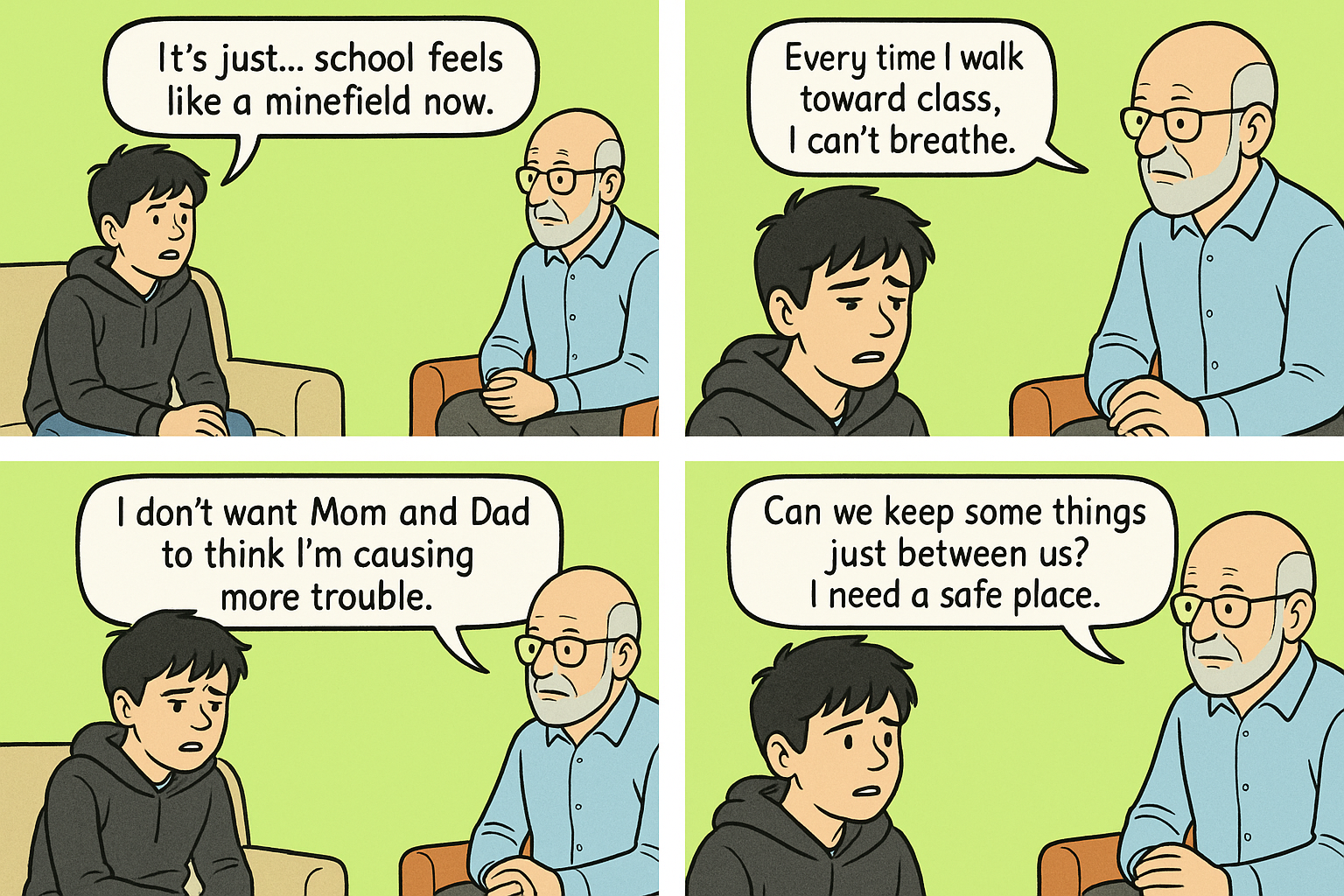
Alex, a 14-year-old, is brought to you after their parents separated. They have been having panic attacks at school, avoiding situations and feeling low. Alex comes with a parent’s consent, but is uncomfortable about the parents knowing everything that is discussed. They say they are afraid of “causing more trouble” at home and at school.
2. The ethical dilemma
The central question is how to balance confidentiality and safety:
- Alex wants some of what they say to stay private from their parents.
- Alex is under 16 and has come with a parent’s consent, which is the clear route to valid consent while competence is uncertain (Lessons 3.1 and 3.1.2). The parents also have legitimate concerns for Alex’s welfare.
- If Alex mentions serious self-harm, suicidal intent, harm from someone else, or risk to others, you must act on it, whatever you promised.
- Alex’s parents have separated, so there may be disagreement between them, and Alex may be caught in the middle.
3. Questions for reflection
Consent and capacity
- How would you check that Alex understands what they are agreeing to?
- What should the consent process include when both a parent and a young person are involved?
Confidentiality
- What can reasonably stay private between you and Alex?
- In what circumstances would you share information, and with whom?
Parents and the setting
- When, if ever, would you include a parent in a session?
- How do you respect Alex’s voice in joint or split sessions?
Safeguarding
- What would you do if Alex told you they were having suicidal thoughts or harming themselves?
- Which services would you contact (children’s social care, NSPCC advice line, the GP or local mental-health service)?
Development
- How do you adapt your explanations and approach to Alex’s age and stage?
4. Principles and policies that apply
| Principle | What it means for Alex’s case | Where to look |
|---|---|---|
| Informed consent | Explain, in words suited to Alex’s age, what IEMT is, what might happen, the limits of the evidence, the limits of confidentiality and what parents can know. Check Alex understands and agrees, as well as the parent. | Lessons 2.1, 3.1.2 and 3.2 |
| Best interests and welfare | Keep Alex’s welfare, voice and development at the centre. Do not be drawn into the parents’ dispute, and do not take sides. | Lesson 3.1.1 (UNCRC articles 3 and 12) |
| Confidentiality and its limits | Agree in advance, with Alex and the parents, what stays private, what will be shared, and what will always be shared: serious risk. | Lessons 2.3 and 3.3 |
| Safeguarding | Ask about safety, and listen for fear of someone at home or at school. Follow recognise, respond, record, refer. Do not wait for certainty. | Lesson 3.1; Safeguarding Policy |
| Parental responsibility | Check who has it, and whether both parents agree. If the parents disagree about the sessions, or there is a court order, take advice before starting or continuing. | Lesson 3.1 |
| Scope and supervision | Confirm that you are trained and insured to work with a 14-year-old with panic attacks, and use supervision. Panic and low mood may need a GP or CAMHS assessment. | Lessons 2.4 and 4.5 |
5. A suggested approach
The stages below show one way to organise the work. Compare them with your own plan.
- Before starting. Meet the parent or parents to explain the process, the limits of confidentiality and what you need from them. Meet Alex separately to explain their rights and what you will keep private. Agree the arrangement, in writing, with both. Check who holds parental responsibility.
- Screen. Ask about Alex’s mood, sleep, school, friends and safety, including suicidal thoughts and self-harm, in a calm and direct way. Decide whether IEMT is suitable now or whether a GP or CAMHS assessment should come first.
- Plan the sessions. Invite Alex to say what they would like to keep private and what they are happy for parents to know. Check in regularly about how Alex feels about their parents’ involvement.
- Keep checking for risk. At each session, ask sensitively about mood and safety. Keep records. If there is a safeguarding concern, follow the steps in Lesson 3.1 without delay.
- Use supervision and refer. Take ethical tension to supervision. If safeguarding is triggered, refer to children’s social care, and consider CAMHS or the GP for ongoing needs.
- Stay transparent. Revisit confidentiality and consent often, for example every few sessions and after anything significant. Tell parents about general progress and attendance, not what Alex has shared privately.
Do not become involved in the parents’ dispute. You may be asked to give an opinion about what is best for Alex, or to write a report for solicitors or a family court. This is a different role, and you should not accept without taking advice. Do not promise Alex that nothing will ever be shared. Explain the limits, so that if you do have to share something, it is not a betrayal.
6. Key learning points
- Consent is relational and developmental. A young person’s capacity grows with age, so adapt consent to age and understanding.
- Confidentiality has to be agreed, and is not all-or-nothing. Young people need a protected space, and you must be clear about what stays private and what must be shared for safety.
- Communicate in a child-centred way. Use language that is clear, non-threatening and suited to adolescents.
- Safeguarding is proactive. Keep watching for suicidal thoughts, self-harm and any other concern. Do not wait for a full disclosure.
- Keep a balance. Keep assessing when to involve parents, when to protect Alex’s privacy, and when to escalate.
7. What went well, and what could improve
Imagine that the work with Alex went reasonably well. A review might say:
- Strengths: Alex felt heard and respected, and the confidentiality arrangements held.
- Challenges: The boundaries were awkward at times, especially where parents’ needs and Alex’s needs overlapped.
- Improvements: Make check-ins about consent and confidentiality routine, keep the records up to date, and revisit the safety plan regularly.
Self-Reflection Exercise
Reflect on how you would handle a case like this:
- How would you assess and support Alex’s developing capacity to consent?
- When would you act out of concern for Alex’s welfare, and how would you explain that to them?
- What would you want to learn about involving parents in work with young people?
- What change in your own practice, policies or supervision would help with future cases involving young people?
Further reading
- NSPCC Learning: Safeguarding children and child protection
- NSPCC Learning: Gillick competence and Fraser guidelines
- GOV.UK: Information sharing advice for safeguarding practitioners
- GOV.UK: Working Together to Safeguard Children
- BACP: Ethical Framework for the Counselling Professions (2018), including the section on working with children and young people
Key Takeaways
- Agree with the young person and their parents, at the start, what will be shared and what will stay private.
- Check who holds parental responsibility, and do not be drawn into a dispute between parents.
- Keep checking for risk, and act without delay if a safeguarding concern appears.
- Keep Alex’s voice, welfare and development at the centre.
- Revisit consent and confidentiality regularly, and use supervision.
Next Steps
Lesson 5.3 brings everything together in three decision exercises.