


PTSD and Limb Loss
The Complex War-Trauma Recovery Project
A Project by The Association for IEMT Practitioners
PTSD + Limb Loss
This project is to help those suffering from long-term issues resulting from severe physical injuries and complex psychological trauma, including PTSD and phantom limb pain. By integrating innovative therapeutic techniques such as Integral Eye Movement Technique (IEMT) and Mirror Visual Feedback (MVF), we are committed to delivering effective recovery solutions. The project is currently in development and has not yet been delivered.
As an apolitical group, our proposed model is to offer free training, ongoing consultation and support to staff of NGOs and other organisations already working with people affected by war.
We are happy to answer any questions or discuss the proposed project with interested organisations.
Email: associationforiemt@gmail.com
Andrew T. Austin
Director for The Association for IEMT Practitioners
Integral Eye Movement Technique (IEMT) is a therapeutic approach that utilizes specific eye movements to help individuals process and release negative emotions, trauma, and limiting beliefs. This technique, developed by Andrew T. Austin, is grounded in the idea that certain eye movements can help the brain access and reprocess memories or emotions causing distress.
IEMT is particularly effective in addressing issues related to anxiety, depression, PTSD, and other emotional challenges, offering a non-invasive method to facilitate change and promote emotional well-being. By focusing on the way memories and feelings are stored in the brain, IEMT aims to help clients achieve a more balanced and positive mental state.
War Zone NGOs, please get in touch to find out how we can help you with staff training: associationforiemt@gmail.com
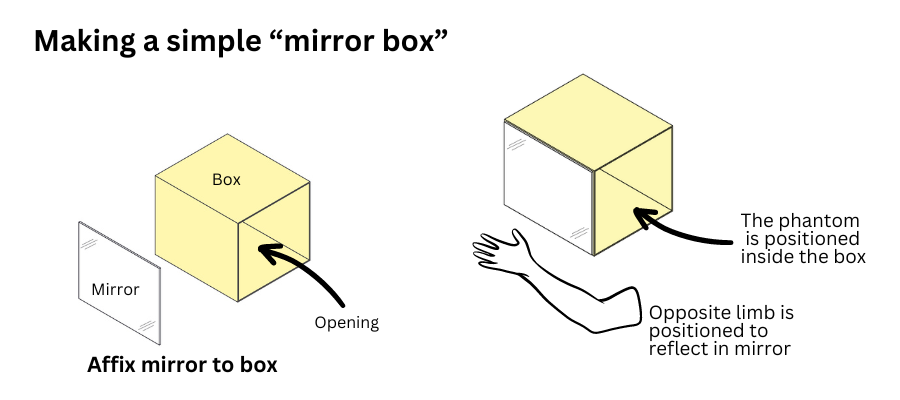
Mirror Visual Feedback (MVF) is an innovative therapeutic approach to ease phantom limb pain and support the recovery of motor functions in limbs compromised by injury.
The process involves using a mirror to generate a reflective illusion of the affected limb, thereby tricking the brain into perceiving motion and touch in the phantom or damaged limb.
This visual feedback can significantly alleviate the pain and discomfort associated with phantom limbs and facilitate the rehabilitation of limbs afflicted with motor deficits.
MVF leverages the brain's plasticity, encouraging the reorganisation of neural pathways to adapt to new circumstances. Thus, it offers a noninvasive and psychologically grounded approach to pain management and physical rehabilitation.
Training Curriculum
- Training curriculum for IEMT and MVF for clinicians is here (opens in new window).
- Training curriculum translated to Ukrainian is here (opens in new window).
Current Training Program (concludes October 2024)
- Training pages (members only)
- Proprioception and The Sensory and Motor Cortex
- Sensorial Remapping Phenomena
- The Limb Image
- Stages of a Session
- Multiple Trauma and Dysmorphic Distress
- The PTSD Lynchpin Revisited
- IEMT Intro Set Up
- K-Pattern for Pain
- K-Pattern Review - Common Mistakes
- Putting it all together
- Presentations Day#1
- Presentations Day#2
- Presentations Day#3
- Presentations Day#4
- Presentations Day#5
- Presentations Day#6
- Presentation Day #7
- Presentation Day #8
Application for Participants
Advisory Board for The Complex War-Trauma Recovery Project
Please send an application for an advisory role to: associationforiemt@gmail.com
Dr Bilal Zafar, MBBS (Dow), FCPS-R (Psych), MRCPsych (Paper A&B)
Senior Psychiatry Resident.
LNH Editor-in-Chief and Head of AI, MEDizzy.com
Dr Bruce Grimley, B.Sc. (Hons), M.Sc. AFBPsS.
Achieving Lives Ltd.
Chartered Psychologist and Author.
Registered Psychotherapist and Accredited Coach.
Registered Supervisor and Accredited Trainer.
Alan Johnson
Change Working Ltd. (www.changeworking.co.uk).
Registered General Nurse.
Registered Psychiatric Nurse.
Trainer & Therapist/Coach.
Arianna Baldini (Arianna MindSunrise).
Registered General Nurse.
IEMT Practitioner.
Communications Officer
Sabine Chartouny
Email: Sabine@integraleyemovementtherapy.com
WhatsApp: +961 3 626 875
Director
Andrew T. Austin
Email: associationforiemt@gmail.com
WhatsApp: +44 7838 387 580
Additional Resources


