






IEMT and MVF Training Curriculum
Training Curriculum
The training programme is comprised of two principle components:- The IEMT for Trauma modules encompass a comprehensive learning day, integrating theoretical knowledge and practical application.
- The application of Mirror Visual Feedback is structured to accommodate varying levels of expertise: a half-day session (4 hours) is designated for clinicians, whilst non-clinical participants are encouraged to engage in a full training day. For this programme, the term 'clinical' is attributed explicitly to professionals credentialed to operate within the medical or surgical domains (such as nurses, physiotherapists, and medical practitioners) and possess relevant clinical experience. It is important to clarify that coaches and hypnotherapists identifying as 'clinical' do not meet this criteria.
1. IEMT for Trauma
Rule setting for the group, mobile phones, toilets, etc.Module 1 - Introductory Concepts
Introduction to eye movements, including NLP’s eye accessing cues and the limitation of this model being only in 2 dimensions when, in fact, eyes move through a 3-dimensional field.The “eye accessing cues” model is well known to many people, even outside of NLP training, and we find that most trainees have accepted this model with little scepticism and understanding. It is found that pointing out that the chart is very limited by its two-dimensional scope and that “eye accessing cues” occur in three dimensions invariably comes as new information even to practitioners trained to trainer level.
 First introductory exercise. In pairs, one person thinks of a situational problem and holds memory while the partner directs eye movements through 3 different axis lines, about 6 times each way. Then, they swap over.
 The trainer will should construct his own story around historically feeling “terrible” because of what today (as an adult) seems like a trivial issue (for example, a lunch box that was stolen in school, a fancy pencil that got spoilt, etc.). This way, the trainees will connect with their own experiences and show that it is not only the “big stuff” that needs to be considered for eye movements to yield sizable results.
Feedback from the group leading them to discover that the following tends to happen to memory:-
- The emotional component of the memory is reduced.
- The visual aspect of memory reduces focus.
- The visual aspect of the memory moves further away.
- Dissociation from the representation of the memory occurs with age progression.
-
Discover from the group:
-
- who found that they felt better or derived benefit/relief from the eye movements applied to a specific memory.
- who found that no change occurred.
- who found that it got worse in some way.
-

The trainer will note any participant who reports a negative somatic response, such as dizziness or nausea. Experience has demonstrated that these are the individuals who 1. are most likely to abreact (creating release/relief) during the exercises and 2. report afterwards deriving the most personal benefit from the work.
Neurological overview of the limbic system. This is a grossly simplified introduction to the limbic system, particularly referring to the hippocampal and amygdaloid regions.Core concepts:
-
- distinctions and differences between visual memory and emotional/kinaesthetic memory concerning Alzheimer's disease and senile dementia (hippocampus/amygdala)
- emotional discrimination (amygdala)
- “The Hungers” or “drives” (hypothalamus)
-
It must be emphasised that this oversimplified description might give the impression that these are the functions of this neurological region, but that they are merely a small aspect of its function.
Q&A and feedback from the group. A common request from the group is to learn more about neurology. Whilst there are a large number of resources, the following books might be most suitable for trainees of IEMT:-
- “Mapping the Mind” by Rita Carter
- “The Emotional Brain” by Joseph LeDoux
- “Phantoms in the Brain” by V.S. Ramachandran.
- All the writings by Oliver Sacks.
-
Module 2 - Introduction to the IEMT Kinaesthetic Pattern (also, "K-Pattern" or "K-Protocol")
The trainees are taken through the script for the “Basic Pattern,” emphasising that it is paramount to follow it exactly as it is. The wording of the script has a specific design, and though a little deviation is acceptable, participants are told to read it word by word with the suggested emphasis and pauses, as and where required.
The script contains embedded commands and suggestions to facilitate the Kinaesthetic Pattern process, and this concept may need to be explained to trainees with little or no prior experience with hypnotic language patterns.

The trainer will mention the Trans-Derivational Search, which is when the mind searches for memory by moving the eyes around in space.
It is essential to point out that feelings are okay not to have a specific name or diagnostic category. The body experiences a wide range of emotions that are difficult to label. The first two questions aim to help the person experience the feeling by mapping it on a scale of 1 to 10 and assessing its familiarity. It is not necessary for the “client” to give a lengthy description or history of the emotion or feeling. This eases the next step, which is the person’s access to the memory, and it is where the eye movements work.
Trainees are instructed to direct their clients in the training exercises to ask, “How does that feel?” when someone presents a thought, an outcome such as behaviour (for example, procrastination), or physical pain. Then, the Kinaesthetic Pattern algorithm follows.
The group is instructed on how to deliver the hand movements “professionally” when directing the client’s eye movements. Posture, position relative to the “client,” arm movement, and levels of eye contact are referenced.The trainees are instructed:
-
- The speed of movement is to be kept consistent, neither too fast nor too slow.
- The eyes of the “client” are taken to the periphery.
- The client's head is to be kept still.
- The client's eyes are to follow the fingers.
- The focal distance to be comfortable (about 2 feet).
-
A demonstration is given.
Set exercise in pairs to practice the IEMT Kinaesthetic PatternSecond exercise. In pairs, one person thinks of a recurring unpleasant feeling, and the other asks the questions as per the script.
If no change in the memory is reported, eye movements are repeated on the same memory.
To the question, “… and how has the feeling changed?” after the response, if required (ask, “Do you want to bring it down further?), the entire formula can be repeated, starting from “on a scale of 1 to 10, how strong…”.
Trainees are told that people are either taught how to feel or learn how to feel. For example, guilt and shame are taught; anxiety and panic are learned.
Feedback and Q&APeople often report being amazed at their inability to recall the memory and the loss of intensity of the feeling. It is essential to introduce how IEMT is attaching a failure-to-recall to the problem, not through conversation but through direct experience. Asking the client to “try harder” to bring the memory back automatically highlights the inability to recall the event with full intensity.
Where appropriate, introduce the Patterns of Chronicity as they arise within the group's behaviour. Typically, a “what if” question arises from someone, introduce the “Great What If Question”. Ideally, the “Three Stage Overreaction” and “Maybe Man” are covered in this module.
Where there is sufficient time before the break, direct the group to repeat the same exercise.
Module 3 - Post-Traumatic Stress Disorder
The trainer will emphasise the existence of PTSD, highlighting its definition and impact, with a diagnostic structure by which it is defined. It is essential to distinguish between something that is perceived, or what someone is simply calling PTSD, and clinically diagnosed PTSD with symptoms meeting the diagnostic criteria set out in the Diagnostic and Statistical Manual of Mental Disorders (DSM-V). It is seen as helpful to give examples of how PTSD came into current terminology and how, to begin with, it was mostly deemed present only in war veterans, refugees, and victims of torture.
The two patterns of Chronicity, “Three-Stage Overreaction” and “Being at Effect rather than at Cause”, are brought up again when discussing the common need on the part of those who develop PTSD to 1. go back to being the person they were before the trauma (“I want my life back”) and the expectation from others to understand their suffering (often demonstrated by the creation of an awareness campaign, another “foundation” or charity, writing a book about the experiences, and so on).
Proposing the existence of “the lynchpin," the trainer will give a lot of stories and examples while explaining “the lynchpin” diagram. The trainer will essentially point out that we can only work with the experiences of the client who is present and not the other person, people, or other extrinsic factors that may have been involved in contributing to the trauma.

The lynchpin is defined as a normal personality trait that was unremarkable before the trauma but has since been reframed by the traumatic experience to be a primary causative factor. Thus, any context or experience in which this trait exists will likely trigger “flashback” experiences.
A common question that emerges is regarding what is the difference between PTSD and cPTSD. It is also not uncommon for trainees to ask, “What if I don’t have a trauma?”
Exercise in pairs to reduce “The Lynchpin” via eye movements.The question is kept simple in pairs: "Have you identified your lynchpin?” Asking the subject to keep that in mind, eye movements are professionally conducted. Then, the two questions are asked: “What did you notice? What did you experience?” Next, swap over.
Feedback from exercise.Trainees report feeling blank, neutral, lighter, or more positive after the exercise. Few also report a sudden change in perspective and a sense of age progression.
Time predication in memory.Explanation of the edit points of memory (every episodic memory has precise edit points for where it starts and stops).
The trainer invites trainees to discover for themselves that every episodic memory has a specific point where it begins and a specific point where it ends before it loops back.
Where the memory is a “still picture” rather than a “movie,” this still picture is a specific snapshot in time, and not, for example, something from 10 seconds earlier or 3 seconds later.
Trainer will educate the trainees on the “living dead metaphor,” which is found to be rather common in trauma patients, and subsequently, a way to address this is presented.
Group exercise as guided visualisation of changing these edit points.In this section, trainees are guided by the trainer to experiment by changing the beginning and endpoint of the memory and report back their experiences.
They are advised to add time to their memory and then notice the impact of it on their emotional charge concerning that event.
Feedback from exercise and Q&A on any aspect of this module.Typically, the feedback includes the experience of the diminished emotional impact of the memory when the edit points are moved.
Explaining “the lynchpin” diagram with examples is important to facilitate the subject's identification of the lynchpin.
The trainer will also recommend highlighting the process for exploring the “living dead metaphor” through the subject's timeline and taking the subject through it a couple of times (and periodically, many times), recognising that it may not be easy for them.
Module 4 - IEMT Application for Pain
An explanation of pain pathways and their clinical management is unnecessary for clinical groups.
For non-clinical groups, the following modules with summary sheets are provided:
-
- Nociceptive Pain Pathway: This pathway is activated by tissue damage or potentially damaging stimuli and conveys signals through peripheral nerves to the brain.
- Neuropathic Pain Pathway: Arises from damage to the nervous system, leading to erroneous pain signals.
- Psychogenic Pain Pathway: Involves pain that is affected or exacerbated by psychological factors, although not exclusively psychological in origin.
- Inflammatory Pain Pathway: Triggered by inflammation, leading to the sensitisation of pain receptors and pathways.
The Ericksonian Model for Pain
-
- Pain is not merely a physical sensation but a complex experience influenced by emotional, psychological, and somatic factors.
- Therapy can effectively address pain by considering its multifaceted nature, including past experiences of pain, current pain, and anticipation of future pain ("The rule of thirds").
- Pain's subjective nature means it can be perceived differently by individuals, offering unique opportunities for therapeutic approaches to intervene.
Application of the K-Pattern to Pain.
Trainees must understand that IEMT will not create anaesthetic or analgesic effects but instead potentially alter pain perception in some patients by affecting the contributory psychologic effects that can amplify pain perception.
Trainees are taught the application of the K-pattern to the rule of thirds.
2. Mirror Visual Feedback (MVF) for Phantom Limb Pain
Each item listed will be explained in full for non-clinical groups, and the training will be extended to a full training day. Much can be omitted for clinical groups, and the training time can be reduced to half a day.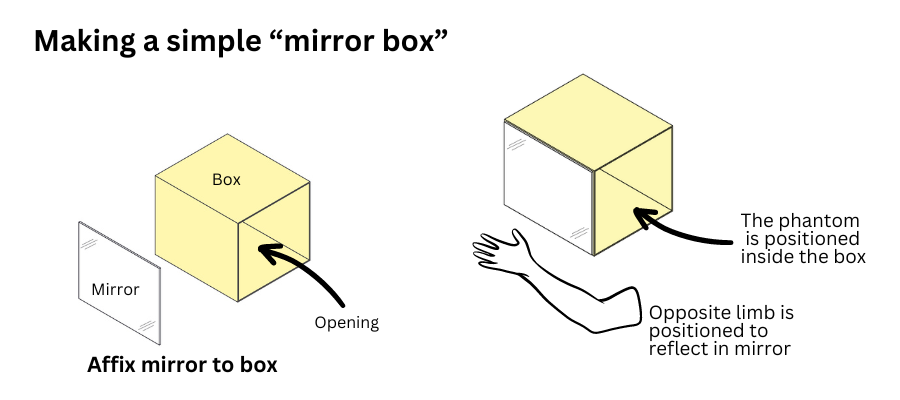 All participants will be shown the most basic and cost-effective way to create a mirror box for amputees of both upper and lower limbs.
 Part 1. Holistic Pre-Assessment of the Patient:
-
- Assessment of patient (PTSD)
- Assessment of patient (delayed organic depression)
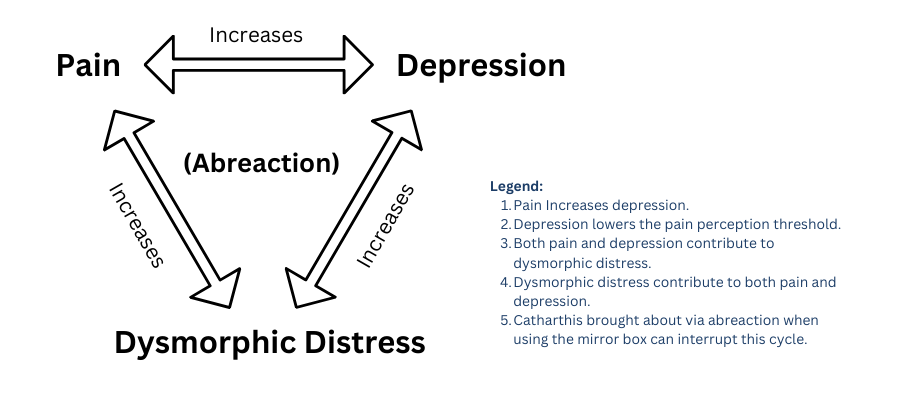
- Assessment of patient (dysmorphic distress)
- Assessment of patient (secondary depression and anxiety)
- Assessment of patient (pre-morbid conditions)
Part 2. Assessment of the Phantom
A correct assessment is essential to determine the correct treatment modality for the pain and to differentiate the pain source from:
-
- Phantom limb pain
- Neuromas
- Stump/dermal sensitivity and recovery
- Muscular spasm
- Psychogenic causes
- Combination of causes
Assessment for suitability for using Mirror Visual Feedback will involve assessing the following:
-
- The limb image
- Mobility and motility of the phantom limb image
- Sensorial remapping
Part 3. Stages of the Treatment Session
Trainees will be taught the experiential stages that patients go through when exploring the effects of the "mirror box" and will be instructed on the correct responses and behaviours when interacting with the patient to facilitate the maximal curative experience.
-
- Stage 1: Patient expectations and anticipation
- Stage 2: Focus of attention
- Stage 3: Reaction and Abreaction
- Stage 4: Emotional reunion with limb image
- Stage 5: Abreactional states
- Stage 6: Fascination and Exploration
- Stage 7: Fatigue
- Stage 8: Telescoping phenomena
Part 4. The Pain-Depression-Dysmorphic Distress Complex
Where injuries have been severe and the body image irreparably altered, additional complex issues can arise. Trainees will be informed about these commonly overlooked complexities and how some key aspects can be managed more effectively.