





Vagus Nerve Stimulation Through Breathing and Vocal Exercises
Non-invasive, zero-cost tools to raise the vagal tone, calm the nervous system, and deepen the emotional shifts created in IEMT sessions.
The vagus nerve responds instantly to the rhythm of your breath and the vibration of your voice. These simple practices (used for centuries in yoga, chanting and healing traditions) are now widely discussed within contemporary autonomic and polyvagal-informed models. When combined with IEMT’s kinaesthetic eye-movement patterns, they create a powerful dual-pathway for emotional recalibration: top-down via the eyes and bottom-up via the vagus.
Diaphragmatic “Belly” Breathing (4-7-8)
- Sit or lie comfortably, with one hand on your belly and one on your chest.
- Inhale quietly through the nose for 4 seconds—belly rises, chest still.
- Hold for 7 seconds.
- Exhale through pursed lips for 8 seconds—feel the gentle abdominal contraction.
- Repeat 4–6 cycles.
Vagal effect: Prolongs the exhale → stimulates parasympathetic “rest-and-digest” via baroreceptors and pulmonary stretch receptors.
Baroreceptors
Baroreceptors are pressure-sensitive nerve endings located mainly in the carotid sinus and aortic arch. When you slow your breathing and extend the exhalation, the fall in intrathoracic pressure increases blood return to the heart and slightly raises arterial pressure.
This gentle rise activates the baroreceptors, which then signal the brainstem (particularly the nucleus tractus solitarius) to dampen sympathetic output and enhance parasympathetic activity. The effect is a coordinated shift toward “rest-and-digest” physiology: heart rate slows, vagal tone increases, and the overall autonomic state becomes more regulated and calmer.
Baroreflex Activation Therapy
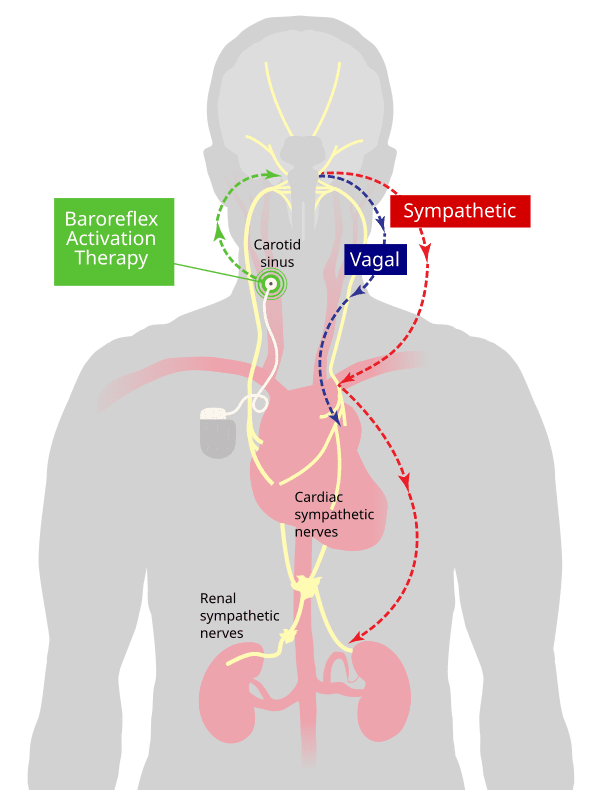
Baroreflex activation therapy stimulates the afferent limb of the baroreflex arc, leading to an increase in vagal (parasympathetic) activity and a reduction in whole-body sympathetic outflow. Clinically, baroreflex activation therapy is used in the management of resistant hypertension and selected cases of heart failure through the electrical stimulation of carotid sinus baroreceptors via an implanted device. Activation of these receptors initiates reflex pathways that suppress sympathetic drive, enhance vagal tone, and lower arterial blood pressure.
Adapted from: Francis, D. (2018, April 20). Baroreflex activation therapy stimulates an afferent limb which causes an increase in vagal activity and a decrease in whole-body sympathetic activity [Illustration]. Wikimedia Commons.

License: CC BY-SA 4.0.
Humming Bee Breath (Bhramari)
- Close ears with thumbs, fingers resting on forehead.
- Inhale deeply, then hum on the exhale (“mmm”) until breath empties.
- Feel the skull and chest vibrate.
- 6–8 rounds.
Vagal effect: Vibration stimulates vagal-related sensory afferents in the external auditory canal and laryngeal tissues, influencing brainstem autonomic circuits.
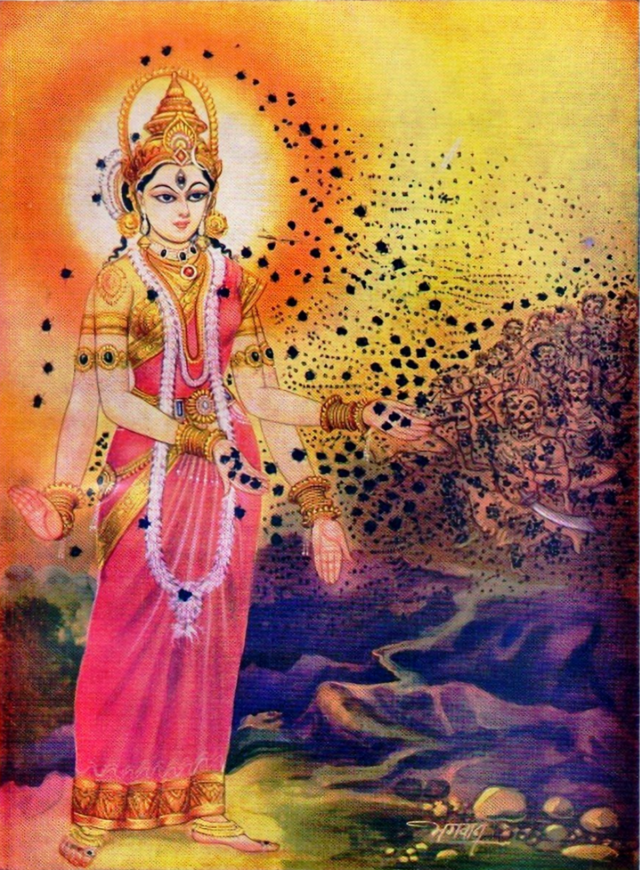
Brahmari is seen releasing her army of black bees against the army of Arunasura.
Source: Ckvicky1992. (2022). Bhramari Devi (Goddess of Black Bees) [Illustration]. Wikimedia Commons. License: CC BY-SA 4.0.

Extended Vocal Toning (“VOO”, “OM”)
- Inhale fully.
- On exhale, produce a low, resonant “VOO” (as in “moon”) or classical “OM”.
- Let the sound roll for the entire exhale.
- Rest, then repeat 5 times.
Vagal effect: Slow, prolonged vocalisation engages laryngeal and respiratory-vagal coordination and has been associated with short-term increases in heart-rate variability in experimental settings (Porges, 2018).
Cold Face/Neck Exposure
- Fill a bowl with cold water (8–12°C).
- Hold breath and immerse face for 15–30 seconds OR press a cold pack to the sides of the neck (carotid area).
- Repeat 2–3 times.
Vagal effect: Triggers the mammalian diving reflex → rapid bradycardia and vagal surge.
Why These Work: The Polyvagal Lens
- Prolonged exhale + vocal vibration → lengthens the respiratory sinus arrhythmia → higher HRV → stronger ventral vagal brake.
- Cold stimulation → activates the vagal “dive” circuit, shifting from fight-flight to social-engagement circuitry in under a minute.
- Eye movements + vagal tone = dual recalibration: cortical (visual-kinesthetic) + subcortical (autonomic).
Research Snapshot
A growing body of research indicates that slow-paced breathing and prolonged exhalation are associated with significant increases in vagally mediated heart-rate variability (HRV) and improvements in autonomic balance. A large systematic review and meta-analysis by Laborde et al. (2022) demonstrated that voluntary slow breathing reliably enhances cardiac vagal activity across a wide range of experimental and training contexts. Mechanistically, this effect is explained by the respiratory vagal stimulation model proposed by Gerritsen and Band (2018), which describes how slow breathing rhythms amplify vagal afferent signalling via the nucleus tractus solitarius and baroreflex pathways.
Emerging pilot research also suggests that humming-based breathing practices (such as Bhramari-style vocalisation) may produce comparable short-term autonomic effects. A recent pilot investigation by Woo and Kim (2025) reported that both slow-paced breathing and humming significantly increased HRV and improved affective state in healthy adults. While these findings support the role of breath and vocalisation in parasympathetic regulation and stress reduction, current evidence remains preliminary, particularly for clinical populations.
Importantly, although breath-based and vocal practices may support emotional regulation and autonomic stability, direct equivalence with transcutaneous or implanted vagus nerve stimulation devices has not been established. These practices should therefore be understood as low-risk, adjunctive self-regulation strategies rather than medical neuromodulation treatments.
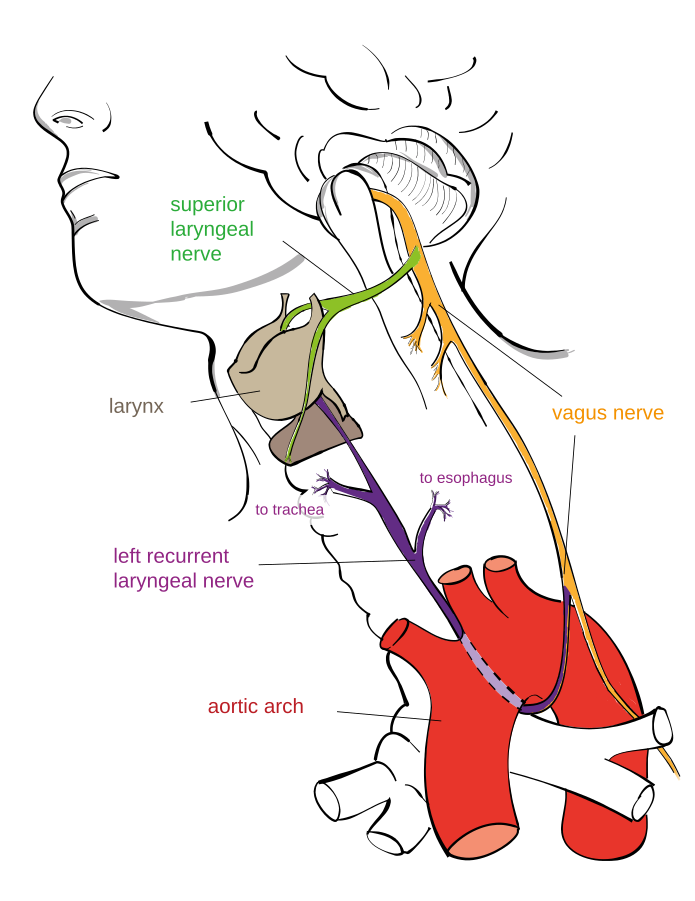
Adapted from: Jkwchui (2014), Recurrent laryngeal nerve [Vector illustration], based on an original drawing by Truth-seeker2004. Wikimedia Commons.

License: Creative Commons Attribution–ShareAlike 3.0 (CC BY-SA 3.0).
Ready-to-Use 3-Minute IEMT + Vagus Experimental Protocol
- 30 sec diaphragmatic 4-7-8 breath
- Run one IEMT eye-movement set on the problematic feeling
- 15 sec “VOO” tone (or honey bee breath)
- Repeat 3–4 cycles
- Finish with 20 20-second cold face splashes
Please report findings in the comments section below.
Safety Note
Breath retention, cold exposure, and prolonged vocalisation may not be appropriate for individuals with cardiovascular disease, asthma, panic disorder, or syncope history. These exercises should be performed gently and discontinued if dizziness, palpitations, or discomfort occur.