







The Human Biome · Article 10 of 26
Panchagavya: History, Composition, Uses, Evidence, and Safety
Educational and scope notice
This material is for education only and does not provide medical diagnosis or treatment advice. IEMT practitioners should remain within their professional scope and refer clients to an appropriately qualified healthcare professional where medical assessment, treatment, prescribed medication, supplements or restrictive diets are involved.
Panchagavya (Sanskrit: पञ्चगव्य) literally means “five (pañca) products of the cow (gavya).” In traditional Indian practice, it refers to a blend of milk, curd (yoghurt), ghee, urine, and dung used in ritual purification, agriculture, and Ayurveda. In contemporary discussion, it sits at the intersection of culture, ecology, and health claims, warranting a careful, evidence-based presentation for practitioners.
This section presents Panchagavya primarily as a cultural and ecological case study. Descriptions of medicinal or psychiatric research are included for contextual completeness and critical appraisal, not as endorsement or guidance for clinical or therapeutic practice.
Etymology and Core Definition
Pañca means 'five'; Gavya means 'derived from the cow'. Panchagavya denotes the combination of five cow-origin products: milk, curd, ghee, urine, and dung. While this “core five” formulation is classical, modern agricultural variants often include adjuncts (e.g., jaggery, banana, tender coconut water) to modulate fermentation and nutrient availability.
Historical and Cultural Context
References to panchagavya appear across classical Indian sources (Hindu ritual texts, Ayurvedic compendia, and pre-modern agricultural manuals). The cow holds an auspicious status in many Indian traditions, and cow-derived substances are used symbolically for purification and practically for farming inputs. Historically, the same material could thus serve ritual, medicinal, and agronomic roles.
“He who has committed a sin, or who has come into contact with what is impure, should purify himself by the use of the five products of the cow (*Pañcagavya*). The five products are milk, curd, ghee, urine, and dung; these, properly mixed, purify like fire and water.”
- Manusmṛti 5.105–106, translated by G. Bühler (Sacred Books of the East, Vol. 25)
Context Note
For practitioner education, it is useful to distinguish symbolic/ritual uses (purification) from functional uses (farming inputs, proposed medicinal effects). Both are culturally meaningful, but they carry different evidentiary and safety considerations.
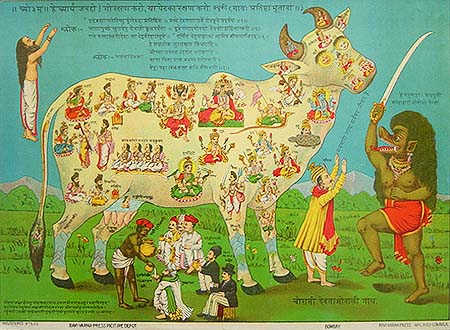
The cow is considered very sacred in Hindu mythology. Inside the cow are drawn images of the major Hindu gods and goddesses.
Source: Lithographic transfer by Fritz Schleicher after an original work by Raja Ravi Varma (1987). Wikimedia Commons.
Composition and Preparation
Core ingredients: unpasteurised cow’s milk, curd, ghee, fresh urine, and fresh dung. (Traditional ratios, which vary, often approximate 1 part urine, 1 part dung, 3 parts milk, 2 parts curd, and 1 part ghee by mass or volume in some medicinal preparations, diluted with water.)
Extended agricultural formulations (illustrative): The mixture may be matured over several weeks with twice-daily stirring to ensure oxygenation and to stop the mixture from stagnating. The mixture is kept covered with a cloth to prevent insect colonisation. Some agronomic recipes add jaggery, banana, tender coconut water, and water to promote fermentation. The matured liquid is then diluted and applied as a foliar spray or soil drench.
Laboratory characterisation (agricultural variants): Studies report acidic to mildly acidic pH (≈5–6), measurable microbial loads (including lactobacilli), variable macro/micronutrients, and organic acids. Exact composition depends on source materials, hygiene, temperature, and maturation time.
Traditional and Claimed Uses
Ayurvedic claims: Immunomodulatory, antioxidant, hepatoprotective, wound-healing, anxiolytic, and general tonic effects have been described in traditional and integrative reviews. Evidence ranges from classical textual authority and preclinical work to small case series; somewhat unsurprisingly, robust human trials remain limited.
Agricultural uses: Widely used in organic farming as a plant growth promoter, soil conditioner, nutrient input, and biostimulant (with anecdotal reports of improved yield and plant vigour). Field protocols vary by crop and region.
Ritual uses: Purification rites, ablutions (abhisheka), and domestic ceremonies in which panchagavya is used symbolically for renewal, cleansing, or consecration.
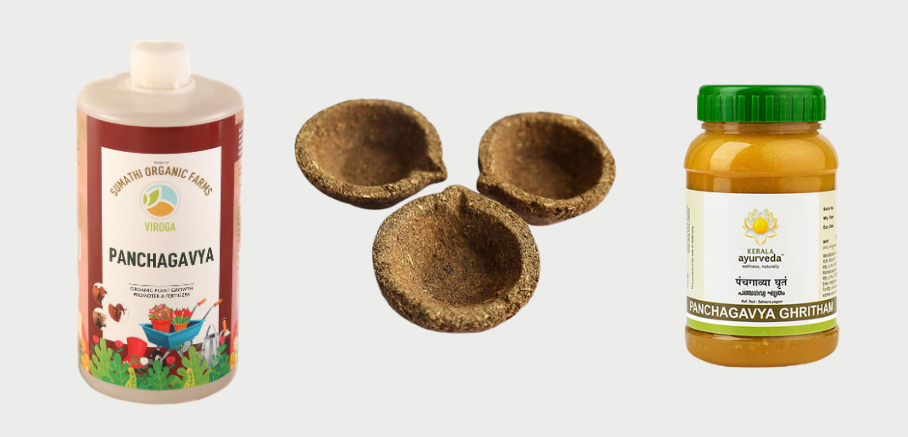
Agricultural Use and Effects of Panchagavya
Panchagavya has been used in traditional Indian agriculture for centuries as a biofertiliser, plant growth stimulant, and natural pesticide. In this context, it functions as a living microbial inoculant: enhancing soil fertility, nutrient cycling, and plant immunity. The practice aligns with the ecological philosophy that healthy soil, like a healthy gut, depends on balanced microbial activity.
Composition and Fermentation:
The preparation combines cow dung, cow urine, milk, curd, and ghee, often enriched with natural fermentable additives such as jaggery, banana, and tender coconut water. During fermentation (typically 15–30 days), the mixture develops a rich microbial ecosystem dominated by beneficial species of Lactobacillus, Saccharomyces, Actinomycetes, and nitrogen-fixing bacteria such as Azotobacter and Rhizobium, though composition varies widely and is not standardised.
Soil and Plant Effects:
Experimental field trials and agricultural university reports (e.g., Tamil Nadu Agricultural University; Kerala Agricultural University) have documented the following benefits when Panchagavya is applied as a foliar spray or soil drench:
- Enhanced soil microbial biomass: increases the population of beneficial microorganisms that improve nitrogen fixation and phosphate solubilisation.
- Improved nutrient uptake: the organic acids and enzymes in fermented Panchagavya chelate micronutrients, making them more available to plants.
- Stimulated plant growth: elevated auxin- and cytokinin-like activity encourages root and shoot elongation, flowering, and fruit set.
- Improved resistance to pests and diseases: certain metabolites in the preparation (such as phenolics and volatile fatty acids) inhibit pathogenic fungi and nematodes.
- Enhanced yield and quality: studies on crops including rice, tomato, okra, chilli, groundnut, and banana report yield increases of 10–30% compared to conventional controls, along with improved shelf life and flavour of produce.
Mode of Application:
For field use, a 3–5% Panchagavya solution is typically sprayed on crops every 10–15 days during the growth period. In seed treatment, soaking in diluted Panchagavya improves germination rates and early vigour. It is also incorporated into composting and integrated organic nutrient management systems alongside other inputs such as neem extract and vermicompost.
Mechanism of Action:
The efficacy of Panchagavya arises from its complex synergy of microbial and biochemical interactions. Beneficial microbes accelerate decomposition and nutrient mineralisation, while plant growth regulators (IAA, GA, and cytokinins) promote vegetative and reproductive growth. The preparation also enhances soil organic carbon and water-holding capacity, restoring degraded soils in a sustainable manner.
Modern Relevance:
In the era of sustainable and regenerative farming, Panchagavya exemplifies a microbiome-based approach to agriculture, harnessing naturally fermented microbial communities to support soil health rather than relying on chemical fertilisers. This mirrors the human gut–biome relationship, where diversity and symbiosis sustain systemic health.
References:
Natarajan, K. (2002). Panchagavya – An Organic Formulation for Sustainable Agriculture. Tamil Nadu Agricultural University.
Choudhary, D. K. et al. (2019). Microbial and biochemical characterisation of Panchagavya and its effect on soil fertility. Journal of Organic Agriculture and Environment, 7(2), 45–54.
Department of Agriculture, Government of India (2020). National Project on Organic Farming – Bio-inputs Manual.
Venkatesan, S., & Natarajan, K. (2016). Influence of Panchagavya on growth and yield of crops. Agricultural Reviews, 37(3), 197–203.
Practitioner Caution
Traditional claims should be described accurately but not presented as established clinical fact. Where clients express interest, remain educational and within scope: provide context and encourage consultation with qualified medical or nutritional professionals.
Proposed Mechanisms and Modern Evidence
Biochemical rationale: Individual components contain fats (incl. short- and medium-chain), proteins/peptides, lactose-derived substrates, minerals, fat-soluble vitamins (A, D, E, K) and water-soluble vitamins (B-complex, C), plus organic acids and phenolics. Fermented variants (due to curd and added substrates) may yield lactic-acid–producing bacteria and bioactive metabolites.
Evidence snapshot: Peer-reviewed reviews highlight potential immunomodulatory and antioxidant effects in preclinical models; however, well-controlled, adequately powered human clinical trials are sparse. For agriculture, operational data and small studies report benefits to plant growth and soil microbiota, though standardisation and replication remain challenges.
Critical appraisal: Heterogeneity of recipes, variable hygiene, and lack of GMP-grade standardisation limit generalisability. Contemporary biomedical standards call for rigorous quality control, contaminant screening, and controlled trials before therapeutic claims can be endorsed.

Panchagavya for Epilepsy and Bipolar Disorder — What Does the Evidence Say?
Claim (Epilepsy): In Ayurveda, Panchagavya Ghrita (a ghee-based formulation containing cow milk, curd, ghee, urine, and dung) is traditionally cited for Apasmara (epilepsy).
What the research shows:
Animal models: Multiple preclinical studies report anticonvulsant and antioxidant effects. In PTZ-induced seizure models in rats, Panchagavya Ghrita increased seizure latency, reduced tonic–clonic episodes, and improved cognitive performance. Effects scaled with dose (500–4,000 mg/kg) and correlated with reduced oxidative stress markers (Joshi et al., Indian Journal of Experimental Biology, 2015).
Adjunct with standard AEDs (rats): In maximal electroshock models, Panchagavya Ghrita potentiated phenytoin and carbamazepine’s antiseizure effects without altering serum drug levels, indicating a pharmacodynamic add-on rather than a pharmacokinetic interaction (Joshi et al., AYU, 2015).
Small clinical studies: An open, randomised parallel trial in 60 children with idiopathic epilepsy compared Panchagavya Ghrita with carbamazepine for 12 months. Both groups improved in seizure frequency and duration; the Panchagavya group also showed better memory scores. However, the trial was open-label with a modest sample size and lacked blinding, so findings are exploratory (Jagtap & Dandekar, Ayushdhara, 2015).
Reviews and overviews: Contemporary reviews acknowledge Panchagavya’s traditional use in epilepsy and note supportive preclinical data but emphasise the absence of rigorous blinded randomised trials (Adiga et al., Epilepsy & Behaviour, 2024).
Claim (Bipolar disorder): References to Panchagavya or related ghritas occur in Ayurvedic protocols for mood disorders, yet there are no controlled human trials demonstrating efficacy in bipolar disorder. Evidence consists only of single-case narratives and conceptual descriptions
There is currently no empirical basis for recommending Panchagavya in mood disorders.
Safety and scope notes:
Preparation quality: Panchagavya includes cow urine and dung derivatives. Without Good Manufacturing Practice (GMP)-grade sourcing and sterilisation, there is a risk of contamination or infection. Only laboratory-prepared clinical-grade formulations should be considered for research use.
Drug interactions: Animal data suggest Panchagavya Ghrita does not significantly alter phenytoin or carbamazepine serum levels while enhancing antiseizure protection. Human pharmacokinetic data with modern antiepileptics (e.g., levetiracetam, lamotrigine) remain unknown; caution is warranted.
Bottom line for practice: For epilepsy, evidence remains preclinical plus small, low-rigour clinical trials. For bipolar disorder, evidence is anecdotal and unsubstantiated. These findings do not justify clinical use outside formal research. Clients should avoid self-medication and continue prescribed medical treatment.
Selected References
Joshi, R., Rege, N. N., & Thatte, U. M. (2015). Anticonvulsant and antioxidant effects of Panchagavya Ghrita in experimental models of epilepsy. Indian Journal of Experimental Biology, 53(11), 720–725.
Joshi, R., Rege, N. N., & Thatte, U. M. (2015). Panchagavya Ghrita as an adjuvant to phenytoin and carbamazepine in experimental epilepsy. AYU (An International Quarterly Journal of Research in Ayurveda), 36(4), 438–444.
Jagtap, A. R., & Dandekar, A. S. (2015). A clinical evaluation of Panchagavya Ghrita in Bal Apasmara (epilepsy in paediatric age group). Ayushdhara, 2(4).
Adiga, S. H., Bhat, S., & Holla, R. (2024). Ayurvedic approaches to epilepsy: Current evidence and future directions. Epilepsy & Behavior, 150, 109594.
Bajaj, K. K., Tandon, N., & Patwardhan, B. (2022). Panchagavya formulations: Traditional rationale, experimental evidence, and research gaps. Journal of Ayurveda and Integrative Medicine, 13(4), 100540.
Safety, Risks, and Ethics
Human ingestion risk: Without strict sourcing and processing controls, dung and urine components can carry pathogens (bacteria, parasites, viruses) and contaminants (e.g., heavy metals, agrochemical residues). Ingestion of unprocessed material is inadvisable in conventional medical frameworks.
Ingestion outside controlled, regulated research settings is not advised and may pose significant health risks.
Agricultural safety: When used as a farm input, attention to dilution, application timing, runoff control, and operator hygiene is essential.
Ethical considerations: Avoid overstating benefits; be sensitive to the cultural significance of the cow; protect vulnerable individuals from unsupported “miracle cure” claims; recommend evidence-based care pathways.
Scope of Practice Reminder
For IEMT practitioners, Panchagavya is best presented as a cultural/ecological case study and a metaphor for “inner ecology”. Do not recommend ingestion or preparation. If clients enquire, provide balanced information and signpost to medical professionals.
Relevance to Gut–Brain Discourse
Panchagavya illustrates how traditional systems conceptualise health as an ecological balance spanning bodies, animals, soils, and seasons. As a teaching device within this course, it supports discussion of (a) embodied metaphors of purity/contamination, (b) microbial fermentation and bioactive products, and (c) the importance of standardisation and safety when translating traditional formulations into modern contexts.
Soil Microbiome Health and the Human Gut Microbiome — A Shared Ecology
Just as fertile soil sustains plant vitality through a balanced network of microorganisms, the human gut maintains physical and emotional health through its own living ecosystem of microbes. Both systems depend on diversity, stability, and continuous nutrient exchange between host and microbial inhabitants.
Soil Microbiome: Healthy soil contains billions of bacteria, fungi, actinomycetes, and archaea that decompose organic matter, fix nitrogen, and recycle minerals. This complex web of life forms the foundation of agricultural productivity and ecological resilience. Disturbance, through chemical fertilisers, pesticides, or erosion, reduces biodiversity and impairs the soil’s capacity to nourish plants.
Human Gut Microbiome: Similarly, the intestinal tract hosts trillions of microorganisms that ferment dietary fibre, synthesise vitamins, regulate immunity, and communicate with the nervous system. Antibiotic overuse, poor diet, and chronic stress parallel soil degradation, disrupting microbial equilibrium and leading to inflammation, mood imbalance, and metabolic disorders.
Common Principles:
• Diversity ensures resilience against pathogens or environmental change.
• Organic matter (fibre in the gut, compost in the soil) fuels microbial metabolism.
• Symbiosis, not sterility, sustains health.
• Restoration requires re-seeding beneficial species: through compost, probiotics, or fermented foods.
• Excessive chemical or pharmaceutical input can sterilise or distort the living system.
Both the soil and the gut are biological "commons", shared environments that integrate chemistry, biology, and behaviour. In agriculture, microbial renewal through composting or formulations such as Panchagavya restores soil fertility. In human health, dietary fibres, fermented foods, and probiotics restore gut balance. In both cases, vitality emerges from the symbiosis between host and microbe, not from isolated chemical control.
The analogy between soil and gut underscores a key therapeutic insight: the health of the individual and the health of the ecosystem mirror one another. Understanding one illuminates the other.
Summary
- Panchagavya combines five cow-derived products; uses span ritual, agriculture, and traditional medicine.
- Claims of benefit are culturally longstanding; modern human clinical evidence is limited and heterogeneous.
- Safety concerns arise from variable hygiene and the inclusion of dung/urine; ingestion outside controlled research is not advised.
- As a teaching topic, it bridges symbolism and ecology, enriching practitioner understanding of “microbiomes” across contexts.
Selected References (for further reading)
- Bajaj, K. K., Chavhan, V., Raut, N. A., & Gurav, S. (2022). Panchagavya: A precious gift to humankind. Journal of Ayurveda and Integrative Medicine, 13(2), 100525.
Open-access review with cultural and scientific overview. - Patil, S. (2023). Therapeutic potential of Panchagavya: A review. Journal of Ayurveda and Herbal Medicine.
Narrative review; notes lack of rigorous clinical trials. - Totawar, T. (2023). Critical review of utilisation of Panchagavya. Journal of Ayurveda and Integrated Medical Sciences (JAIMS).
Methodological and safety considerations. - Tamil Nadu Agricultural University. (n.d.). Organic farming: Panchagavya. TNAU Agritech Portal.
Preparation and agronomic application protocols.
Several cited studies originate from regional or traditional medicine journals and should be interpreted as preliminary or exploratory rather than definitive.