



The Human Biome · Article 9 of 26
Faecal Microbiota Transplantation (FMT): History, Development, and Clinical Applications
Educational and scope notice
This material is for education only and does not provide medical diagnosis or treatment advice. IEMT practitioners should remain within their professional scope and refer clients to an appropriately qualified healthcare professional where medical assessment, treatment, prescribed medication, supplements or restrictive diets are involved.
This section is provided for educational context only. Faecal microbiota transplantation is a medical procedure and does not fall within the scope of IEMT practice.
Faecal Microbiota Transplantation (FMT) refers to the therapeutic transfer of intestinal microorganisms from a healthy donor into the gastrointestinal tract of a recipient. The procedure aims to restore a balanced microbial ecosystem following dysbiosis, most notably in cases of recurrent Clostridium difficile infection (CDI). More recently, it has been explored for a range of metabolic, inflammatory, and neuropsychiatric conditions, including autism spectrum disorder (ASD).
Historical Background
The therapeutic use of faecal material has deep historical roots. The earliest known reference appears in 4th-century China, where the physician Ge Hong described using a delightful preparation known as "yellow soup" (a suspension of faeces administered orally) to treat severe diarrhoea and food poisoning. Similar practices were documented in traditional veterinary medicine, particularly equine care, where healthy animal faeces were used to treat colic and gastrointestinal infections.
Emergency Prescriptions Kept up One’s Sleeves
Historical records from traditional Chinese medicine describe the oral administration of human faecal suspensions for the treatment of severe diarrhoea and food poisoning. During the Eastern Jin Dynasty (4th century CE), the physician Ge Hong documented the use of a preparation made from the stool of a healthy individual mixed with water (commonly referred to as “yellow soup”) to restore intestinal balance and vitality in critically ill patients.
“When a person suffers sudden and severe diarrhoea with a loss of fluids and faintness, take the stool of a healthy man or woman, mix it with water to form a yellow broth, and give it to drink. Though unclean, the broth restores balance within the intestines and brings back life.”
These descriptions appear in Ge Hong’s medical text Zhou Hou Bei Ji Fang (Handbook of Prescriptions for Emergencies) and represent some of the earliest recorded accounts of microbiota-based therapy.
In the modern era, FMT first appeared in Western medical literature in 1958, when Ben Eiseman and colleagues at the University of Colorado reported using faecal enemas to successfully treat four patients suffering from pseudomembranous colitis following antibiotic therapy (Eiseman et al., Surgery, 1958). These cases marked the first clinical evidence that reintroducing normal gut flora could reverse life-threatening dysbiosis.
Constituents and mechanisms of microbiome-based interventions
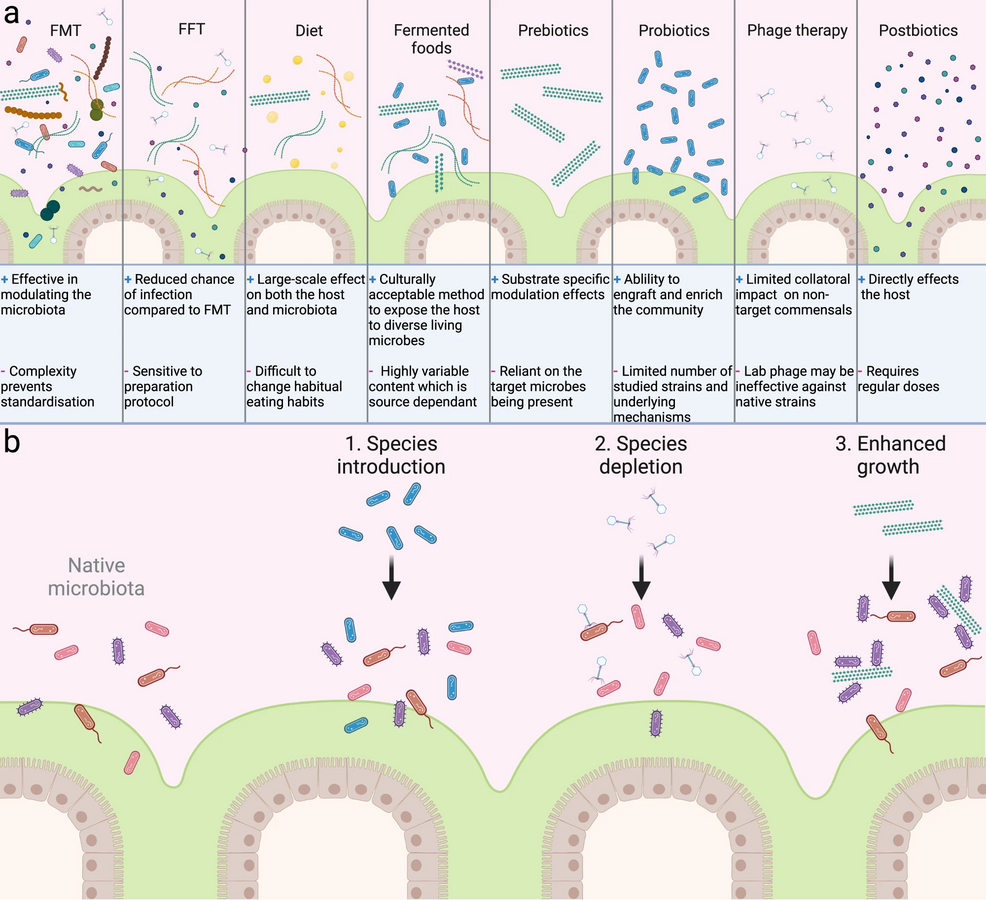
a. Common constituents of microbiome-based intervention methods are broadly illustrated.
b. Schematic of the three major categories by which interventions influence the gut microbiome.
The simplified native microbiome members are coloured shades of red to purple, while introduced species are shades of blue and prebiotic fibres are green.
FMT faecal microbiota transplant, FFT faecal filtrate transplant.
Source: Hitch, T. C. A., Hall, L. J., et al. (2022). Microbiome-based interventions to modulate gut ecology and the immune system. Nature Reviews Gastroenterology & Hepatology.
License: CC BY 4.0.
Development of Modern Techniques
Over the past several decades, the procedure has evolved from crude faecal suspensions to highly controlled, standardised microbial preparations. The basic principle remains the same, to transfer a diverse community of healthy microorganisms, but the methods and delivery routes have expanded considerably.
Common Methods of Administration
- Colonoscopy: The most common method, allowing direct infusion of processed donor stool into the colon. It ensures maximal contact with the large intestinal mucosa and high microbial engraftment rates.
- Nasogastric or nasojejunal tube: Delivers the suspension through the upper gastrointestinal tract. Although less invasive, it carries a small risk of aspiration and is now less preferred.
- Enema or rectal catheter: Simpler and less costly, but typically requires multiple treatments for sustained benefit.
- Capsule (oral encapsulated FMT): Developed in the 2010s, encapsulated frozen stool preparations offer a non-invasive alternative with similar efficacy for CDI, increasing patient acceptability (Youngster et al., 2014).
Donor screening has become a critical component of modern FMT practice. Donors undergo rigorous testing for infectious agents (HIV, hepatitis, syphilis, enteric pathogens) and metabolic disorders to prevent iatrogenic complications. Faecal samples are processed in sterile conditions, homogenised with saline or glycerol, filtered, and stored at –80°C until use. In many clinical settings, material is sourced from regulated stool banks such as OpenBiome (Boston, USA) or the UK’s Microbiome Restoration Centre.
“Super Donors” and the Ideal Donor Profile in Faecal Microbiota Transplantation
In clinical Faecal Microbiota Transplantation (FMT), not all donors achieve the same therapeutic outcomes. A small subset of individuals (often referred to in the literature as ‘high-response’ or ‘super donors’) consistently provide microbial material that results in superior clinical success across multiple recipients. In large-scale FMT programmes and stool banks, approximately ten highly effective donors have produced the majority of successful treatments, leading to the informal term "Super 10".
Super donors are characterised by exceptional microbial diversity, metabolic resilience, and immune-modulatory balance. Their gut ecosystems demonstrate a high abundance of beneficial taxa such as Faecalibacterium prausnitzii, Bacteroides uniformis, Akkermansia muciniphila, and Eubacterium hallii, species linked to anti-inflammatory effects, intestinal barrier stability, and short-chain fatty acid (SCFA) production.
Research indicates that FMT outcomes depend not only on the recipient’s health but also on the composition and functionality of the donor microbiota. In one pivotal study (Wilson et al., Cell Host & Microbe, 2019), remission rates for ulcerative colitis were dramatically higher when stool from a single "super donor" was used compared with material from multiple average donors. These findings suggest that donor-specific microbial ecology plays a decisive role in engraftment success and therapeutic durability.
The Ideal Donor Profile
Modern stool banks such as OpenBiome (USA) and the Microbiome Restoration Centre (UK) employ stringent selection criteria to identify and maintain high-quality donors. The goal is to ensure microbial stability, safety, and therapeutic potency while excluding transmissible pathogens or metabolic risks.
The ideal FMT donor typically meets the following criteria:
• Excellent general health: No chronic gastrointestinal, metabolic, autoimmune, or psychiatric conditions.
• No recent antibiotic exposure: At least six months since any antibiotic, antifungal, or antiparasitic medication.
• Healthy body weight: A body mass index (BMI) between 18.5 and 25 to minimise metabolic dysbiosis risk.
• Balanced lifestyle: Regular sleep–wake rhythm, moderate exercise, and a diverse, plant-rich diet that promotes microbial diversity.
• Low systemic inflammation: Normal C-reactive protein (CRP) and cytokine profiles, with no evidence of immune dysregulation.
• Negative infectious disease screening: Comprehensive serology for HIV, hepatitis A/B/C, syphilis, Epstein–Barr virus, cytomegalovirus, and SARS-CoV-2.
• Clear stool pathogen testing: Negative for Clostridium difficile, Salmonella, Campylobacter, Giardia, Helicobacter pylori, and intestinal parasites.
• Stable gut microbiome: Demonstrated microbial richness with high Firmicutes-to-Bacteroidetes balance, assessed by metagenomic sequencing.
• Psychological stability: No history of psychiatric illness or substance misuse, as stress and cortisol dysregulation influence microbial composition.
Emerging research aims to identify the signature bacterial consortia that define super donor status, potentially allowing laboratory synthesis of these ecosystems without relying on human donors. Such “next-generation microbiota therapies” could provide the precision and reproducibility of pharmaceuticals while preserving the biological efficacy of natural microbiota transfer.
Mechanisms of Action
The therapeutic rationale for FMT lies in restoring microbial diversity and ecological stability following dysbiosis. Antibiotics, infections, or chronic inflammation can drastically reduce microbial diversity, allowing pathogenic species to dominate. FMT reintroduces a healthy microbial community capable of:
- Competing with pathogenic bacteria (e.g., C. difficile) for nutrients and attachment sites.
- Producing antimicrobial compounds and short-chain fatty acids that inhibit pathogens.
- Restoring immune tolerance through modulation of cytokine production (reducing IL-6, TNF-α) and increasing regulatory T-cell activity.
- Influencing neurochemical signalling by re-establishing the gut–brain axis balance via metabolites, vagal activity, and neurotransmitter precursors.
What Is Actually Transplanted in Faecal Microbiota Transplantation (FMT)?
Faecal Microbiota Transplantation (FMT) involves transferring microbial communities from the stool of a healthy donor into the gastrointestinal tract of a recipient. The purpose is to reintroduce a balanced ecosystem of microorganisms that can restore intestinal function following dysbiosis.
Importantly, modern FMT does not use raw faecal matter directly. Donor stool is carefully processed in controlled laboratory conditions to isolate and preserve its microbial content while removing solids, undigested material, and potential pathogens.
The resulting preparation typically contains:
• Viable bacteria: including commensal species such as Bacteroides, Firmicutes, Lactobacillus, and Bifidobacterium, which support digestion and immune regulation.
• Archaea, fungi, and viruses: smaller but important members of the gut microbiome that contribute to metabolic balance and ecological stability.
• Metabolites and signalling molecules: such as short-chain fatty acids (SCFAs), bile acids, and microbial peptides that modulate gut–brain and immune communication.
Two main approaches are currently used:
1. Traditional whole-stool FMT: Processed donor stool is homogenised, filtered, and diluted with saline or glycerol before infusion via colonoscopy, enema, or oral capsule.
2. Defined microbial consortia (“next-generation FMT”): Laboratory-cultured combinations of specific bacterial strains designed to reproduce the ecological and therapeutic effects of whole FMT without using faecal material directly. Examples include experimental formulations such as RBX2660 and SER-109, now undergoing clinical trials.
In essence, what is transplanted is not waste material but a living, complex microbial ecosystem, a biological community capable of restoring intestinal homeostasis, regulating immune responses, and influencing systemic health through the microbiota–gut–brain axis.
Video Playlist - Andrew T. Austin's FMT experience.
Link to webpage with clinic details, etc.: https://23nlpeople.com/faecal-microbiota-transplant-poop-transplant-stool-transplant-my-experience-with-other-peoples-poop/
Full playlist for my FMT Experience: https://www.youtube.com/playlist?list=PLYt4GdlVVi_EA41QNglv5Hh-piVnaxSMs
Clinical Applications and Research Evidence
1. Clostridium difficile Infection (CDI)
FMT is now recognised as a first- or second-line therapy for recurrent C. difficile infections, particularly after antibiotic failure. Clinical trials demonstrate success rates exceeding 85–90%, far surpassing conventional antibiotic therapy. A landmark randomised controlled trial by van Nood et al. (2013), published in the New England Journal of Medicine, found that 81% of patients treated with FMT via nasoduodenal infusion achieved resolution after a single treatment, compared with only 31% in the vancomycin group.
Further meta-analyses confirm FMT’s superiority for recurrent CDI, leading to its inclusion in major clinical guidelines (e.g., NICE 2021, American Gastroenterological Association 2020). The therapy is now approved in the UK under a "specials" regulatory status and is widely available in tertiary centres.
2. Inflammatory and Metabolic Disorders
Beyond infection, FMT has been investigated for ulcerative colitis, Crohn’s disease, irritable bowel syndrome (IBS), and metabolic syndrome. Trials in ulcerative colitis show modest efficacy, with remission rates around 25–30% after multiple infusions (Paramsothy et al., JAMA, 2017). Mechanistic data suggest that FMT may downregulate pro-inflammatory cytokines and increase microbial diversity, but outcomes remain variable and donor-dependent.
In metabolic disorders, small studies indicate that FMT from lean donors can temporarily improve insulin sensitivity and lipid metabolism (Vrieze et al., 2012). However, effects often wane over time, suggesting a need for sustained microbial and lifestyle support.
3. Autism Spectrum Disorder (ASD) and Neurodevelopmental Research
Interest in FMT for neurodevelopmental conditions stems from growing evidence of gut dysbiosis and gastrointestinal symptoms among individuals with autism. A pivotal open-label study by Kang et al. (2017, Microbiome) enrolled 18 children with ASD and treated them with FMT after a 2-week antibiotic course and bowel cleansing. Results showed an 80% reduction in gastrointestinal symptoms and significant improvements in behavioural assessments, including the Childhood Autism Rating Scale (CARS). Remarkably, follow-up at two years (Kang et al., 2019) demonstrated the persistence of both microbial diversity gains and behavioural improvements.
Despite these promising findings, the study lacked a placebo control and involved a small cohort. In the USA and China, bigger double-blind trials are now in progress. Early data suggest that microbial modulation may improve social functioning and sensory processing, possibly via serotonin and GABA pathways.
It remains essential to note that FMT for autism is still considered experimental and should only be conducted under approved research protocols. The potential for long-term physiological and psychological consequences necessitates stringent ethical oversight.
Safety, Risks, and Regulatory Considerations
While generally safe under clinical supervision, FMT is not without risks. Reported adverse effects include transient abdominal discomfort, flatulence, and mild fever. Rare but serious complications, such as infection transmission or immune reactions, have occurred when donor screening was inadequate. In 2019, the US FDA reported two cases of Escherichia coli bacteraemia following unscreened FMT, one of which was fatal.
Current regulations in the UK classify FMT as a "biological medicinal product", requiring standardised donor screening, traceability, and informed consent. The National Institute for Health and Care Excellence (NICE) supports its use for recurrent C. difficile infection under controlled conditions but limits broader application to research settings.
DIY FMT — A Warning Against Unsupervised Gut Transplants
While FMT is increasingly used under clinical supervision for specific indications, at-home or “do-it-yourself” versions of the procedure carry significant and under-recognised risks.
Don't risk it, no matter what idiots on Reddit tell you.
Among documented harms:
In 2019, the Food and Drug Administration (FDA) issued a safety alert after recipients of stool transplants developed severe bacterial infections (including Shiga‐toxin-producing Escherichia coli (STEC) and extended-spectrum-beta-lactamase (ESBL)-producing E. coli) due to inadequately screened donor material.
In a published account, a patient described performing a DIY transplant at home following multiple antibiotic‐resistant Clostridioides difficile (C. difficile) infections, blending donor stool with saline and administering it herself. Although her C. difficile resolved, the procedure was unsupervised and profoundly risky.
Recent media reporting describes a case in which a woman with severe Irritable Bowel Syndrome (IBS) performed self-administered stool transplants using her brother’s and boyfriend’s stool. Some gut symptoms improved, but she later developed new health issues, including acne (mirroring her brother) and depression (mirroring her boyfriend) - potentially reflecting the transfer of undesired microbial or metabolic traits. https://www.businessinsider.com/woman-diy-poop-transplants-got-brother-acne-fecal-microbiota-transplant-2024-5
Key risks of DIY FMT include:
- Introduction of undetected pathogens or multidrug-resistant organisms due to a lack of clinical screening.
- Improper preparation or delivery (e.g., home blending, unsupervised enemas) leading to infection, perforation, or systemic spread.
Unintended metabolic, immunologic, or neuropsychiatric consequences: the case of acne, mood changes, and donor-trait "transfer" illustrates how complex and unpredictable microbiota interactions can be.
- Lack of long-term data regarding safety, engraftment stability and off-target effects when performed outside regulated settings.
DIY FMT may seem appealing, but it is not a safe “home remedy,”, no matter what they say on Reddit and elsewhere. Without rigorous donor screening, standardised processing, appropriate clinical indications, and follow-up, it can cause serious harm. Practitioners and clients should view FMT strictly within regulated medical contexts and discourage unsupervised experimentation.
Ethical and Future Considerations
As scientific interest in microbiota therapies expands, ethical issues around consent, donor privacy, and long-term monitoring are becoming increasingly important. FMT challenges traditional medical boundaries by introducing living biological systems as therapy, raising questions of identity, symbiosis, and risk communication.
Emerging frontiers include the development of defined microbial consortia (laboratory-cultured combinations of beneficial bacteria) which aim to replicate the effects of FMT with greater safety and precision. Advances in synthetic biology may eventually allow the creation of “next-generation probiotics” designed to modulate specific neurotransmitters or immune pathways.
Summary
- FMT has ancient origins but has become an evidence-based therapy for recurrent Clostridium difficile infection.
- Modern techniques include colonoscopic infusion, enema, and encapsulated delivery, with rigorous donor screening protocols.
- Emerging evidence supports potential benefits in inflammatory bowel disease, metabolic disorders, and autism spectrum disorder, though many applications remain experimental.
- Safety depends on clinical oversight, proper screening, and adherence to ethical and regulatory standards.
- Future directions include defined microbial therapies and precision microbiome engineering.
Selected References
- Eiseman, B., Silen, W., Bascom, G. S., & Kauvar, A. J. (1958). Fecal enema as an adjunct in the treatment of pseudomembranous enterocolitis. Surgery, 44(5), 854–859.
- van Nood, E., Vrieze, A., Nieuwdorp, M., et al. (2013). Duodenal infusion of donor feces for recurrent Clostridium difficile. New England Journal of Medicine, 368(5), 407–415.
- Vrieze, A., et al. (2012). Transfer of intestinal microbiota from lean donors increases insulin sensitivity in individuals with metabolic syndrome. Gastroenterology, 143(4), 913–916.
- Paramsothy, S., et al. (2017). Multidonor intensive faecal microbiota transplantation for active ulcerative colitis: A randomised placebo-controlled trial. The Lancet, Volume 389, Issue 10075, 1218-1228.
- Kang, D.-W., Adams, J. B., Gregory, A. C., et al. (2017). Microbiota Transfer Therapy alters gut ecosystem and improves gastrointestinal and autism symptoms. Microbiome, 5(10), 1–16.
- Kang, D.-W., Adams, J. B., Coleman, D. M., et al. (2019). Long-term benefit of microbiota transfer therapy in autism symptoms and gut microbiota. Scientific Reports, 9, 5821.
- Youngster, I., Russell, G. H., Pindar, C., et al. (2014). Oral, capsulized, frozen fecal microbiota transplantation for relapsing Clostridium difficile infection. JAMA, 312(17), 1772–1778.
- Du, H., Kuang, T., Qiu, S., Xu, T., Huan, G., Fan, G., & Zhang, Y. (2019). Fecal medicines used in the traditional medical system of China: A systematic review of their names, original species, traditional uses, and modern investigations. Chinese Medicine, 14, 31.
- National Institute for Health and Care Excellence (NICE). (2014). Faecal microbiota transplant for recurrent Clostridium difficile infection. Interventional Procedures Guidance [IPG485].