







The Human Biome · Article 17 of 26
Lactose Intolerance – Genetics, Digestion, and Global Variation
Educational and scope notice
This material is for education only and does not provide medical diagnosis or treatment advice. IEMT practitioners should remain within their professional scope and refer clients to an appropriately qualified healthcare professional where medical assessment, treatment, prescribed medication, supplements or restrictive diets are involved.
Lactose intolerance is the inability to digest lactose, the natural sugar found in milk and dairy products. It is one of the most common food intolerances worldwide and provides a striking example of how human genetics, diet, and microbial adaptation interact across cultures and evolutionary history.
I hope to show here that lactose intolerance is not inherently a medical disorder, but rather a normal genetic variation that has often been medicalised in Western contexts.
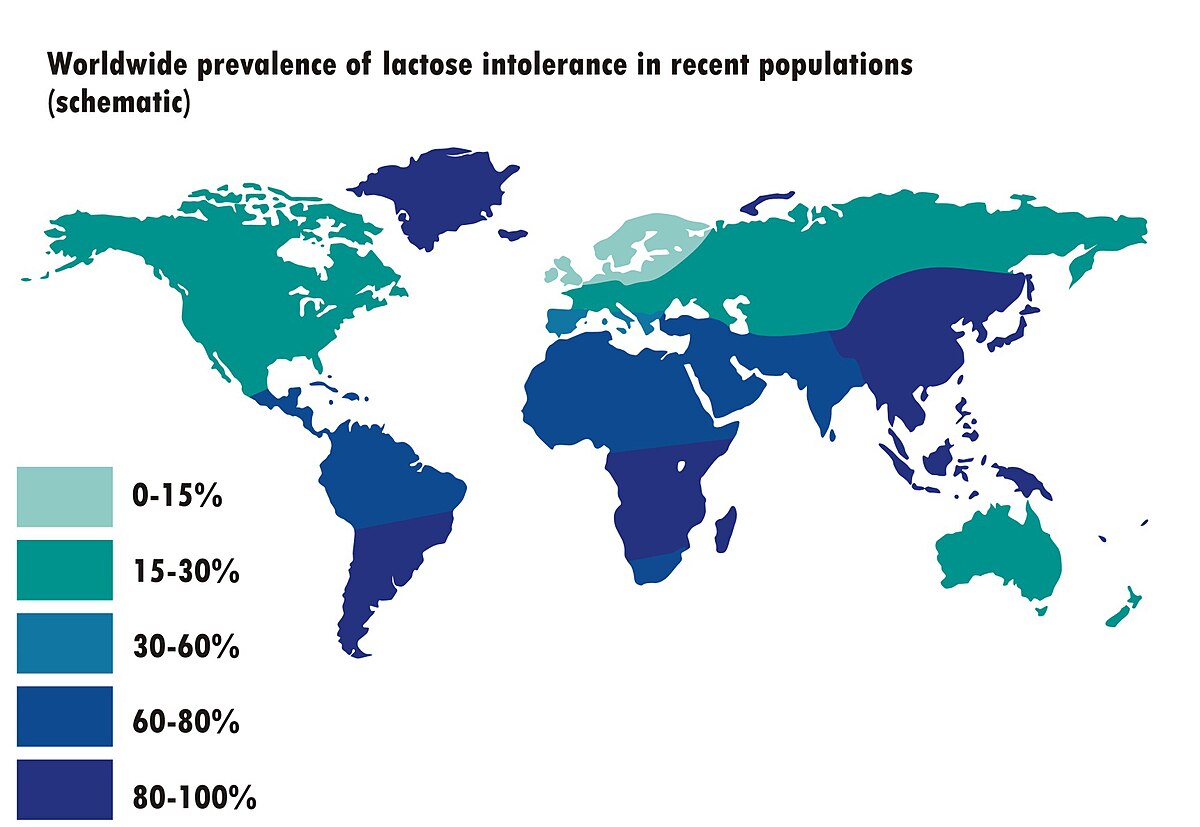
Source: Food Intolerance Network (2013) [NmiPortal]

Data sources:
Tin, S., & Wongarn, R. (2004). Lactose intolerance in Thai adults. Journal of the Medical Association of Thailand, 87(12), 1501–1505.
Scrimshaw, N. S., & Murray, E. B. (1988). Prevalence of lactose maldigestion. American Journal of Clinical Nutrition, 48(Suppl), 1086–1098.
Sahi, T. (1994). Genetics and epidemiology of adult-type hypolactasia. Scandinavian Journal of Gastroenterology, 29(Suppl 202), 7–20.
Yoshida, Y., Sasaki, G., Goto, S., Yanagiya, S., & Takashina, K. (1975). Studies on the etiology of milk intolerance in Japanese adults. Gastroenterologia Japonica, 10(1), 29–34.
Notes: Subsequent analyses (e.g., PMID: 20144208) suggest updated regional interpolations. The East Asian high-intolerance boundary may be positioned further north, and small high-lactase-persistence populations in parts of West Africa, the Arabian Peninsula, and Pakistan may be underrepresented.
Understanding Lactose and Lactase
Lactose is a disaccharide sugar composed of glucose and galactose. To absorb it, the body requires the enzyme lactase, which is produced by specialised cells in the lining of the small intestine. Lactase splits lactose into its two simple sugar components so they can enter the bloodstream.
In most mammals, lactase production declines after weaning, since milk is no longer a dietary staple. When this decline occurs in humans, undigested lactose passes into the large intestine, where bacteria ferment it, producing gases, bloating, cramps, and diarrhoea. This genetic pattern is called lactase non-persistence. The term 'lactose intolerance' refers to the presence of gastrointestinal symptoms that may occur in individuals with lactase non-persistence after consuming lactose.
The Genetics of Lactase Persistence
Some human populations have developed a genetic adaptation that allows them to continue producing lactase throughout life: a trait known as lactase persistence. This trait is controlled by regulatory mutations near the LCT gene on chromosome 2, which encodes the lactase enzyme. The most well-studied variant is called C/T-13910, located upstream of the LCT gene.
People who carry the T allele (often of European or East African descent) maintain high lactase production into adulthood. Those with the ancestral C allele typically lose lactase activity after early childhood. This genetic difference explains much of the variation in adult dairy tolerance, although additional variants and environmental factors also play a role.
Global Population Differences
Lactase persistence and intolerance vary dramatically by region and ancestry:
- Northern Europeans – Among the highest lactase persistence rates (over 90%). The ability to digest milk likely provided a nutritional advantage during the development of dairy farming around 8,000 years ago.
- Southern Europeans and Middle Easterners – Intermediate prevalence (40–70%), reflecting mixed genetic and dietary adaptation.
- East Asians – Very low lactase persistence (less than 10%). In the past, dairy was not a common part of traditional East Asian diets.
- West Africans and African Americans – Typically 20–30% lactase persistence, with some pastoral groups in East Africa (e.g., Tutsi, Maasai) showing much higher rates due to independent mutations in the same gene region.
- Indigenous Australians and Native Americans – Nearly universal lactase non-persistence, reflecting non-dairy ancestral diets.
These differences are among the clearest examples of gene–culture co-evolution: populations that relied on dairy as a food source evolved the genetic ability to digest it, while others did not.
A cultural bias towards consuming dairy leads to the perception of lactose intolerance in susceptible individuals as being a "disorder."
Lactase Persistence Around the World
The ability to digest milk into adulthood (known as lactase persistence) varies widely across human populations. This difference reflects one of the clearest examples of gene–culture co-evolution: in regions where dairy farming became central to survival, natural selection favoured individuals with sustained lactase enzyme activity.
| Region / Population | Approximate Lactase Persistence (%) | Notes |
|---|---|---|
| Northern Europe (e.g., UK, Scandinavia) | 85–95% | Highest prevalence. Linked to dairy culture from Neolithic farming communities. |
| Southern Europe & Middle East | 40–70% | Mixed ancestry and dietary history. Partial adaptation to dairy consumption. |
| East Asia | 5–10% | Low prevalence. Traditional diets relied on plant foods and fermented soy rather than milk. |
| South Asia | 15–40% | Variable rates. Higher persistence in northern India, where dairy is culturally significant. |
| West Africa | 20–30% | Low overall, but pastoral groups show higher rates due to independent KIT-13910 mutations. |
| East African pastoral groups (e.g., Maasai, Tutsi) | 70–90% | Independent genetic variants for lactase persistence evolved under dairy-based subsistence. |
| Indigenous Americans & Australians | 0–10% | Minimal historical dairy use. Near-universal lactose intolerance in adulthood. |
These global patterns show how genetics and culture evolve together. Lactase persistence is advantageous only in societies where milk is a staple food - elsewhere, lactose intolerance remains the natural, ancestral state.
Genetic marker: The most studied variant is C/T-13910 upstream of the LCT gene on chromosome 2, found in high frequency among Europeans and some African pastoral groups.
Lactase Persistence as Evolution in Action
The evolution of lactase persistence is one of the clearest examples of rapid human adaptation. The genetic change that allows adults to digest milk arose independently in several populations within the past 10,000 years: a remarkably short period in evolutionary terms.
Following the domestication of cattle, sheep, and goats during the Neolithic period, milk became a reliable source of calories and nutrients in certain societies. Individuals who could digest lactose into adulthood gained a selective advantage, particularly during periods of food scarcity. As a result, genetic variants that maintained lactase production beyond childhood spread rapidly in populations where dairying became central to subsistence.
The Key Genetic Change
The most studied variant in European populations, C/T-13910, is located in a regulatory region upstream of the LCT gene on chromosome 2. Rather than altering the lactase enzyme itself, this mutation prevents the normal post-weaning decline in lactase production by keeping the gene active throughout life.
In East African and Middle Eastern pastoral populations, different mutations in the same regulatory region produced the same functional outcome. This represents convergent evolution, in which distinct populations independently developed similar biological adaptations in response to comparable environmental pressures.
A Case Study in Gene–Culture Co-evolution
Lactase persistence illustrates a dynamic feedback loop between culture and biology:
- Culture shaped genetics: The practice of dairying created selective pressure for lactase persistence.
- Genetics reinforced culture: Populations with the trait could rely more heavily on milk, further embedding dairy into their diets.
- Multiple origins: The trait evolved independently at least three times, in Europe, East Africa, and the Arabian Peninsula.
Archaeological and genetic evidence suggests that in some northern European populations, lactase persistence rose from very low levels to over 80% within just a few thousand years - one of the fastest documented examples of positive selection in human evolution.
Importantly, cultural solutions to lactose digestion emerged before this genetic adaptation. Milk fermentation began soon after animal domestication, around 8,000–9,000 years ago, in regions such as Anatolia, the Fertile Crescent, and the Balkans. Residues found on Neolithic pottery indicate that fermentation allowed early populations to consume dairy with reduced lactose content long before lactase persistence became common.
In essence, the ability to drink milk in adulthood is not universal but represents a relatively recent evolutionary outcome. It highlights how human biology continually reshapes itself in interaction with culture, technology, and environment.
Symptoms and Mechanisms
When undigested lactose reaches the colon, resident bacteria ferment it into gases such as hydrogen and methane, as well as short-chain fatty acids. The resulting rise in osmotic pressure draws water into the bowel, causing:
- Bloating and abdominal distension
- Flatulence
- Abdominal cramps
- Diarrhoea or loose stools
- Occasionally nausea or fatigue
Severity varies depending on the amount of lactose consumed, residual enzyme activity, gut transit time, and the composition of the individual’s microbiome.
The Role of the Gut Microbiome
The microbiome plays a crucial role in modulating lactose intolerance. Certain gut bacteria, such as Bifidobacterium and Lactobacillus species, can metabolise lactose in the colon, reducing symptoms by fermenting it more efficiently, but they do not replace lactase activity in the small intestine.
Regular consumption of fermented dairy products such as yoghurt or kefir may help maintain tolerance, as the bacteria in these foods pre-digest lactose during fermentation.
Interestingly, people who consume small amounts of dairy regularly often experience fewer symptoms than those who completely avoid it: their gut bacteria adapt to aid digestion.
Diagnosing Lactose Intolerance
Diagnosis may involve one or more of the following:
- Hydrogen breath test: Measures hydrogen in the breath after a lactose challenge. Elevated levels indicate fermentation by gut bacteria.
- Lactose tolerance test: Blood glucose levels are monitored after lactose ingestion; failure to rise suggests poor digestion.
- Genetic testing: Identifies variants of the LCT gene associated with lactase persistence or non-persistence.
- Elimination and re-introduction: Observing symptom response after removing and then re-adding lactose-containing foods.
Fermentation as an Ancient Solution to Lactose Intolerance
Long before the evolution of genetic lactase persistence, humans had already found a practical way to make milk digestible, fermentation. By allowing bacteria and yeasts to convert lactose into lactic acid, early pastoral societies transformed milk into yoghurt, cheese, kefir, and butter, all of which contained significantly less lactose.
How Fermentation Reduces Lactose
Lactic acid bacteria such as Lactobacillus delbrueckii and Streptococcus thermophilus consume lactose during fermentation, producing lactic acid and lowering the pH.
Aged cheeses undergo further microbial metabolism that almost completely removes lactose.
Fermented dairy drinks like kefir contain mixed cultures that continue to digest residual lactose even after consumption, helping intestinal tolerance.
Cultural Significance
Fermentation enabled non–lactase-persistent populations to benefit from milk’s nutrients without discomfort. In doing so, it shaped entire cuisines, from the yoghurt and labneh of the Middle East to the kefir of the Caucasus and the aged cheeses of Europe. These foods became nutritional bridges between biology and culture.
In evolutionary terms, fermentation came first, a cultural adaptation that preceded, and later complemented, the genetic evolution of lifelong milk tolerance.
Management and Dietary Strategies
Lactose intolerance does not require total dairy avoidance. Most people tolerate small or moderate amounts of lactose, especially when consumed with other foods.
Practical approaches include:
- Choosing low-lactose or lactose-free products such as hard cheeses and butter.
- Consuming yoghurt or kefir with live cultures that assist in lactose digestion.
- Taking lactase enzyme supplements before eating dairy.
- Gradually reintroducing small amounts to promote microbial adaptation.
- Ensuring adequate calcium and vitamin D intake through non-dairy sources if dairy is limited.
🧀 Lactose Content of Common Cheeses
| Cheese Type | Typical Lactose Content (grams per 100g) | Notes |
|---|---|---|
| Parmesan (aged 12+ months) | 0.0–0.1 | Virtually lactose-free due to long ageing. Usually well tolerated. |
| Cheddar (mature) | 0.1–0.5 | Most lactose removed during whey separation. Ageing reduces it further. |
| Swiss / Emmental | 0.1–0.4 | Contains minimal lactose. Beneficial bacterial cultures persist. |
| Gouda (aged) | 0.2–0.6 | Low lactose content. Mild flavour and good digestibility. |
| Mozzarella (fresh) | 0.1–0.7 | Lower lactose than milk. Higher when very fresh. |
| Brie / Camembert | 0.4–0.8 | Soft-ripened. Lactose gradually consumed by surface mould. |
| Ricotta | 2.0–3.5 | Made from whey. Higher lactose, often poorly tolerated. |
| Cottage cheese | 2.5–3.0 | Contains added milk. One of the higher-lactose cheeses. |
| Cream cheese | 2.5–4.0 | Fresh cheese. Little fermentation, retains most lactose. |
| Feta | 0.5–1.5 | Moderate lactose. Tolerance varies by individual. |
| Blue cheese (e.g. Stilton, Roquefort) | 0.2–1.0 | Aged. Low lactose but may cause reactions due to mould or histamine. |
Note: Cheeses aged for several months are generally low in lactose but may be high in histamine. Fresh, unaged cheeses and whey-based products retain more. Individual tolerance depends on the total portion size and gut microbial adaptation.
Evolutionary and Cultural Perspectives
The global distribution of lactose intolerance offers insight into human adaptation and dietary evolution. In regions where animal herding and milk consumption became central to survival, natural selection favoured mutations maintaining lactase production. Elsewhere, cultures developed alternative strategies: fermentation to reduce lactose content or complete reliance on plant-based nutrition.
Fermented dairy products such as yoghurt, kefir, and cheese may have originated as cultural solutions to lactose intolerance: transforming milk into a more digestible, low-lactose food while preserving its nutritional value.
Lactose intolerance is a result of both biology and culture. It is not a disease in most contexts but a normal genetic variant in the majority of the world’s population. Understanding one’s lactase status and microbiome can help tailor dietary choices for comfort and nutrition.
From a microbiome perspective, the goal is not to eliminate dairy but to determine the balance between genetics, microbial support, and cultural food wisdom that best suits the individual.