







The Human Biome · Article 18 of 26
Fermented Foods & Live Cultures – Traditional Foods That Support Microbial Diversity
Educational and scope notice
This material is for education only and does not provide medical diagnosis or treatment advice. IEMT practitioners should remain within their professional scope and refer clients to an appropriately qualified healthcare professional where medical assessment, treatment, prescribed medication, supplements or restrictive diets are involved.
Fermentation is one of humanity’s oldest methods of food preservation and enhancement. Long before refrigeration or modern microbiology, cultures around the world learned that allowing foods to ferment could not only prevent spoilage but also improve flavour, digestibility, and health. Today, science recognises fermented foods as a vital source of beneficial live microorganisms that can support the body’s microbial diversity, especially within the gut.
What Is Fermentation?
Fermentation is a natural metabolic process in which microorganisms such as bacteria, yeasts, or fungi convert sugars and starches into acids, gases, or alcohol. These by-products preserve food, inhibit harmful microbes, and create the tangy, complex flavours associated with fermented foods. Common fermentation agents include Lactobacillus species (for lactic acid fermentation) and various yeasts such as Saccharomyces cerevisiae.
The Microbial Benefit
Unlike sterilised or heavily processed foods, fermented foods often contain living cultures that can survive digestion transiently or exert effects through their metabolic activity as they pass through the gut. Rather than permanently colonising the intestine, these microbes interact temporarily with the existing microbiome and contribute to microbial diversity primarily through the production of metabolites. Even when long-term colonisation does not occur, fermentation-derived compounds, such as lactic acid, short-chain fatty acids, and other bioactive metabolites, can support digestion, modulate immune function, and improve the gut environment.
Traditional Examples from Around the World
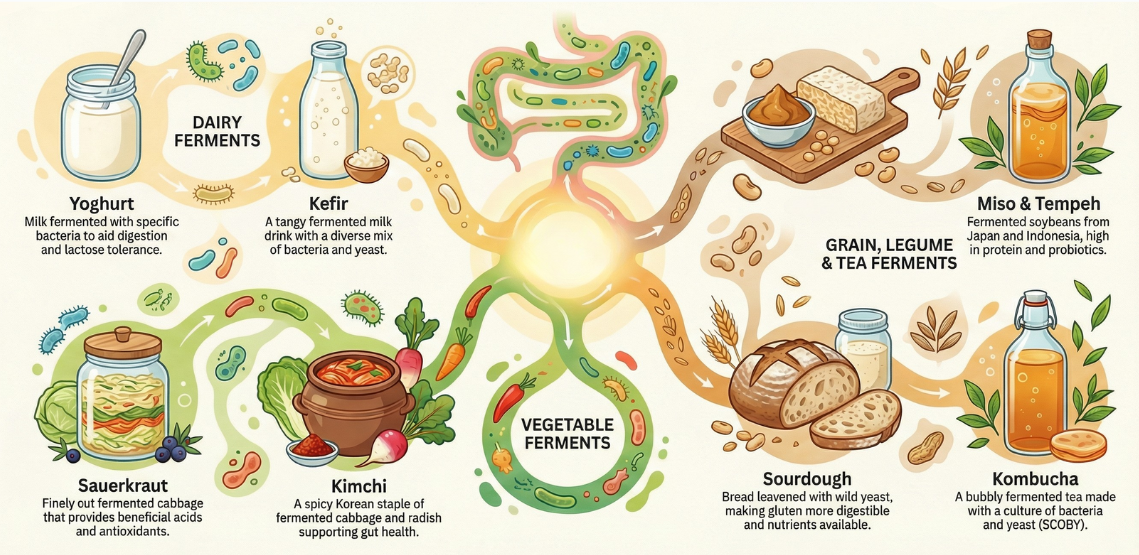
- Yoghurt – produced by fermenting milk with Lactobacillus bulgaricus and Streptococcus thermophilus. Known to aid digestion and lactose tolerance.
- Kefir – a tangy fermented milk drink originating in the Caucasus, containing multiple bacterial and yeast species within a polysaccharide “grain”. More diverse than most yoghurts.
- Sauerkraut – fermented cabbage rich in Lactobacillus plantarum and Leuconostoc mesenteroides. Provides beneficial acids and antioxidants.
- Kimchi – a spicy Korean fermentation of cabbage, radish, and chilli. Contains lactic acid bacteria that support gut and immune health.
- Miso – Japanese soybean paste fermented with Aspergillus oryzae mould and lactic acid bacteria, used to make soups and sauces.
- Tempeh – fermented soybeans bound by fungal mycelium (Rhizopus oligosporus), high in protein and probiotics.
- Kombucha – fermented tea made with a symbiotic culture of bacteria and yeast (SCOBY). Produces organic acids and mild carbonation.
- Sourdough – bread fermented with wild yeasts and lactic acid bacteria—makes gluten more digestible and nutrients more available.
- Fermented vegetables and pickles – traditional in nearly every culture, providing lactic acid bacteria and enzymes that aid digestion.
Kimchi
Kimchi is a traditional Korean fermented food made primarily from vegetables, such as Chinese cabbage (baechu) and radish (mu), seasoned with salt, garlic, chilli, ginger, and fish sauce or shrimp paste. It is both a culinary staple and a cultural symbol in Korea, representing preservation, community, and health.
A Brief History
The origins of kimchi date back over two thousand years. Early records from the Three Kingdoms period (around the 7th century CE) describe salted vegetables used to preserve food through the winter. The addition of chilli peppers, which arrived from the Americas in the 16th century, transformed kimchi into its modern, spicy form. Today, there are hundreds of regional and seasonal varieties, reflecting Korea’s geography and climate.
How Kimchi Is Made
Kimchi fermentation begins with salting the cabbage or vegetables to draw out moisture and create an environment inhospitable to spoilage organisms. The salted vegetables are then rinsed, mixed with a paste of garlic, chilli, ginger, spring onions, and fish sauce, and packed tightly into jars or crocks. Fermentation occurs at a cool room temperature for several days, then continues slowly in cold storage. The process is anaerobic, meaning it occurs without oxygen, allowing lactic acid bacteria to thrive.
The key transformation is driven by naturally occurring microbes on the vegetables and in the environment. No starter culture is needed, the right conditions allow beneficial bacteria to dominate naturally.
Microbes Typically Found in Kimchi
- Leuconostoc mesenteroides – initiates fermentation, producing carbon dioxide and lactic acid; creates kimchi’s characteristic tang and slight effervescence.
- Lactobacillus plantarum – emerges later and maintains acidity, enhancing preservation and probiotic potential.
- Lactobacillus brevis – contributes flavour and additional probiotic diversity.
- Weissella koreensis and Weissella cibaria – early fermenters common in authentic Korean kimchi, producing antimicrobial compounds and peptides.
As fermentation progresses, these bacteria generate lactic acid, lowering the pH and preventing spoilage. The balance of species shifts over time: early fermentation favours Leuconostoc species, while later stages favour Lactobacillus species, yielding the sour, mature taste preferred in stews and soups.
Nutritional and Microbial Benefits
- Rich in lactic acid bacteria that support gut microbial diversity.
- Contains vitamin C, beta-carotene, and antioxidants from vegetables and spices.
- Lowers intestinal pH, inhibiting pathogenic bacteria.
- Associated with improved digestion and immune modulation in clinical studies.
Did you know?
Kimchi’s microbial composition varies by season, region, and even household, each jar develops a unique microbial signature, making every batch a living expression of its environment.
How Fermented Foods Support the Microbiome
Fermented foods contribute to gut health through several mechanisms:
- Introducing beneficial microbes: They provide transient but supportive populations of lactic acid bacteria and yeasts that interact with resident gut flora.
- Lowering the gut pH: Lactic acid production creates an environment that discourages pathogenic bacteria and favours beneficial strains.
- Producing bioactive compounds: Fermentation generates vitamins (notably B-group and K₂), short-chain fatty acids, and peptides that modulate immunity.
- Enhancing nutrient absorption: Fermentation breaks down anti-nutrients such as phytates, increasing mineral bioavailability.
- Improving gut barrier function: Some fermentation-derived metabolites are associated with strengthened tight junctions and reduced intestinal permeability.
Scientific Evidence and Health Links
Recent studies show that regular consumption of fermented foods is associated with greater microbial diversity and lower inflammatory markers in the body. A 2021 study at Stanford University found that participants who ate a diet rich in fermented foods (including yoghurt, kimchi, and kefir) for ten weeks increased microbial diversity and decreased systemic inflammation compared to those on a high-fibre diet alone.
Clinical evidence also links fermented food consumption to improvements in digestion, lactose tolerance, and even mood regulation, through effects on the gut–brain axis. However, not all fermented foods contain live cultures - pasteurisation or excessive processing can destroy beneficial microbes, leaving only flavour and acidity but no probiotic activity.
Fermented vs. Probiotic Products
“It’s important to distinguish between naturally fermented foods and industrial probiotic products. Fermented foods contain complex, naturally evolving microbial communities, while probiotic supplements typically contain a limited number of well-characterised strains in controlled doses. Both can be beneficial; however, fermented foods provide ecological diversity and food-matrix interactions that are difficult to replicate in capsule form.”
Practical Tips for Including Fermented Foods
- Start with small portions and build gradually to allow the gut to adapt.
- Choose raw or unpasteurised versions whenever possible to ensure live cultures are present.
- Store homemade ferments in cool conditions and use clean utensils to avoid contamination.
- Rotate different types (e.g., yoghurt, sauerkraut, and miso) to maximise microbial variety.
- If sensitive to histamine or yeast, introduce fermented foods cautiously and monitor reactions.
Cautions: Histamine Intolerance and IBS
While fermented foods are generally safe, individuals with histamine intolerance, mast cell activation, or certain gut disorders such as IBS may experience adverse reactions to aged or fermented products. In these cases, alternative methods of supporting gut health - such as prebiotic fibre and non-histamine-producing probiotics - may be better tolerated.
Histamine in Fermented Foods
Fermentation naturally increases histamine levels in foods. During fermentation, certain bacteria (especially species of Lactobacillus and Enterococcus) convert the amino acid histidine into histamine as part of their normal metabolism. Histamine content depends more on fermentation conditions and microbial composition than on the food itself.
Foods such as sauerkraut, kimchi, yoghurt, kefir, and aged cheeses can therefore contain high amounts of histamine, which may trigger symptoms in sensitive individuals. These can include flushing, itching, headaches, nasal congestion, or digestive discomfort, particularly in people with histamine intolerance or mast cell activation.
The amount of histamine varies widely depending on fermentation time, temperature, and bacterial species. Freshly made, lightly fermented products usually contain less histamine than long-fermented or aged foods. Commercial products that are pasteurised before sale tend to have lower histamine levels but also lack live cultures.
If you are sensitive to histamine:
- Choose short-fermented or freshly prepared ferments.
- Avoid older, strongly sour batches or long-stored jars.
- Introduce fermented foods gradually and monitor tolerance.
- Support histamine breakdown with good gut health and adequate nutrients such as vitamin C and vitamin B6.
Fermented foods are valuable for microbiome diversity; however, for individuals with histamine sensitivity, freshness, moderation, or avoidance may be necessary.