






IEMT for Bad Dreams and Nightmares
IEMT for Bad Dreams and Nightmares: A Practitioner Framework for Assessment and Intervention
Abstract. Nightmares and disturbing dreams are common across the lifespan and may present clinically as sleep disruption, anticipatory anxiety, and distress on waking. This practitioner-focused article outlines a pragmatic IEMT-informed framework for working with nightmares and bad dreams, drawing attention to (1) anticipatory states prior to sleep, (2) the kinaesthetic-emotional state on waking, (3) the role of dreams as a theatre for consciously suppressed affect and thought, and (4) identity-based and anthropomorphic components within dream content. The approach emphasises careful differential interpretation (particularly in children), state-based intervention using the basic IEMT pattern, and the use of identity algorithms where dream elements appear to operate “independently” within the dream narrative.
Scope and Audience
This material is intended for IEMT practitioners, advanced practitioners and trainers. It highlights clinically useful considerations that may not be covered in foundational practitioner training, with particular emphasis on how dream-related material can be converted into workable states and identity targets within IEMT practice.
The Anticipatory State: “Before Sleep” Material
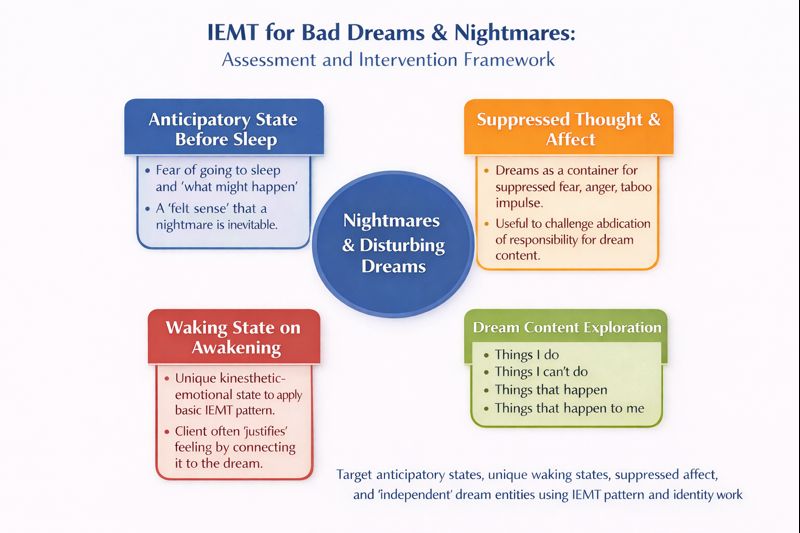
A frequent and clinically significant feature of nightmares is the presence of an anticipatory state prior to sleep. This tends to present in two broad forms:
- Fear of: “I’m scared to go to sleep because of what might happen.”
- A felt sense / knowing: a kinaesthetic anticipation that a nightmare is “coming,” sometimes experienced as certainty, a "knowing", rather than fear.
In most children and many adults, anticipatory experience may be present without the cognitive or linguistic sophistication to describe it. Practitioners can often elicit useful data through developmentally appropriate questioning and observation. Where anticipatory states are clearly present, they may be treated as legitimate IEMT targets: the fear of the nightmare, or the sensed inevitability of it, can be worked with using the basic IEMT pattern.
A practical caution is required here: children may be quick to be “therapised” for developmentally normal instability by overly concerned parents and their eager therapists. Equally, panic states in children can be misread as misbehaviour, acting out, or “night terrors,” when the underlying experience is closer to panic. The practitioner's stance should therefore be one of careful interpretation rather than diagnostic haste.
The Waking State: The Most Actionable Entry Point
Not all nightmares are dramatic “screamers.” Many are quieter - i.e. mildly disturbing dreams followed by waking with an uneasy kinaesthetic-emotional state. This waking state is often the most clinically useful entry point for IEMT.
Practitioners can teach clients to become rapidly aware (immediately upon waking) of the kinaesthetic state present and to apply the basic IEMT pattern directly to that state themselves. This is particularly relevant when the waking state appears unique (i.e., not commonly felt in daytime life).
Within this framing, the relationship between feeling and dream is reversed from the typical client interpretation. The dream is not treated as the originating cause of the feeling. Rather, the dream is understood as a narrative that justifies or explains a pre-existing affective state that becomes available during sleep. When awake, clients often distract, deny, suppress, or override that same affect. During sleep, the “conscious denial” systems are reduced, and the feeling gains access to awareness; the dream then supplies a story that makes the feeling intelligible. The conscious awareness of this feeling lingers for a while upon waking, giving the client the opportunity to apply IEMT to it.
Practical note: if clients apply eye-movement work immediately upon waking, advise that working with eyes open may reduce discomfort associated with eye dryness after sleep.
Dreams as a Container for Suppressed Thought and Affect
Dreams can be conceptualised as an environment in which consciously suppressed emotions and thoughts become available. Many individuals manage intrusive or socially unacceptable thoughts during waking life through attention-shifting, self-regulation, moral codes, and behavioural constraints. During sleep, these constraints loosen, allowing dream content to express violence, fear, insecurity, desire, lust, and taboo impulses.
This raises an important clinical nuance: people often abdicate responsibility for dream content (“it was just a dream”). Yet dream production remains a function of the same brain and person. In practice, the therapeutic objective is not a moral judgement of dream content, but increasing the client’s authority and agency over their internal states, especially when those states spill into sleep and impair rest.
The frame for the client to learn is not "these nightmares happen to me" but rather, "I am the person creating this nightmare/dream experience."
Nightmares, Panic, and the Risk of Misinterpretation in Children
In young people, nightmare phenomena may intersect with panic-like states. Some children who “freak out” at night may be experiencing panic attacks rather than solely dream-driven distress. Because children may lack the language to describe panic, adults may mislabel the experience as behavioural acting out. Similarly, upon exposure to a therapist, routine and transient childhood panic experiences may be turned into "generalised anxiety disorder", "panic disorder" or any one of the frames within pop-diagnostics and pop-psychology.
So, practitioners must avoid this opposite error: assuming every disruptive nighttime episode is pathological. Developmental transitions in the nervous system can cause chaotic sleep phenomena without requiring therapy. A measured stance is recommended: assess carefully, intervene proportionately, and avoid escalating normal developmental variability into a clinical identity.
Working with Dream Recall as a State Target
A simple, high-utility approach is to work directly with dream recall intensity. Ask the client to bring the dream to mind and rate the recall (e.g., “How strong is it out of ten?”). The recall, as a present-state representation, can then be processed using the IEMT K-Pattern.
The Dreamer’s Identity: Age, Role, and Position in the Dream
In addition to state work, practitioners can use identity-based approaches by eliciting the identity of the dreamer within the dream. For example:
- “In that dream, how old are you?”
- “Where are you?”
- “What is happening around you?”
This allows the practitioner to locate the dreamer as an identity-position within the dream ecology and apply identity algorithms accordingly.
“Things I Do,” “Things I Can’t Do,” “Things That Happen,” and “Things That Happen to Me”
A pragmatic classification for exploring recurring dream structure is to differentiate between:
- Things I do (errors, accidents, mistakes initiated by the dreamer)
- Things I can’t do (inability, paralysis, obstruction, impotence)
- Things that happen independently of me (external events such as collapse, disaster, earthquake)
- Things that happen to me (being chased, attacked, pursued, harmed)
Recurring patterns here frequently mirror waking-life themes (e.g., responsibility, powerlessness, threat, unpredictability), even when the symbolism appears remote or irrational. This classification provides a structured route from narrative content to processable states and identities.
Anthropomorphication and “Independent” Dream Entities
Many dreams contain entities that appear to have a life of their own, monsters, hostile figures, disasters, pursuing agents, or recurring external forces. While the dreamer experiences these as external, the clinical move is to treat these entities as workable identity targets.
Practically, this means applying identity elicitation and the identity algorithm to the entity itself, not only to the dreamer’s fear response. For example:
- “How old is the monster?”
- “Where is it?”
- “What is happening around it?”
This approach can also be applied to recurring non-agentic themes (e.g., earthquakes). The point is not to interpret symbolically as an abstract metaphor, but to treat the representation as an identity-state component available for processing.
Depression, Dreaming, and Early Morning Waking
An important clinical proposition (drawn from Human Givens concepts associated with Ivan Tyrrell and Joseph Griffin) is that dreams may actively contribute to daytime mood. In this view, depressives may be depressed by their dreams rather than merely dreaming negatively because they are depressed.
Clinically, this invites intervention aimed at waking states and dream-affect, particularly in clients with early morning waking. A frequently noted feature is the abruptness of waking, moving rapidly from sleep into full, clear consciousness, often accompanied by sharply intensified self-critical appraisal. A further nuance is the reported precision of wake times (e.g., consistently waking at a very specific minute).
In this context, teaching clients to process the waking state with the IEMT basic pattern, and to work with salient dream emotions, can produce rapid symptomatic relief for some individuals.
Alpha-State Capacity, Daydreaming, and Restorative “Play”
A related factor in depressive presentation is diminished access to light trance or alpha-like states (daydreaming, drifting, relaxed imagery). Where such capacity is reduced, mood may worsen, and sleep/dream quality may degrade.
A practical intervention is to train alpha-state access through guided imagery and simple internal visual tasks (e.g., imagining walking a familiar route, tracking a pendulum swing, or visualising a rotating wheel). The objective is to restore the client’s capacity for inner “downtime” that is not dominated by internal dialogue.
More broadly, the material highlights the role of play and fantasy as psychologically restorative. Highly creative and happier individuals often engage in private fantasies without shame. Depressed clients frequently report the opposite - no fun, no play, no daydreaming - suggesting that reintroducing playful imagination may be part of restoring emotional flexibility.
Bedwetting: Authority, Decision-Making, and Sleep-State Control
A brief clinical aside concerns bedwetting. A cautious stance is recommended: do not intervene unless the young person experiences it as a problem and requests help (e.g., embarrassment around school trips or sleepovers). Where work is undertaken, a useful intervention is to elicit the child’s implicit rule structure through a bind-style question (sensitively delivered and calibrated):
“Would you wet the bed when you’re awake? … So what makes it acceptable to wet the bed when you’re asleep?”
The practitioner then works with the responses (and the emotional field in the family system) using IEMT processes. The therapeutic intention is to strengthen the child’s sense of authority over sleep-state decisions, rather than positioning sleep as helplessness.
Dream Types: Which Dreams Are Most Clinically Useful?
Not all dreams provide equally workable material. A pragmatic differentiation is:
- Dreams that wake you up: typically short, coherent, often negative, and yield clean state material on waking.
- Dreams that maintain sleep: “sleep-protective” dreams that may be fragmentary and quickly forgotten.
- Dreams that process/integrate experience: information-dense, symbolically rich, and often confusing/frustrating.
For IEMT, the first category (dreams that wake the person) often provides the most actionable material, because the waking state and associated affect are immediately available for processing.
IEMT work with nightmares and disturbing dreams can be conceptualised as state-first, identity-second. Prioritising anticipatory states before sleep and kinaesthetic states on waking often yields the most direct access to workable material. Dream content then becomes a resource for identifying recurring themes of agency, inability, external threat, and “independent” entities that can be treated as identity targets within IEMT algorithms.
The overarching clinical goal is not dream interpretation in the symbolic or analytic sense. It is to support the client in developing greater authority over internal states and representations (both awake and asleep) so that sleep becomes restorative rather than emotionally coercive
Useful article. I’m someone that often experiences / creates very vivid and complex dreams, often with recurring content. I’ve used IEMT with myself on this, but this article gives me more areas for experimentation. Thanks