







History of Memory Research
The scientific study of memory has undergone a significant transformation over the last two millennia. What began as philosophical speculation gradually evolved into structured experimentation, neuropsychology, cognitive neuroscience, and contemporary computational approaches. This survey outlines the major phases, figures, and theoretical developments that have shaped our present understanding of how memory functions, fails, and reconstructs experience.
Early Philosophical Foundations
Classical Antiquity
Western thinking about memory originates in Greek philosophy. Plato conceptualised memory as an internal wax tablet on which impressions are stamped, anticipating later discussions of encoding fidelity and distortion. Aristotle, in De Memoria et Reminiscentia, emphasised associative principles such as contiguity, similarity, and contrast - mechanisms still central to modern learning theory.
Plato and Aristotle
Plato (c. 428–348 BCE)
Plato was one of the most influential figures in Western philosophy, whose writings shaped early theories of knowledge, perception, and memory. He proposed that memory functions as an imprinting process, comparing it to a wax tablet upon which experiences leave impressions. His dialogues suggest that recollection involves recovering innate knowledge, linking memory to metaphysical ideas about truth and the nature of reality. Plato’s work introduced enduring questions about the reliability of memory and the distinction between appearance and underlying forms.
Aristotle (384–322 BCE)
A student of Plato, Aristotle produced the first systematic psychological account of memory in De Memoria et Reminiscentia. He framed memory as a natural biological function, grounded in associative processes of contiguity, similarity, and contrast. Aristotle distinguished between memory, retention, and recollection, offering an early model of retrieval processes. His approach was empirical and observational, laying the groundwork for later scientific study. Aristotle’s influence endures in contemporary theories of associative learning, cognitive organisation, and the mechanisms guiding recall.
Key Quotes from De Memoria et Reminiscentia
1. On the nature of memory
“Memory is of the past; for the present we have perception, and for the future expectation.”
2. On memory as a mental image
“The affection we call memory is a state induced by a mental image, as a likeness of that of which it is a memory.”
3. On recollection versus simple remembering
“Recollection is the recovery of an image, and it is a kind of search. Remembering happens to us, but recollecting is something we do.”
4. On associative principles
“We recollect by passing from one state to its successor in a regular order, the movement of thought following the original sequence of events.”
5. On the physical basis of memory
“Memory belongs to the same part of the soul as imagination, for it is an affection of the sensory faculty, impressed like a seal upon the body.”
Roman and Medieval Thought
Roman rhetoricians, notably Cicero and Quintilian, developed the method of loci, a spatial mnemonic technique that remains a powerful memory strategy. During the medieval period, monastic scholars expanded these methods, integrating them into elaborate memory palaces used for theological study and preaching.
Examples of the Method of Loci
The method of loci uses familiar spatial environments (real or imagined) to organise and strengthen memory. By placing information along a mental pathway, recall becomes a matter of mentally “walking through” the space.
Example 1: Remembering a Speech
Imagine entering your front door and seeing a large book on the floor representing your introduction. Moving into the hallway, you picture a clock whose hands point to your first argument. In the kitchen, a brightly coloured painting symbolises your second argument, and in the living room, a burning candle stands for your concluding point. As you mentally walk the route, each location cues the next section of your talk.
Example 2: Learning a List of Concepts
To memorise key psychological terms, place each concept in a location along a known route:
– At the gate: “Perception” appears as an oversized eye.
– At the path: “Encoding” is represented by a scribe engraving symbols into stone.
– At the garden table: “Storage” takes the form of a locked chest.
– At the shed: “Retrieval” becomes a ladder used to reach the chest.
Example 3: Studying Historical Figures
Assign each philosopher to a room in your house:
– Plato sits in the study beside a wax tablet.
– Aristotle is in the library holding scrolls marked “association.”
– Ebbinghaus stands in the kitchen with a string of nonsense syllables.
– Bartlett appears in the lounge, rearranging pieces of a story puzzle.
These vivid, structured images strengthen retention by leveraging spatial memory, visual detail, and associative encoding.
The Emergence of Experimental Memory Research
Hermann Ebbinghaus and the Quantification of Memory
The modern science of memory began with Hermann Ebbinghaus, who in 1885 published Über das Gedächtnis. Using nonsense syllables to control for prior associations, he generated the first empirical measures of learning, forgetting, and savings. His forgetting curve and spacing effect remain foundational phenomena in cognitive psychology.
The Forgetting Curve and the Spacing Effect
Ebbinghaus demonstrated that memory retention declines rapidly after learning, following a predictable exponential pattern now known as the forgetting curve. Within hours or days, much of the newly acquired information fades unless it is revisited or meaningfully reinforced. This finding was groundbreaking because it provided the first quantitative description of how memories deteriorate over time.
From this work, Ebbinghaus also identified the spacing effect: information is remembered far more effectively when learning is distributed across multiple sessions rather than concentrated in a single massed period. Spaced repetition slows the rate of forgetting, strengthens long-term retention, and reduces the cognitive effort required during later recall. These principles have become central to modern educational practice, memory research, and the design of evidence-based learning systems.
William James and Functionalism
In The Principles of Psychology (1890), William James distinguished between primary (short-term) and secondary (long-term) memory, while describing memory as an adaptive process rather than a static store. James’ functionalist orientation anticipated later ecological perspectives emphasising purpose, behaviour, and real-world cognition.
William James (1842–1910)
William James was an American philosopher and psychologist widely regarded as one of the founders of modern psychology. In The Principles of Psychology (1890), he offered one of the first comprehensive accounts of human mental life, integrating introspective observation with emerging scientific methods. James distinguished between primary (short-term) and secondary (long-term) memory, laying conceptual foundations for later models of memory systems.
His work emphasised the adaptive, functional nature of mental processes, proposing that consciousness, attention, and memory serve practical purposes in guiding action and survival. James also introduced influential ideas about habit formation, emotion (notably the James–Lange theory), and the fluid, ever-changing “stream of consciousness.”
Although he wrote before the rise of modern cognitive science, his insights anticipated many contemporary themes in psychology and continue to shape theoretical discussions about mind, behaviour, and experience.
Behaviourism and the Suppression of Memory
The rise of behaviourism (Watson, Skinner) shifted focus away from internal mental processes. Memory was reframed as behavioural learning, with emphasis on stimulus–response associations, reinforcement schedules, and habit formation. While this movement limited theoretical innovation about internal representation, it contributed rigorous methodological tools and experimental control, later adopted by cognitive researchers.
The Cognitive Revolution
Information-Processing Frameworks
The cognitive revolution reintroduced mental processes as legitimate scientific objects. Memory was reconceptualised as an information-processing system, involving encoding, storage, and retrieval. Key figures included Donald Broadbent, whose filter model of attention shaped early models of mental architecture.
Donald Broadbent (1926–1993)
Donald Broadbent was a pioneering British experimental psychologist whose work helped define the early cognitive approach to attention and information processing. Working at the Applied Psychology Unit in Cambridge, he sought to understand how humans cope with overload in complex environments, particularly in aviation, communication systems, and real-world tasks requiring rapid decision-making.
Broadbent’s most influential contribution was the Filter Model of Attention, outlined in his landmark book Perception and Communication (1958). He proposed that the mind processes sensory inputs through a limited-capacity channel, with an early-stage selective filter allowing only certain information to reach conscious processing. This framework provided one of the first formal, testable models of mental architecture and became foundational to the cognitive revolution of the mid-20th century.
His research advanced experimental methodology and established attention as a central topic in cognitive psychology. Broadbent’s influence continues to be felt in contemporary models of selective attention, cognitive load, aviation psychology, and human–machine interaction.
Multi-Store Models
Atkinson and Shiffrin (1968) proposed the influential multi-store model, distinguishing sensory registers, short-term memory, and long-term memory. Rehearsal was seen as the primary mechanism through which information is transferred to durable storage.
Richard C. Atkinson (b. 1929) & Richard M. Shiffrin (b. 1942)
Richard Atkinson and Richard Shiffrin are American cognitive psychologists best known for developing the influential multi-store model of memory, first presented in 1968. Their collaboration produced one of the earliest formal frameworks describing memory as a system composed of distinct components: sensory registers, short-term memory, and long-term memory.
Their model emphasised the role of controlled processes (especially rehearsal) in transferring information from short-term to long-term storage. Although later research refined or expanded on this view, the Atkinson–Shiffrin framework served as a crucial foundation for the emerging field of cognitive psychology, steering experimental work toward systematic investigations of encoding, retrieval, and storage mechanisms.
Shiffrin went on to develop highly influential mathematical models of memory, including the Search of Associative Memory (SAM) model. At the same time, Atkinson contributed significantly to learning theory, cognitive modelling, and science policy. Together, their work shaped decades of research into memory structure and information processing.
Working Memory and Capacity Limits
George Miller (1956) identified constraints on short-term memory capacity (“the magical number seven, plus or minus two”). Later, Baddeley and Hitch (1974) advanced this with the working memory model, introducing the phonological loop, visuospatial sketchpad, and central executive to explain multi-component processing. A fourth subsystem, the episodic buffer, was added in 2000.
The Components of Working Memory
The working memory model proposed by Baddeley and Hitch describes short-term cognitive processing as a system of multiple specialised components rather than a single, undifferentiated store. Each subsystem handles different kinds of information, allowing the mind to manage several tasks simultaneously.
Phonological Loop
The phonological loop maintains and manipulates verbal and auditory information. It consists of a short-lived sound-based store and an articulatory rehearsal process that refreshes material (such as repeating a phone number silently). This subsystem supports language comprehension, inner speech, and the acquisition of new vocabulary.
Visuospatial Sketchpad
The visuospatial sketchpad temporarily holds visual images and spatial layouts. It is essential for tasks such as mental rotation, navigation, remembering the location of objects, and planning movements. This subsystem processes both static visual patterns and dynamic spatial information.
Central Executive
The central executive acts as a supervisory system that coordinates attention, allocates cognitive resources, and manages the activities of the subcomponents. It does not store information itself but directs selective attention, switches between tasks, and integrates information across modalities.
Episodic Buffer
Added to the model in 2000, the episodic buffer serves as a temporary, multimodal storage system that binds information from the phonological loop, visuospatial sketchpad, and long-term memory into coherent episodes. It allows meaningful, integrated representations, such as remembering a scene that combines visual details, spoken dialogue, and contextual knowledge.
Schema Theory and Constructive Memory
Frederic Bartlett
Bartlett’s Remembering (1932) challenged the notion of memory as a literal storehouse. His experiments demonstrated systematic distortions in participants' recall of unfamiliar narratives, leading to the concept of schemas - cognitive structures that shape perception, encoding, and recall. Memory was revealed to be reconstructive rather than reproductive.
Frederic C. Bartlett (1886–1969)
Frederic Bartlett was a British psychologist whose work fundamentally reshaped the scientific understanding of memory. As the first Professor of Experimental Psychology at the University of Cambridge, he rejected the idea that memory operates as a passive storage system. Instead, in his landmark book Remembering (1932), Bartlett demonstrated that memory is actively constructed, influenced by cultural expectations, prior knowledge, and personal meaning.
Through experiments such as the famous “War of the Ghosts” study, Bartlett showed that people unconsciously reshape unfamiliar material into forms that fit their existing mental structures: an insight that led to the development of schema theory. His work revealed systematic patterns of distortion, omission, and rationalisation, highlighting the reconstructive nature of remembering long before this view became mainstream.
Bartlett’s contributions extended beyond theoretical advances. He played a major role in applied psychology during both World Wars, focusing on skilled performance, fatigue, and human factors. His legacy continues to influence research on perception, memory, cognition, and the interaction between cultural frameworks and mental processes.
Later Developments
Schema theory influenced subsequent research on scripts, frames, and knowledge structures (e.g., Roger Schank and Robert Abelson), highlighting how past experience organises both memory and anticipatory cognition.
Neuropsychology and the Discovery of Memory Systems
Patient H.M. and the Hippocampus
The turning point in memory neuroscience came from the case of Henry Molaison (H.M.), whose bilateral hippocampal removal to treat epilepsy resulted in profound anterograde amnesia. Research by Brenda Milner demonstrated that declarative memory depends on medial temporal lobe structures, while procedural learning can remain intact.
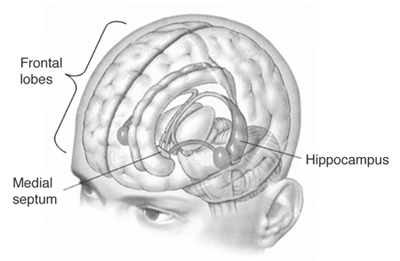
A faculty member from the Department of Brain and Cognitive Sciences wrote: "He is considered the most important patient in the study of the human brain, known worldwide only by his initials, HM. In death, we learned his name. He was Henry Gustav Molaison. He died at a nursing home on December 2, 2008, at the age of 82, after living for most of his life in a state of permanent amnesia. Over 55 years, Mr. Molaison was the subject of intense scientific study, and he's credited with helping scientists unlock secrets of how we form memories. When he was 27, Mr. Molaison underwent brain surgery to cure a seizure disorder, and that surgery left him unable to form new memories of his own.
Dr. Suzanne Corkin (a faculty member at MIT) studied him extensively.
H.M. was studied extensively at MIT by many faculty and students. H.M. hoped the research he took part in would help other people. He and his court-appointed guardian consented to the studies, and they also agreed to donate his brain for future study. The result was a far better understanding of how our brains make new memories, and researchers were able to tease out the differences between short-term and long-term memory creation.
Multiple Memory Systems
This led to the differentiation of declarative (episodic, semantic) and non-declarative (procedural, priming, conditioning) memory systems. Parallel processing models emerged, showing that memory operations are distributed across cortical and subcortical networks rather than localised to a single “memory centre.”
Long-Term Potentiation (LTP)
In 1973, Bliss and Lømo demonstrated LTP in the hippocampus, a durable strengthening of synaptic transmission following stimulation. This became the dominant neurobiological model of learning and memory consolidation, linking cellular plasticity to behavioural change.
Tim Bliss (b. 1940) & Terje Lømo (b. 1935)
Tim Bliss and Terje Lømo are neuroscientists whose groundbreaking collaboration in the early 1970s led to the discovery of long-term potentiation (LTP), a durable increase in synaptic strength following high-frequency stimulation. Their 1973 publication on LTP in the hippocampus provided the first clear physiological mechanism that could plausibly account for learning and long-term memory formation at the cellular level.
Working at the University of Oslo, Lømo initially observed lasting changes in synaptic responses during stimulation of the perforant path in rabbits. Bliss later joined him to refine these experiments, demonstrating that brief, patterned electrical stimulation could produce long-lasting enhancement in synaptic transmission. This discovery supplied a direct link between neural plasticity and behavioural learning theories.
Their work transformed the field of memory research by shifting attention toward synaptic mechanisms, paving the way for decades of investigation into molecular plasticity, neural circuitry, and the biological foundations of learning. LTP remains one of the most studied and influential phenomena in modern neuroscience, forming a cornerstone of contemporary models of memory consolidation and neural adaptation.
Contemporary Memory Science
Encoding and Consolidation
Research in the late 20th century emphasised consolidation processes involving hippocampal–cortical interactions, sleep-dependent memory reactivation, and systems consolidation extending over months or years. Computational models (e.g., complementary learning systems) helped explain why the hippocampus rapidly encodes episodic information while the neocortex supports gradual integration.
Reconsolidation and Memory Updating
Since the early 2000s, studies on memory reconsolidation have challenged the idea of stable long-term memory traces. Upon retrieval, memories enter a labile state in which they may be modified or disrupted. This has profound implications for psychotherapy, trauma interventions, eyewitness testimony, and the ethics of memory alteration.
Emotion, Stress, and Neuroendocrine Modulation
Advances in affective neuroscience have shown how stress hormones, amygdala activation, and vagal influences modulate encoding and consolidation. Emotional arousal typically enhances memory for key features while impairing peripheral detail: a pattern with important forensic implications.
The Dark Side of Memory Research
False Memories and Suggestibility
Elizabeth Loftus and colleagues demonstrated how easily suggestion, leading questions, and repeated interviews can implant false memories of events that never occurred. These findings transformed legal practice and exposed significant vulnerabilities in eyewitness testimony and in therapeutic methods relying heavily on guided imagery or regression techniques.
Elizabeth F. Loftus (b. 1944)
Elizabeth Loftus is an American cognitive psychologist whose work has had a profound impact on the scientific understanding of memory, particularly in relation to eyewitness testimony and the malleability of recollection. Through a series of influential experiments beginning in the 1970s, she demonstrated that memory is highly susceptible to suggestion, leading questions, and post-event information. Her research showed that entirely false memories of events that never occurred can be implanted under certain conditions.
Loftus’s findings challenged long-held assumptions about the accuracy of human memory and reshaped legal practice worldwide. Her work contributed to reforms in police interviewing, courtroom procedures, and forensic guidelines, emphasising the need for caution when relying on eyewitness accounts. Beyond the legal arena, her studies raised critical ethical questions about therapeutic practices that attempt to “recover” buried memories.
Author of more than 20 books and hundreds of scientific articles, Loftus is widely regarded as one of the most influential psychologists of the late 20th and early 21st centuries. Her research continues to shape debates on memory reliability, trauma, and the interactions between cognition, emotion, and social influence.
Recovered Memory Therapy Controversies
In the 1980s and 1990s, some therapeutic movements claimed that long-buried traumatic memories could be reliably recovered through hypnosis, age regression, or guided visualisation. Subsequent analysis revealed high risks of confabulation and therapist-induced pseudo-memories. Professional bodies now emphasise caution, evidence-based practice, and avoidance of suggestive techniques.
Eyewitness Memory and Legal Reform
Research on identification errors, memory contamination, and the fragility of recall under stress has led to significant reforms in lineup procedures, interview methods, and police protocols. The Cognitive Interview, for example, was developed to enhance accuracy while reducing suggestibility.
The Cognitive Interview
The Cognitive Interview (CI) is a structured interviewing technique developed by psychologists Ronald Fisher and Edward Geiselman in the 1980s to improve the accuracy and completeness of eyewitness recall. It is grounded in principles of cognitive psychology, particularly the understanding that memory is reconstructive and that retrieval is highly sensitive to context, cues, and the manner of questioning.
The CI enhances recall by reinstating the original event's mental and environmental context. Witnesses are encouraged to reconstruct the scene, including sensory details, emotions, and spatial arrangements, which helps activate associated memory pathways. Interviewers avoid leading questions and instead guide the witness through multiple retrieval routes (such as recalling events in different orders or from different perspectives) to access additional details that may not surface through linear narration.
A core aim of the Cognitive Interview is to maximise accurate recall while minimising suggestibility. This is achieved through open-ended questioning, active listening, and careful avoidance of assumptions or embedded information. Research consistently shows that the CI yields significantly more accurate details than standard police interviewing techniques, without increasing the rate of false information.
Today, the Cognitive Interview is widely used in investigative and forensic settings and continues to influence best-practice guidelines for interviewing victims, witnesses, and vulnerable populations.
Future Directions
- Neurocomputational Models: Integrating neuroscience with machine learning to simulate memory architectures.
- Connectomics: Mapping large-scale network dynamics shaping encoding and retrieval.
- Epigenetics: Investigating how gene expression changes support long-term memory persistence.
- Therapeutic Modulation: Pharmacological and behavioural interventions to modify maladaptive memories.
- Ethical Considerations: Managing risks associated with memory enhancement, alteration, and neurotechnological intervention.
Memory science continues to evolve rapidly, drawing together psychology, neuroscience, computation, philosophy, and law. Its history demonstrates not only the complexity of human remembering but also the ethical responsibilities that accompany any attempt to influence it.