







Core Negative States
Core Negative States: A Structural Perspective on Inner Peace and Psychological Congruence
The concept of Core Negative States provides a complementary framework to the IEMT model, addressing the deep structural conditions that undermine inner peace, authenticity, and psychological stability. While much therapeutic work focuses on symptoms, behaviours, or coping strategies, this framework targets the foundational self-evaluations that shape identity, perception, and long-term patterns of suffering.
The origins of this perspective are informed by the Core Transformation model developed by Connirae Andreas and Tamara Andreas, which identifies universal core positive states such as peace, unity, and wholeness. The present framework extends that logic by asking a structurally symmetrical question: if there are universal core positive states, are there also universal core negative states?
Clinical observation suggests that there are indeed core negative states which, when left unaddressed, organise denial, persona formation, overcompensation, and chronic internal conflict. These states are not surface-level beliefs, but deep evaluative identity positions that individuals actively avoid acknowledging. Some observers may find this to be analogous to Jung's "shadow".
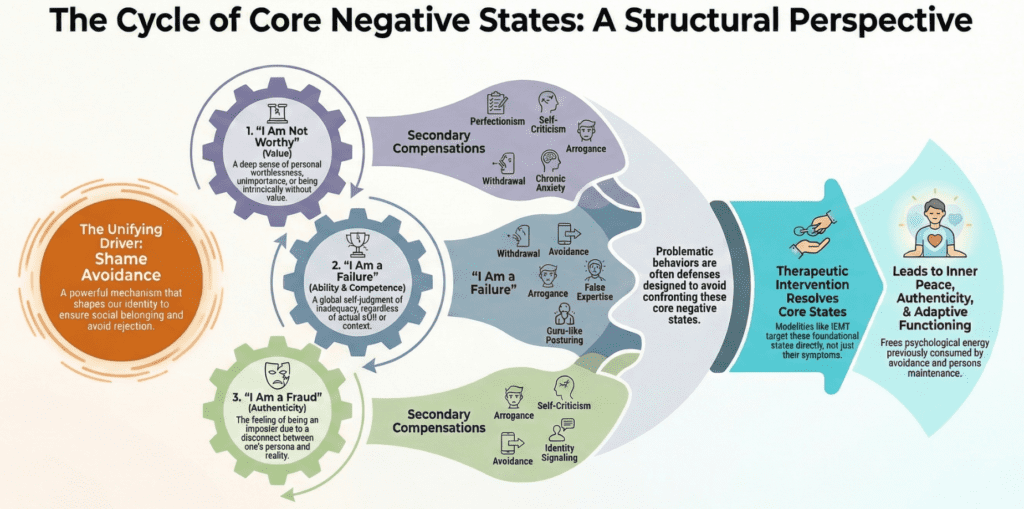
The Three Core Negative States
While not exhaustive, three core negative states appear to be particularly prevalent and structurally significant across clinical populations. These states frequently operate outside conscious awareness and are defended against through elaborate psychological and social strategies.
1. “I Am Not Worthy” — Value
This state concerns perceived personal value. It manifests as a sense of worthlessness, unimportance, or an intrinsic lack of value. Importantly, it is often environmentally acquired rather than internally generated, arising from prolonged experiences of being undervalued, overlooked, or marginalised.
Individuals organised around this state regulate their lives according to a narrow bandwidth of perceived worth. They may avoid opportunities that exceed their internal valuation, tolerate being undervalued by others, or experience distress when overvalued due to fear of exposure. Reassurance from others rarely alters this state, as self-valuation remains structurally intact.
2. “I Am a Failure” — Ability and Competence
This core negative state relates to perceived inadequacy of skill, intelligence, or capability. It is often maintained by inappropriate measurement criteria, contextual mismatch, or rigid comparisons rather than objective inability.
Competence is inherently contextual. Individuals may excel in one domain while appearing inept in another. However, when the “I am a failure” state dominates, contextual nuance collapses into global self-judgement. The individual concludes not “I have not learned this,” but rather “I am inherently lacking.” Readers may like to refer to Carol Dweck's work on the "fixed" and "growth" mindsets for more on this structuring.
This state frequently gives rise to compensatory behaviours, including false expertise, avoidance, exaggerated certainty, or guru-like posturing, as a means of pre-emptively avoiding exposure to ignorance or error.
3. “I Am a Fraud” — Authenticity
The third core negative state concerns authenticity and identity congruence. It is commonly recognised in contemporary discourse as imposter syndrome, though this framework takes a more structurally direct view.
The experience of being a fraud arises when individuals present a persona that diverges from their lived reality. This is not merely deception of others, but self-deception: an attempt to conform to perceived social, professional, or cultural expectations in order to avoid rejection or shame.
Attempts to “perform authenticity” often deepen the problem, as authenticity cannot be enacted as a strategy. Resolution requires relinquishing persona maintenance rather than refining it.
Shame Avoidance as the Unifying Structure
These three core negative states are unified by a common function: shame avoidance. Shame avoidance operates as a robust regulatory mechanism within individuals and cultures, shaping conformity, identity signalling, and behavioural compliance.
From consumer behaviour and fashion cycles to professional subcultures and ideological identities, shame avoidance incentivises individuals to display the correct cultural “tokens of recognition” that signal belonging. Failure to do so risks social rejection, ridicule, or moral condemnation (imagined or otherwise).
Over time, individuals internalise these pressures, leading to the denial of disowned aspects of self and overcompensatory behaviours designed to ensure they are never perceived as unworthy, incompetent, or fraudulent.
Clinical Implications
Many problematic behaviours that clients later regret or criticise in themselves are not primary issues, but secondary compensations driven by these core negative states. Self-criticism, perfectionism, arrogance, withdrawal, and chronic anxiety often represent attempts to avoid confronting the underlying states directly.
Effective change work, therefore, requires targeting the core negative states themselves rather than their downstream manifestations. Whether through IEMT, metaphors of movement, Core Transformation, or other structured change methodologies, the task is to bring these states out of denial and into conscious engagement.
Integration with IEMT
Within the IEMT framework, core negative states can be treated as structurally analogous to patterns of chronicity. Both represent deep organisational constraints that prevent natural psychological resolution. IEMT processes can be applied directly to the felt sense of unworthiness, failure, or fraudulence, rather than to the behaviours they generate.
By resolving these core states, individuals no longer need to overcompensate, perform identities, or defend against shame. Psychological energy previously consumed by avoidance becomes available for adaptive functioning, authenticity, and relational flexibility.