







The Polyvagal Theory: Ventral and Dorsal Vagal Systems
Learning outcome: Distinguish anatomical structures from the behavioural interpretations proposed by polyvagal theory.
Begin with the anatomy
The nucleus ambiguus and dorsal motor nucleus of the vagus are brainstem structures with different populations and projections. The nucleus tractus solitarius receives much visceral sensory input. These structures do not amount to two separate peripheral nerves labelled “safety” and “shutdown”. The term dorsal vagal complex in neuroanatomy commonly includes the NTS, dorsal motor nucleus and area postrema.
Cardiac control and visceral control involve specialised circuits. A broad anatomical label should not replace an account of the cells, projections and effect being discussed. Vagal functions also interact with sympathetic, spinal, endocrine and enteric pathways.
What the theory proposes
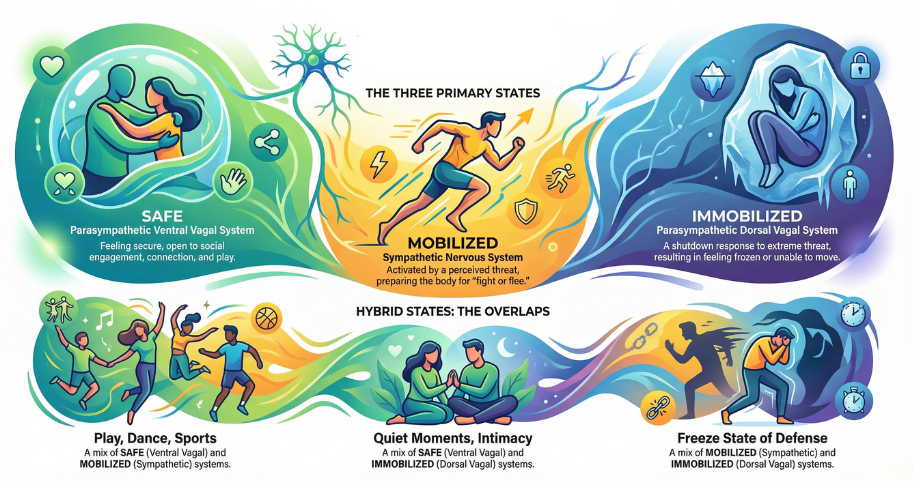
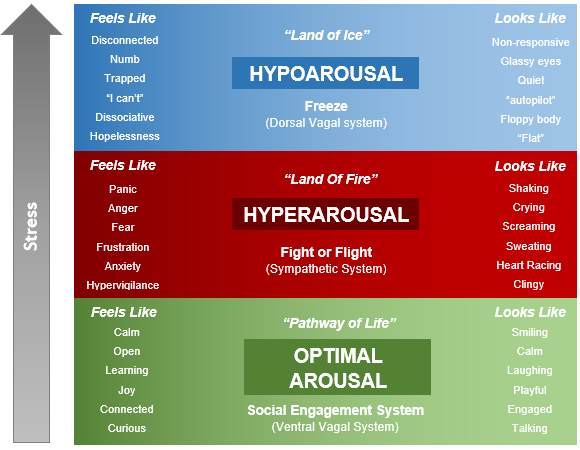
Polyvagal theory relates autonomic regulation to social engagement and defensive behaviour, using concepts such as neuroception and ventral/dorsal vagal organisation. Treat these as propositions of the model. They are not a validated bedside system for assigning nerve activity from a person’s emotion, posture or facial expression.
Neuroception is the theory’s term for processes of detecting safety and threat outside conscious awareness. It should not be used as a measurable diagnosis unless the construct and measurement have been explicitly defined.
Read the scientific disagreement directly
Grossman’s 2023 critique challenges central physiological and evolutionary premises. A further expert critique and Porges’s response appeared in 2026. Porges argues that critics misrepresent the theory’s level of explanation; critics dispute its anatomical, comparative and measurement foundations. The disagreement should be visible to learners, rather than reduced to a claim that the theory is established neuroscience. 2023 critique; 2026 evaluation; 2026 response.
Clinical communication without overreach
A person’s numbness, reduced speech, fatigue or immobility has multiple possible explanations. “Dorsal vagal shutdown” is not a diagnosis of depression, ME/CFS, dissociation or a neurological disorder. Do not attribute symptoms to a vagal state in place of an appropriate assessment.
Predictability, consent and sensitive pacing are useful features of care regardless of which explanatory model a practitioner uses. Their value does not require claiming that eye contact activates a specific vagal circuit. Adapt communication to the individual; do not require a particular gaze, voice or posture as a sign of progress.
A comparison task
- Observation: “The client spoke more slowly and reported feeling less distressed.”
- Model-based interpretation: “A polyvagal account might describe this as a change in state.”
- Unsupported physiological conclusion: “We measured ventral vagal activation from their voice.”
Check your understanding
Is the existence of two vagal motor nuclei sufficient to prove the theory’s emotional hierarchy?
Show the explanation
No. The anatomical structures are real; the proposed mapping from them to complex emotional states is a separate claim requiring direct evidence.
Medical reading and sources
- Patros et al. (2025). The physiology, anatomy and stimulation of the vagus nerve in epilepsy.
- Prescott & Liberles (2022). Internal senses of the vagus nerve.
- Grossman (2023). Fundamental challenges to the five basic premises of polyvagal theory.
- Grossman et al. (2026). Why the Polyvagal Theory Is Untenable: an international expert evaluation.
- Porges (2026). When a Critique Becomes Untenable: a scholarly response.
Illustrations and further viewing
The original course media are retained below. Diagrams of emotional states illustrate a proposed model; they do not measure nerve activity. Read any claims in external videos alongside the evidence and limitations above.

Return to the course index, reading library and assessment
Teaching text revised 13 October 2026. This lesson supports professional learning; it does not confer competence to diagnose disease or prescribe stimulation.