






Speech Act Theory
Speech Act Theory: Understanding What We Do With Words
In the study of language and communication, Speech Act Theory, first introduced by J. L. Austin and later developed by John Searle - offers a robust framework for understanding how words function not only to convey information but also to perform actions. Within therapeutic contexts such as Integral Eye Movement Technique (IEMT), this perspective can shed light on the subtle and often unspoken dynamics that shape the therapeutic exchange.
From Saying to Doing
Austin’s original insight was that language is not merely a vehicle for stating facts (constatives), but can also be used to carry out actions (performatives). When a therapist says, “I understand,” this is not only a description of their mental state; it is also an act of acknowledging the client’s experience. Searle expanded this concept into a more formal classification of speech acts, identifying different types based on their communicative function.
Types of Speech Acts
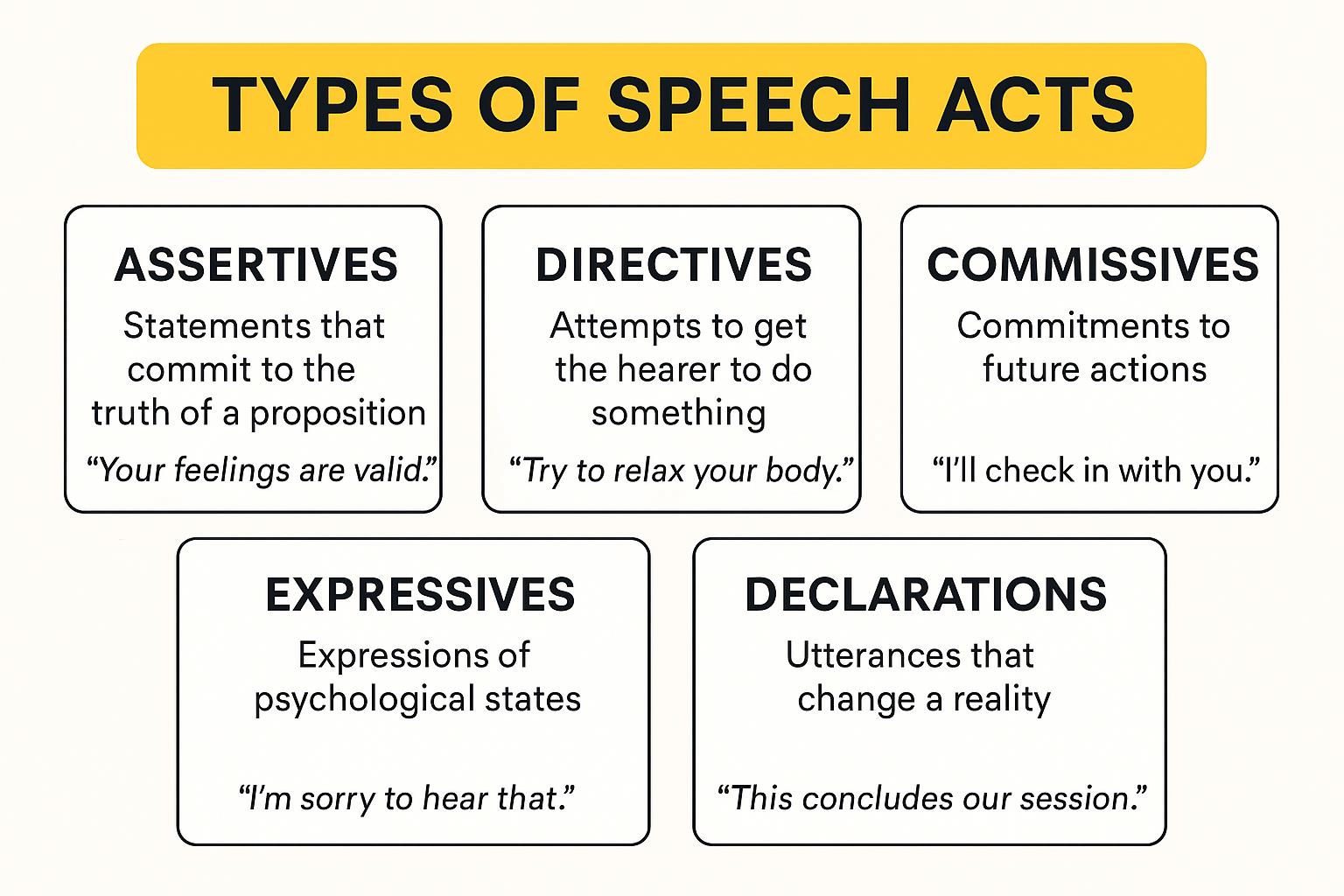
Searle proposed five primary categories of speech acts:
- Assertives – Statements that commit the speaker to the truth of the proposition, e.g., “Your reaction is understandable.”
- Directives – Attempts to get the hearer to do something, e.g., “Tell me more about that memory.”
- Commissives – Commitments to future action, e.g., “We will return to this topic later.”
- Expressives – Expressions of psychological states, e.g., “I’m pleased with the progress you’ve made.”
- Declarations – Utterances that change reality simply by being spoken, e.g., “The session is now concluded.”
In psychotherapy, each of these categories can influence the client’s perceptions, expectations, and emotional responses.
Illocutionary Force and Perlocutionary Effect
Speech Act Theory distinguishes between the illocutionary force (what the speaker intends to accomplish by the utterance) and the perlocutionary effect, how the utterance actually impacts the listener. For example, the therapist’s question “When was the first time you felt this?” may be intended (illocution) to prompt memory retrieval, but it may also evoke unexpected emotions or associations (perlocution).
This distinction is particularly important in IEMT, where precise language choices can guide the client’s attention in a way that supports therapeutic goals without inadvertently introducing confusion or resistance.
Speech Acts in Therapeutic Practice
In therapy, the effectiveness of speech acts depends on shared understanding and context. A directive such as “Let’s pause here” may be received as collaborative guidance in one session, but as an abrupt interruption in another, depending on the relational dynamics. Similarly, expressives like “I’m concerned about this pattern” may encourage reflection or trigger defensiveness.
By becoming aware of the types of speech acts used and their potential effects, practitioners can refine their communicative approach, ensuring that interventions are both intentional and ethically attuned.
Why Speech Act Theory Matters in IEMT
For IEMT practitioners, integrating Speech Act Theory into professional awareness can offer several benefits:
- Clarity of intention – Understanding the type of act being performed helps maintain focus on the therapeutic objective.
- Ethical sensitivity – Being mindful of the illocutionary and perlocutionary dimensions reduces the risk of misinterpretation.
- Improved rapport – Adjusting the form and tone of speech acts can foster trust and collaboration.
Ultimately, Speech Act Theory reminds us that therapy is not simply about what we say, but how our words act upon the therapeutic process. This awareness enables practitioners to align language use with the principles of effective, ethical, and client-centred care.
References:
- Austin, J. L. (1962). How to Do Things with Words. Oxford: Clarendon Press.
- Searle, J. R. (1969). Speech Acts: An Essay in the Philosophy of Language. Cambridge: Cambridge University Press.