






Physiological State Accessing Cues (PSACs) in Integral Eye Movement Technique
Physiological State Accessing Cues (PSACs) form a foundational, though frequently under-emphasised, component of Integral Eye Movement Technique (IEMT). While IEMT is often described in terms of its procedural elements - eye movements, memory imprinting, and affective reprocessing - PSACs address a deeper and more clinically decisive layer of therapeutic work: the ongoing physiological organisation of emotional states.
Beyond Technique-Centric Therapy
A persistent limitation across many therapeutic modalities is the tendency to reduce complex human suffering to discrete techniques. Whether in psychiatry (where intervention becomes synonymous with medication selection) or in technique-driven psychotherapies that substitute pharmacology with procedural interventions, the underlying error is the same: mistaking method for understanding; knowing techniques is not the equivalent to understanding the human experience.
Within IEMT, PSACs exist precisely to counter this reductionism. Emotional suffering does not reside solely in internal imagery, verbal cognition, or isolated memories. Rather, it is distributed throughout the entire physiological system, shaping posture, muscle tone, breathing, gesture, facial expression, and movement dynamics. Any therapeutic model that fails to account for this distribution risks superficial or incomplete change.
Related Articles
Holistic Observation and Clinical Literacy
The concept of “holistic” assessment, often dismissed as vague or imprecise (because it usually is), has a precise and rigorous meaning within PSAC-informed practice. It refers to the clinician’s capacity to observe and interpret the client as a whole system, rather than relying exclusively on verbal self-report. Via the Patterns of Chronicity work, IEMT aims to go beyond simple symptom amelioration to work with the system that produces and supports the symptoms in the first place.
Practitioners are already biologically and socially equipped to read non-verbal communication, or at least we should hope they are, as all humans do this continuously in everyday life. Yet within clinical contexts, this innate capacity is frequently overridden by formal diagnostic categories and scripted questioning, leading practitioners to miss overt physiological indicators of distress, dysregulation, or state change. Too many clinicians ignore what is being overtly communicated in favour of pathologising everything.
PSACs reassert the legitimacy of direct observation: watching how a client sits, moves, breathes, tenses, collapses, or flows between states. These cues often communicate more accurately than verbal descriptions, particularly when clients are motivated, consciously or unconsciously, to please the therapist or minimise reported distress.
Physiology as the Gateway to State
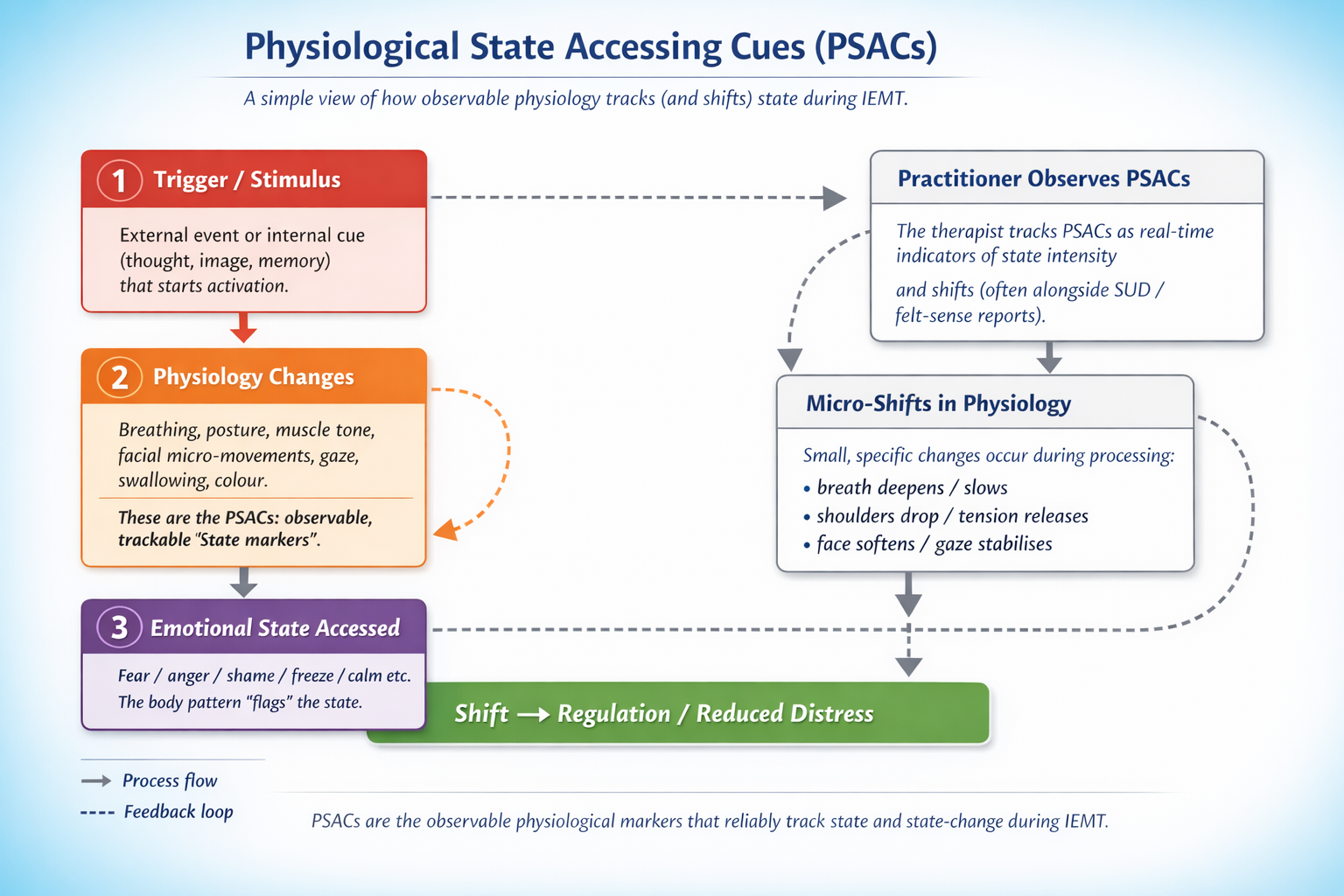
Physiological State Accessing Cues are based on a simple but powerful premise: emotional and identity states are accessed, maintained, and reactivated through physiological sequences. These sequences may include gross posture and gesture, or micro-level muscular tensions that occur below conscious awareness.
This principle is well established outside psychotherapy. In the work of Stanislavski, for example, actors do not “pretend” their way into a role cognitively. Instead, they access identity through physiological relaxation, posture, tension patterns, and movement, allowing the psychological state to emerge organically from the body.
Similarly, research into micro-expressions by Paul Ekman demonstrates that fleeting muscular activations - often detectable only through slowed video analysis - reveal emotional states that contradict conscious verbal reporting. PSACs draw on this same understanding, applying it clinically and dynamically within therapeutic interaction.
PSACs Within the IEMT Process
In practical IEMT work, PSACs operate continuously alongside the formal protocols rather than within their own context or techniques. When a client is asked to rate affective intensity, access an imprinting memory, or engage in eye movements, the practitioner is simultaneously tracking physiological indicators of change or deterioration.
In many cases, the practitioner should already know whether an intervention has been effective before asking the client to verbally re-rate intensity. Improvements or regressions are visible in facial colour, muscle tone, breathing patterns, posture, eye focus, and overall affective coherence.
This becomes especially critical when clients report post-session adverse effects such as nausea, dizziness, or headaches. Rather than treating these as post hoc anomalies, PSAC-informed practice asks what physiological processes were occurring during the intervention itself. Excessive eye movement duration, failure to interrupt escalating distress, or unobserved somatic overload are common contributing factors.
Interrupting and Redirecting State Access
A central clinical advantage of PSACs lies in the practitioner’s ability to interrupt maladaptive state-accessing sequences and reinforce adaptive ones. Once a practitioner can identify how a client physiologically enters a negative state, that sequence can be disrupted in real time through conversational, attentional, or behavioural interruptions.
Conversely, when a client accesses a positive or regulated state (often marked by spontaneous laughter, release of tension, or postural reorganisation) the practitioner can track and reinforce the physiological pathway used to enter that state. Over time, this enables clients to regain conscious access to resourceful states outside the therapy room.
This process parallels elements found in the “Mytho Self” model developed by Joseph Riggio, in which peak states are identified and accessed through their physiological signatures. PSACs extend this principle clinically, embedding it within trauma resolution and affective restructuring.
Feedforward Physiology and Long-Term Change
PSACs are not limited to resolving historical emotional data. They also address the feedforward mechanisms by which past experiences continue to shape future behaviour. Trauma and adverse life events condition the body to re-enter specific physiological states automatically, often long after the original trigger has passed.
By altering both the stored imprint and the physiological pathway that reactivates it, IEMT works at two levels simultaneously: modifying the historical record and disrupting the embodied habits that perpetuate suffering. This dual intervention explains why effective therapeutic change cannot be achieved through cognitive reframing or imagery work alone.
Emotional suffering is not merely remembered; it is enacted. PSACs provide the clinician with a means of observing, interrupting, and reorganising that enactment at the level where it actually occurs - within the body itself.
Physiological State Accessing Cues represent a core clinical literacy within Integral Eye Movement Technique. They restore attention to the embodied nature of emotional experience, protect against technique-driven blindness, and enable more precise, ethical, and effective intervention.
By integrating PSACs into routine practice, IEMT practitioners move beyond asking clients how they feel and begin to see how those feelings are organised, accessed, and sustained. In doing so, therapy becomes less about delivering techniques and more about engaging with the living system sitting in front of us.