
Overstating Harm
Definition: Overstating harm is the tendency to exaggerate or amplify the extent, severity, or impact of harm in relation to an event, experience, or behaviour. Instead of describing harm proportionately, the harm is presented as more damaging than it realistically is. This may arise from cognitive bias, heightened emotional states, or deliberate rhetorical strategy.
While overstating harm can sometimes mobilise support or justify protective action, it often undermines credibility, escalates conflict, and obscures accurate assessment of risk and responsibility.
Academic Origins
The phrase itself was first brought into prominence by Sarah Schulman in her 2016 book Conflict Is Not Abuse: Overstating Harm, Community Responsibility, and the Duty of Repair. Schulman argues that people often conflate ordinary conflict with abuse, overstating harm in ways that simplify complex dynamics into victim-perpetrator binaries. She suggests that this overstatement can be a way of avoiding accountability, escalating conflict, and preventing meaningful repair and resolution.
In parallel, psychologist Nick Haslam introduced the concept of “concept creep” in 2016 to describe how harm-related terms such as abuse, bullying, trauma, and prejudice have broadened in scope over time. This expansion leads to less severe situations being interpreted as harmful, which is a form of overstating harm through semantic drift. Although Haslam did not use the term directly, his framework offers a closely related psychological perspective.
Together, Schulman and Haslam provide two distinct but complementary views:
• Sarah Schulman (2016): explicitly frames and names the issue of “overstating harm” in the context of interpersonal and social conflict.
• Nick Haslam (2016): provides the psychological account of how harm-related language expands (“concept creep”), capturing a similar phenomenon at a conceptual level.
Implications in Therapeutic Work
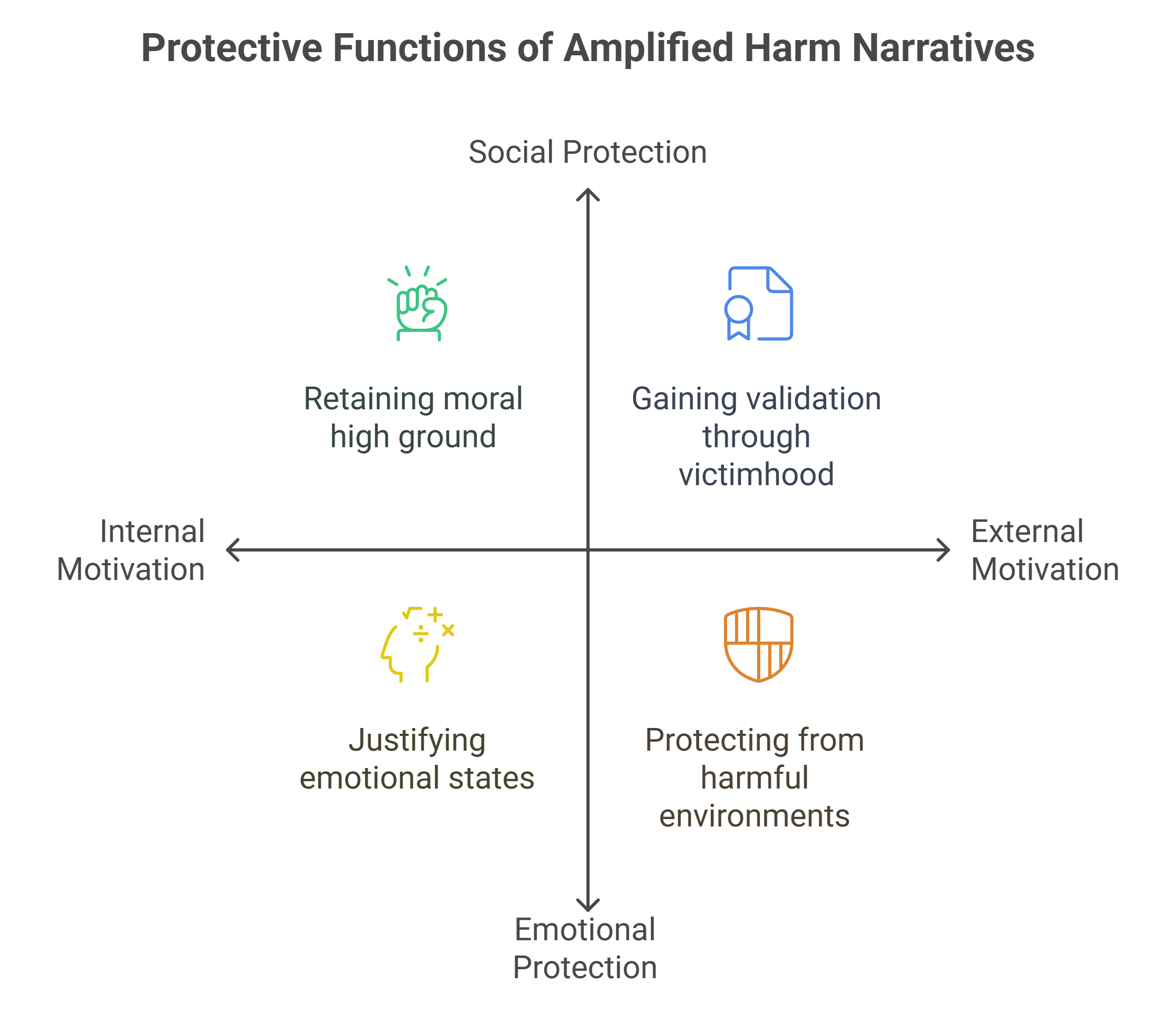
In the context of therapy, overstating harm may serve unconscious protective functions. Clients may hold onto amplified harm narratives as a way of:
- Justifying emotional states or behaviours
- Retaining a moral high ground in unresolved interpersonal dynamics
- Protecting themselves from re-engagement with harmful environments
- Gaining validation through identification with victimhood
However, these narratives, though emotionally compelling, can inhibit healing, entrench identity in trauma, and prevent cognitive reappraisal. Therapists must walk a careful line: respecting the client's lived experience without reinforcing distorted appraisals of events.
How IEMT Can Help
Integral Eye Movement Technique (IEMT) offers an approach that does not challenge the veracity of the memory itself, but changes how the event is represented at the neurological and emotional level.
- Reducing Emotional Imprint: Through eye movement patterns, the emotional charge of the memory can be reduced - leading to a clearer and more proportional appraisal of the event.
- Interrupting Patterns of Chronicity: Clients who continually revisit the same overstated narrative may be stuck in a cycle of chronicity. IEMT helps break these by shifting perspective and reducing compulsive rehearsal.
- Decoupling Identity from Harm: Overstating harm often fuses “what happened” with “who I am.” IEMT’s identity work provides a structured approach to separating these elements and reframing the self-concept.
Real-World Example
Example: A man reports he was “emotionally destroyed” by a colleague who ignored him in a meeting. On deeper enquiry, the event was a single instance of non-response in a high-pressure context. Through IEMT, the client reconnects with the original emotional imprint: being ignored by a parent during early childhood. Once processed, the recent event no longer holds disproportionate emotional weight. His language shifts from “I was destroyed” to “It stung, but I moved on.”
Client-Friendly Summary
Sometimes, without realising it, people describe past events as far worse than they actually were. This doesn’t mean they’re lying; it’s usually because strong emotions make memories feel more intense than they really were. Over time, the story we tell ourselves gets bigger and heavier. IEMT helps you take the weight out of these memories, so you can think about what happened more clearly and feel more in control again.
References
- Schulman, S. (2016). Conflict Is Not Abuse: Overstating Harm, Community Responsibility, and the Duty of Repair. Arsenal Pulp Press.
- Haslam, N. (2016). Concept creep: Psychology’s expanding concepts of harm and pathology. Psychological Inquiry, 27(1), 1–17. https://doi.org/10.1080/1047840X.2016.1082418
- Heterodox Academy. (2022). Revisiting Conflict Is Not Abuse. heterodoxacademy.org
- The Cut. (2020). Sarah Schulman on conflict and accountability. thecut.com
- Wikipedia. (2025). Concept creep. Retrieved from en.wikipedia.org