






Manipulative Underspecification
Summary
TL:DR “Manipulative underspecification,” as introduced by Justin D’Ambrosio, denotes a strategic form of conversational ambiguity whereby a speaker deliberately leaves the content of an assertion under-specified to preserve deniability and later “retroactively” commit to the interpretation most advantageous to their ulterior goals.
In psychotherapy settings, clients may employ this tactic, consciously or unconsciously, to steer the therapeutic process, manage impressions, or test the therapeutic alliance.
Within the domain of IEMT, practitioners may prefer to consider this within the realm of what is commonly taught as "Maybe Man" phenomena.
Below is a full 90-minute lecture by Justin D'Ambrosio on A Theory of Manipulative Speech.
1. Theoretical Background
Within Gricean pragmatics, successful communication presupposes cooperation: speakers provide just the right level of informativeness to answer the Question Under Discussion (QUD). By contrast, in manipulative underspecification, the speaker intentionally provides less information than would optimally answer the QUD, inducing the listener to infer a stronger, yet ambiguous, content under a presumption of cooperation. D’Ambrosio characterises such utterances as mock speech acts - pied-piping - because they mimic genuine assertions while concealing the speaker’s true, non-communicative agenda.
Gricean pragmatics, developed by philosopher H. P. Grice, centres on the idea that speakers and listeners typically co-operate in conversation by adhering (implicitly) to a set of conversational “maxims.” These ensure efficient, truthful and relevant exchange:
- Cooperative Principle: “Make your conversational contribution such as is required, at the stage at which it occurs, by the accepted purpose or direction of the talk.”
- Maxim of Quantity: Give as much information as needed, but no more.
- Maxim of Quality: Do not say what you believe to be false or lack adequate evidence for.
- Maxim of Relation: Be relevant.
- Maxim of Manner: Avoid obscurity and ambiguity; be brief and orderly.
When speakers flout one of these maxims deliberately (while still appearing to co-operate), listeners draw on context to infer additional meaning, known as a conversational implicature. For instance, if someone says “Some of the guests have arrived,” one might infer “Not all have” by assuming they’d be more precise if they meant otherwise.
2. Mechanisms of Manipulative Underspecification
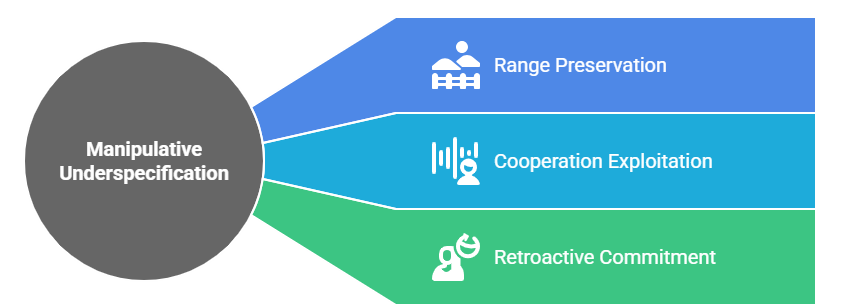
- Range Preservation: The speaker’s utterance is compatible with multiple specific propositions (e.g. “I’m doing okay” might mean “I’m handling things well” or “I’m barely managing”).
- Cooperation Exploitation: The listener, trusting the speaker’s cooperation, “strengthens” the assertion to one of the more informative interpretations, often to the speaker’s advantage.
- Retroactive Commitment: Once the listener has publicly or privately adopted an interpretation, the speaker can claim that this was their intended meaning all along, thus updating the common ground in their favour.
3. Psychotherapy Context: Why Clients Might Underspecify
In therapy, the client–therapist relationship is predicated on trust and openness. Manipulative underspecification can manifest as a client’s tactic to:
- Gauge Therapist Responsivity: A client uncertain about revealing trauma (“I had some bad experiences last year”) may use ambiguity to see whether the therapist presses for detail or changes topic.
- Manage Self-Presentation: A client may downplay severity (“I’ve been feeling off”), hoping the therapist infers mild distress, thereby avoiding the stigma of pathology.
- Test Boundaries and Alliance: By offering under-specified complaints (“You probably wouldn’t get how I feel”), clients may assess whether the therapist will challenge or validate them.
When the behaviour is scrutinised, it may well be seen as a "tactic" as stated here; however, remember it might just be what the client does and has always done as an adaptive response to life pressures and so is more automatic than consciously willed.
4. Clinical Examples
| Example | Underspecified Utterance | Possible Specific Readings | Therapeutic Implications |
|---|---|---|---|
| Avoiding Intimacy | “I’m fine with talking about my past.” | • “I’m ready to explore everything.” • “I only want to mention superficial details.” | Therapist may ask open vs. closed questions; misreading can either force trauma too soon or leave it unaddressed. |
| Emotion Minimisation | “Things have been up and down.” | • “I’m mildly stressed occasionally.” • “I’ve had suicidal thoughts.” | A therapist may ask open vs. closed questions; misreading can either force trauma too soon or leave it unaddressed. |
| Alliance Testing | “Maybe therapy isn’t helpful for people like me.” | • “I doubt any therapy works.” • “I’m only here because someone made me.” | Therapist response can either reinforce safety (“Let’s explore that”) or cause withdrawal if misread. |
5. Strategies to Address Underspecification
- Explicit Clarification Requests: “When you say ‘up and down,’ could you give an example of what that’s like for you?”
- Reflective Summaries: Paraphrasing back multiple readings: “It sounds like sometimes the mood swings are minor, but at other times they feel overwhelming—does that capture it?”
- Meta-Communication: Addressing the communication style directly: “I’ve noticed you often offer broad descriptions—what makes it hard to specify?”
- Scaling Questions: “On a scale of 0 to 10, where would you place your distress last week?”
Manipulative underspecification is a subtle yet powerful conversational strategy that can intrude upon the therapeutic process by introducing uncertainty about clients’ intentions and experiences. By recognising the hallmarks of this phenomenon and employing targeted clarification techniques, therapists can foster more transparent communication and maintain a genuinely cooperative alliance.