



Gricean Pragmatics
Paul Grice’s theory of pragmatics, developed in the 1960s and 70s, remains a foundational pillar in the philosophy of language and linguistic pragmatics. At its core, Gricean pragmatics concerns itself with how people use language in context to communicate meanings that go beyond the literal semantic content of words. In psychotherapy, particularly in conversational, client-led models such as Integral Eye Movement Technique (IEMT), understanding the pragmatics of client speech can be essential for eliciting deeper meanings, identifying incongruities, and working more effectively with implied or distorted narratives.
The Cooperative Principle
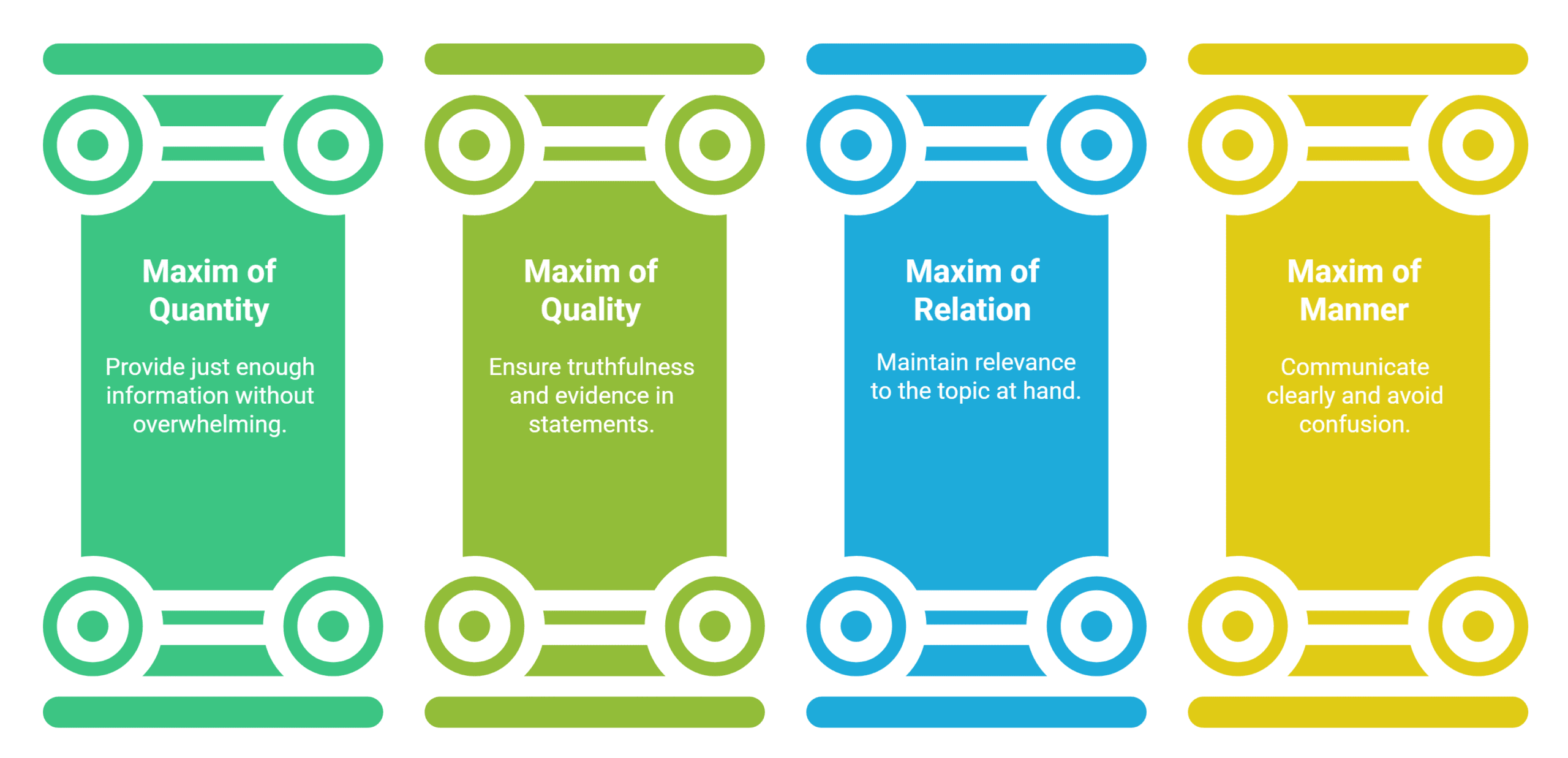
Grice proposed that human communication is governed by what he termed the Cooperative Principle: the assumption that interlocutors are working together to achieve effective communication.
Four conversational maxims underpin this principle:
- Maxim of Quantity: Provide as much information as is needed, and no more.
- Maxim of Quality: Do not say what you believe to be false or lack adequate evidence for.
- Maxim of Relation: Be relevant.
- Maxim of Manner: Avoid obscurity and ambiguity; be orderly and clear.
While these maxims are idealised, they serve as a useful framework for interpreting conversational meaning. In psychotherapy, they can help the practitioner identify where a client may be intentionally or unintentionally flouting these principles, often revealing psychological content not expressed at the surface level.
Implicature: Saying One Thing, Meaning Another
One of Grice’s most enduring contributions is the concept of implicature , the idea that speakers often imply meanings not explicitly stated.
For example:
Therapist: Did you tell your partner how you felt?
Client: I told them they could do whatever they wanted.
On the surface, the client has answered. But through the lens of Gricean pragmatics, the practitioner may observe a flouting of the Maxim of Relation or Quantity, the answer appears evasive or insufficient. This allows the therapist to hypothesise: is the client avoiding emotional expression? Are they signalling resignation or passive aggression? Recognising the presence of implicature opens therapeutic routes to explore underlying attitudes and beliefs.
Gricean Maxims in Therapeutic Dialogue
Let us consider some examples of how the maxims might appear in a therapeutic setting:
- Maxim of Quantity (Violation): A client gives overly detailed accounts of irrelevant events, perhaps to avoid discussing a distressing topic.
- Maxim of Quality (Violation): A client makes clearly exaggerated claims - “No one has ever cared about me” - which may point to cognitive distortions or unprocessed grief.
- Maxim of Relation (Violation): When asked a direct question, a client replies tangentially - signalling avoidance, resistance, or redirection.
- Maxim of Manner (Violation): A client speaks in vague or cryptic terms - “It’s just... you know, the thing” - possibly indicating dissociation, shame, or difficulty verbalising emotions.
By paying attention to these violations or “floutings,” practitioners trained in modalities such as IEMT can become more attuned to what is being communicated beneath the words. This attention to pragmatic detail strengthens the practitioner’s ability to track state changes, identify incongruities, and formulate precise interventions.
Therapeutic Relevance: Beyond the Words
In traditional psychodynamic therapy, the “unspoken” has long been a subject of analysis. Grice’s framework provides a structured, language-oriented way of understanding why and how people might speak indirectly.
In IEMT practice this approach becomes particularly useful in identifying:
- Manipulative underspecification - where the client is deliberately vague or non-committal.
- Denial through misdirection - shifting topic subtly when the conversation gets close to the emotional core.
- Meta-communication - where what is communicated about the relationship is more important than the words themselves.
These elements, when recognised and addressed sensitively, can allow for powerful shifts in a client’s presentation. For example, recognising a client’s evasion might lead the therapist to ask, “It sounds like this is something hard to put into words - is that right?” Such questions honour the pragmatic function of speech and invite further self-reflection.
Challenges and Cautions
It is important to note that Grice’s maxims are culturally bound. What counts as “relevant” or “clear” in one cultural context may be different in another. Furthermore, some clients, particularly neurodivergent individuals, may struggle with conversational conventions due to differences in social processing, rather than avoidance or resistance.
Thus, while Gricean pragmatics offers a rich analytical framework, therapists must apply it judiciously and compassionately, always considering the client's context, neurotype, and expressive capabilities.
Gricean pragmatics provides an invaluable set of tools for therapists wishing to listen not just to what is said, but how it is said. Whether identifying indirect speech, detecting incongruity, or helping clients articulate their inner world more clearly, this linguistic perspective complements the goals of IEMT and related therapies. As communication remains central to all therapeutic practice, sharpening our pragmatic listening is both clinically sound and deeply humane.
An excellent piece. I think this sits well with the language aspects (Grove) relevant to IEMT; another area that I find fascinating.