






Dealing with Abreactions
Dealing with Abreactions in Integral Eye Movement Technique (IEMT): Distinguishing Release from Control and Managing Escalation
Abstract. Abreactions (sudden intensifications of emotional or physiological distress during therapeutic work) are often treated as inherently therapeutic catharsis. However, practitioner observation within IEMT contexts suggests two functionally different phenomena may present with similar outward form: (1) emotional discharge associated with relief, and (2) escalating “signal” behaviour that operates to control, interrupt, or dominate the interpersonal context. This article outlines the developmental observations that led to a pragmatic, three-stage model of escalation (signal → amplification → full-blown takeover), provides a clinically useful framing for intervention via the “That’s right…” acknowledgement sequence, and offers safety-oriented guidance for responding when escalation reaches behavioural risk.
Context: Why Abreactions Became Clinically Salient in Early Eye-Movement Work
In early training events, prior to the formal naming and structuring of IEMT, eye movement demonstrations frequently elicited strong affective reactions. Participants would sometimes become distressed, tearful, or behaviourally disrupted. A practical learning quickly emerged: do not schedule emotionally provocative demonstrations in the final portion of a workshop, as recovery time and containment become constrained, leaving the facilitator with an unresolved escalation at the end of the event.
More broadly, these early experiences highlighted a distinctive characteristic: eye movement work appeared capable of rapidly stirring negative affect and destabilising presentation. While emotional discharge sometimes led to relief, this was not consistently the case. This variation prompted closer examination of what “abreaction” actually accomplishes- and what it sometimes achieves interpersonally.
A Counterintuitive Observation: Attention Can Stabilise the Negative State
A central working hypothesis emerged from repeated observation: the facilitator’s attention to the distressed state may inadvertently maintain it. This is consistent with everyday developmental and social dynamics, where certain displays intensify when met with focused attention, and diminish when the interpersonal payoff is removed.
In practical terms, reducing engagement with emergent distress (when clinically safe) often resulted in the state resolving without additional intervention. This did not imply indifference; rather, it reflected a deliberate choice not to reinforce escalation via over-attention. This compares to situations in psychiatry where a patient only receives maximal attention when they display symptoms and are largely ignored when symptom-free or otherwise.
Pseudo-Seizure and the Role of Clinical Discernment
An extreme demonstration case sharpened this stance. During a workshop, a demonstration subject displayed a convulsive episode consistent with a pseudo-seizure rather than a naturally occurring epileptic seizure. The facilitator’s response was to outwardly ignore the episode by masking the immediate stress of the situation and continuing the educational explanation, rather than making the event the centre of attention. The episode quickly and predictably resolved, and subsequent client feedback reported significant positive change.
This episode is not presented as a universal template, but as an illustration of a guiding principle: discernment matters. Behaviour that appears dramatic does not necessarily indicate a physiological emergency, nor does it automatically indicate a therapeutic breakthrough. The practitioner’s task is to remain calibrated, informed, and procedurally grounded.
Two Phenomena Often Confused: Therapeutic Discharge vs Contextual Hijack
Abreaction, as a term, has been used in psychotherapy to describe a deliberate manoeuvre: reliving and expressing distress with subsequent relief. Many individuals recognise spontaneous versions of this (crying “from nowhere,” laughter release, or post-rage relief) where the discharge reduces internal pressure.
However, practitioner observation suggested that some presentations labelled as “abreaction” function differently. In these instances, escalation serves to control the interaction: distress emerges in a way that forces the practitioner (or system) to change course, abandon an intervention, or restore the client’s preferred structure.
Because these two phenomena can look similar, IEMT practice emphasises functional assessment: what is the behaviour doing in the interaction? Is it discharging and resolving, or escalating to dominate and redirect?
A Note on Abreaction in the Wider History of Therapy
Historical uses of abreaction include problematic applications in memory-based trauma contexts (notably in the era of “recovered memory” approaches), where emotional catharsis was sometimes treated as confirmation of events rather than as emotional output - an approach that has been widely criticised for iatrogenic harm.
Where abreaction has demonstrated notable utility is in certain psychosomatic or conversion-like presentations (historically observed in post-war “shell shock” syndromes) where intense emotional release could correspond with rapid changes in somatic symptoms. Importantly, symptom resolution is not equivalent to global cure; it may represent resolution of a single layer of expression.
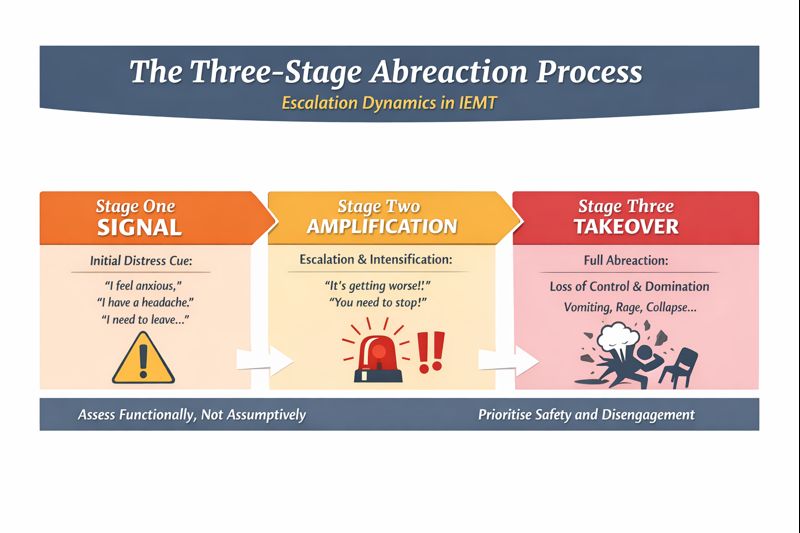
The Three-Stage Abreaction Model: Signal, Amplification, Takeover
Repeated clinical and workshop observation led to a three-stage escalation model, particularly prominent in clients presenting with chronicity patterns (e.g., persistent anxiety, chronic fatigue, and high contextual control behaviours).
- Stage One: The Signal. An initial cue appears (“I feel anxious,” “I have a headache,” “I need to go outside,” “I feel sick”). Functionally, the signal communicates: something unpleasant is happening; you must change.
- Stage Two: Amplification. If the signal is not responded to by changing the direction of the work, the intensity increases. The affect, symptom, or display becomes louder: verbally, physiologically, and non-verbally. This phase often includes an implied threat: I have warned you; I will escalate further.
- Stage Three: Full-Blown Abreaction (Takeover). A threshold is crossed, and the behaviour dominates the context. This may include vomiting, hyperventilation, convulsion-like display, extreme anger, property damage, or a total hijack of the session environment. Functionally: you did not comply, so I will punish and control by overwhelming the context.
The time-course from Stage One to Stage Two varies by individual tolerance and learned patterns. The model is presented as a descriptive framework for escalation dynamics - not as a judgment that all strong emotions are manipulative.
“Substitution of State” as Permission
A key conceptual move is recognising how “state” can become a permission structure. In some individuals, having a feeling is treated as a sufficient reason to suspend responsibility or obligations (“I don’t feel like it,” “I don’t feel well,” “If you make me, I’ll become unwell”). This logic may be idiosyncratically valid within the person’s constructed reality, even when it does not function in the external world.
This is observable not only in therapy rooms, but also in social systems (families, workplaces, institutions). The clinical question is not moral condemnation, but whether this pattern maintains chronicity, avoidance, and relational conflict.
The “That’s Right…” Method: Acknowledgement Without Yielding Control
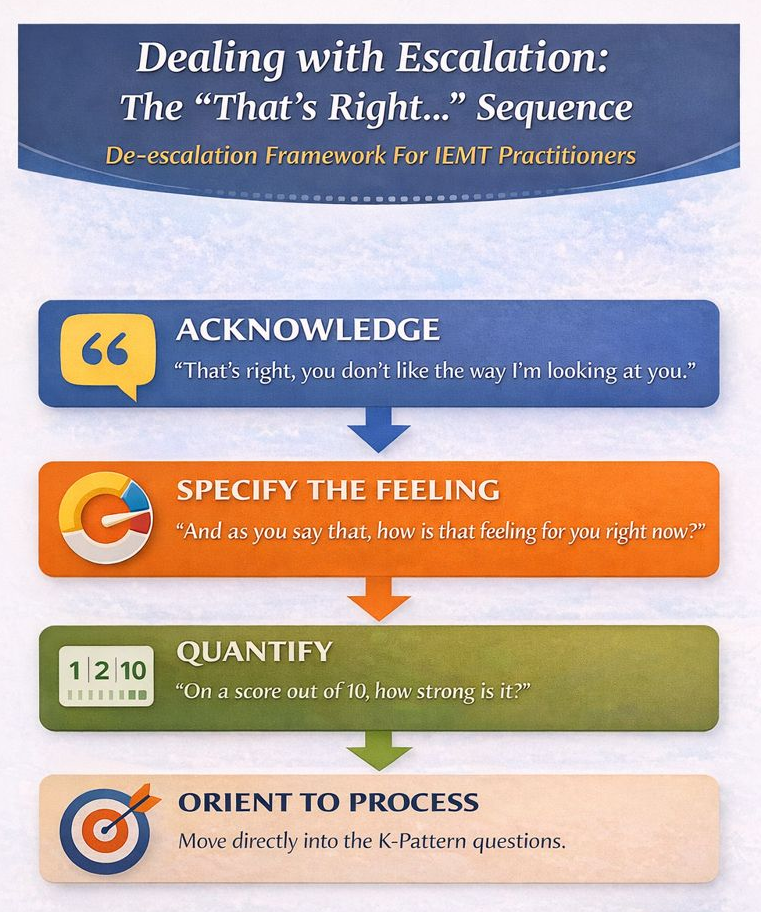
A central IEMT conversational manoeuvre for handling escalation patterns is the “That’s right…” acknowledgement sequence. The purpose is to acknowledge the client’s expressed experience without dismissing it or being controlled by it, and then immediately move to a next-step function that returns the interaction to process.
Critically, “That’s right” must not be used punitively, sarcastically, or as a dominance game. It is a bridge from interactional escalation into structured process work.
A clinically useful structure is:
- Acknowledge: “That’s right, you don’t like the way I’m looking at you.”
- Specify the feeling: “And as you say that, how is that feeling for you right now?”
- Quantify: “On a score out of 10, how strong is it?”
- Orient to process: move directly into the K-Pattern questions.
This maintains momentum while preventing the client from defining “what happens next” via escalation. The practitioner remains responsible for the next step function.
What to Do at Stage Three: Safety and Non-Engagement
When escalation reaches Stage Three, the default guidance is simple: do not engage with the display. In many contexts, the most effective response is to remove the audience and remove the interpersonal payoff, much as one would respond to a child’s tantrum by not providing an attentive stage.
Where there is any risk of harm to the practitioner or others, the priority becomes personal safety. In such cases, the correct intervention may be to leave the room, exit the building, seek assistance, and disengage from containment attempts. The professional “one-up” role does not obligate the practitioner to remain present in escalating risk.
Practitioners should also consider third-party dynamics: witnesses, managers, colleagues, or family members may respond unpredictably, intensifying drama or redirecting blame. Escalations never occur in a vacuum; they occur in systems, and these systems are not always particularly helpful in such situations.
Practitioner Development: Session Analysis, Recording, and Micro-Calibration
A strong recommendation is systematic practice review: video or audio recording (with consent), transcription, and session analysis. Abreaction dynamics often begin as subtle signals that are missed in the moment. Reviewing sessions allows practitioners to identify:
- Early-stage cues that precede escalation
- Practitioner responses that inadvertently reinforce Stage One or Stage Two
- Missed content when multiple signals appear simultaneously
- Non-verbal patterns: facial expression, pacing, tone, and “how you come across”
This micro-calibration approach supports practitioner competence beyond certification: not merely “running sessions,” but understanding the interactional mechanics of what is actually occurring in the therapeutic exchange.
Abreactions in IEMT contexts should be assessed functionally rather than assumed to be inherently therapeutic. While emotional discharge can yield relief, escalating “signal” behaviour may serve as a control mechanism that stabilises chronicity and disrupts therapeutic progress. The three-stage model (signal → amplification → takeover) provides a practical framework for recognising escalation early.
The “That’s right…” acknowledgement method, used ethically and with appropriate next-step structure, offers a conversational pathway back into IEMT process work without entering control/counter-control games. Where escalation reaches behavioural risk, safety and disengagement are legitimate and often essential responses. Finally, systematic session analysis is presented as one of the most direct routes to practitioner mastery in recognising and handling these dynamics.