





Conversation Analysis
Conversation Analysis: Understanding the Structure of Talk
Conversation Analysis (CA), developed by Harvey Sacks, Emanuel Schegloff, and Gail Jefferson, is a method for examining the fine-grained organisation of everyday talk. Rather than focusing on the content of what is said, CA analyses the structure of interaction: how participants take turns, repair misunderstandings, and manage the flow of conversation.
Turn-Taking
One of the foundational insights of CA is that conversation is a highly organised system of turn-taking. Participants work together to minimise gaps and overlaps between turns. In therapy, understanding turn-taking can help practitioners recognise when a client is signalling readiness to speak, hesitancy, or disengagement.
Repair Mechanisms
CA also examines how speakers manage and resolve problems in speaking, hearing, or understanding. These are called repair mechanisms. For example:
- Self-repair – The speaker corrects themselves mid-utterance: “I first noticed it last—no, actually two weeks ago.”
- Other-repair – The listener prompts clarification: “Sorry, when you say ‘it,’ what do you mean?”
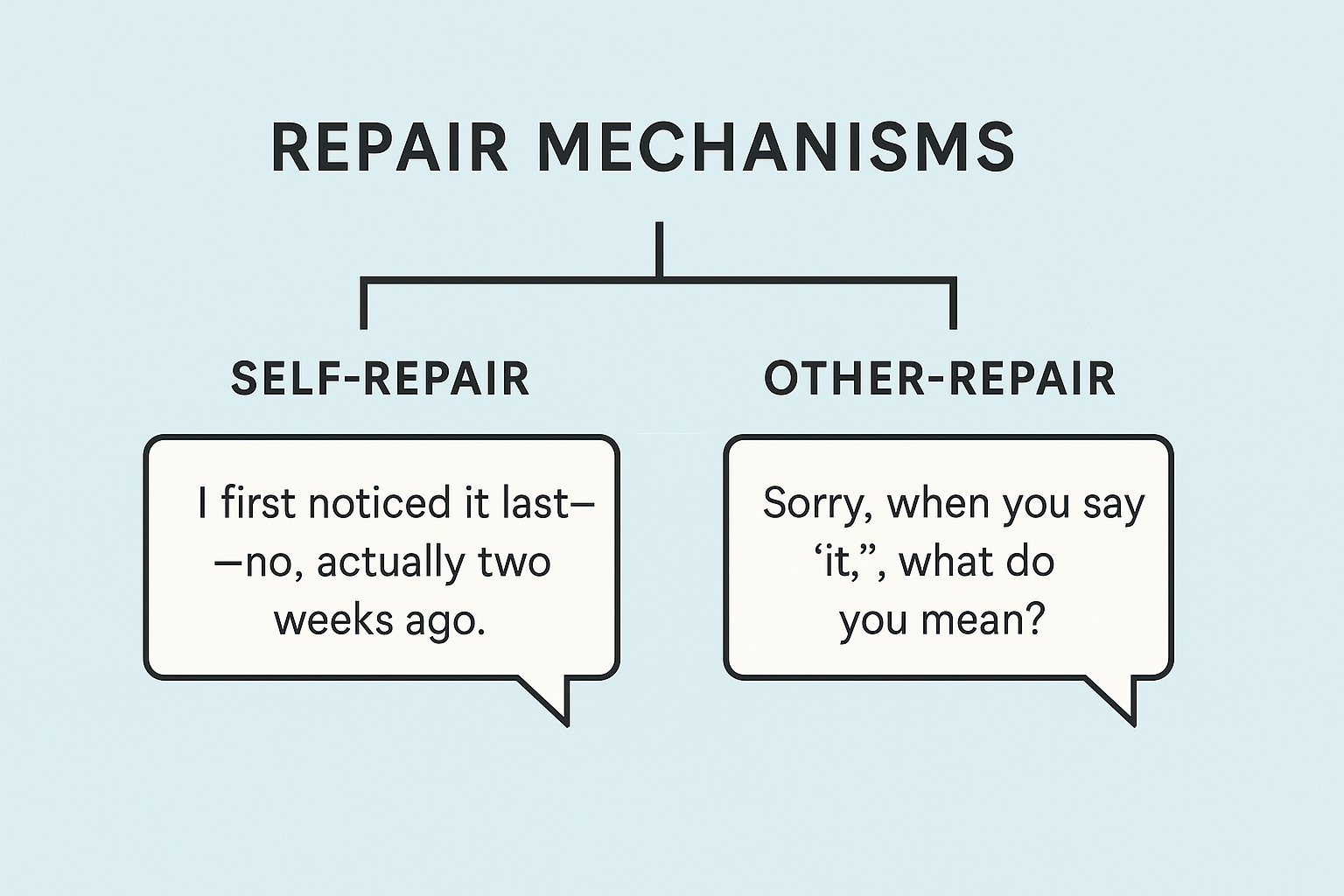
In IEMT, clients may use self-repair when refining their descriptions of experiences, and therapists may employ other-repair to clarify ambiguous or underspecified statements.
Sequential Organisation
Conversation unfolds in sequences of related turns, such as question–answer or greeting–greeting. The placement of a response within a sequence can affect how it is interpreted. A pause before answering may be heard as hesitation, uncertainty, or resistance.
Adjacency Pairs in Conversation Analysis
Adjacency pairs are a fundamental concept in Conversation Analysis (CA), referring to paired utterances where the first part (e.g., a question, greeting, or invitation) creates an expectation for a specific type of second part (e.g., an answer, return greeting, or acceptance/rejection). These pairs form the building blocks of sequential organisation in talk, ensuring conversations progress coherently. For instance, a question like "How are you feeling today?" typically elicits a response such as "I'm feeling anxious," maintaining the interaction's flow.
In CA, adjacency pairs are analysed for their "conditional relevance," meaning the absence of an expected second pair part is noticeable and accountable, speakers may pursue a response if it's missing. This structure highlights how participants collaboratively construct meaning through interaction.
Application in Integral Eye Movement Technique (IEMT)
In IEMT sessions, adjacency pairs are crucial for guiding clients through eye movement exercises and emotional exploration. Practitioners can use question-answer pairs to probe traumatic memories, such as "Can you describe the image in your mind?" followed by the client's description. Recognising when a client delays or avoids the second pair part (e.g., through silence or topic shift) can signal resistance or emotional blocks, allowing the therapist to adjust pacing or employ repair mechanisms. This enhances therapeutic rapport and ensures eye movement interventions are timed effectively, promoting deeper emotional processing.
Example: Therapist: "What emotion comes up with that memory?" Client: "Fear... but it's fading now." Here, the pair facilitates progression toward integrating eye movements for change.
Preference Organization
Preference organization in CA describes how responses to first pair parts are structured to favor certain outcomes over others. "Preferred" responses are typically direct, immediate, and affiliative (e.g., agreeing or accepting), while "dispreferred" ones involve delays, mitigations, or rejections (e.g., hesitations like "Well..." before disagreeing). This organization reflects social norms of politeness and cooperation in interaction.
CA research shows dispreferred responses often include accounts or explanations to soften potential conflict, such as "I'd love to, but I'm busy" instead of a blunt "No."
Application in IEMT
For IEMT practitioners, understanding preference organisation helps interpret client responses during identity or emotion mapping exercises. A preferred acceptance of a reformulation (e.g., Therapist: "So this feels like guilt?" Client: "Yes, exactly.") indicates alignment, while a dispreferred response (e.g., pause followed by "Not really, it's more like shame.") signals a need for clarification. This insight allows therapists to navigate sensitive topics ethically, using eye movements to resolve dispreferred emotional states and foster client empowerment.
In therapeutic contexts, encouraging clients to express dispreferred responses without fear can reveal underlying patterns, aligning with IEMT's goal of transforming chronic emotional responses.
Advanced Therapeutic Insights from CA Research
Recent CA studies in psychotherapy emphasize video analysis to capture non-verbal cues like nodding or gaze, which complement verbal turns. For instance, research shows mutual affect regulation through bi-directional interactions, where therapists' responsive presence holds space for client arousal. In IEMT, integrating bodily signals (e.g., eye fixation during talk) with CA can enhance outcomes.
CA also identifies "transformative sequences" - moments of change in talk, such as when a client's resistance dissolves after a well-timed repair. Practitioners can apply this by reviewing session transcripts for patterns, improving ethical and effective interventions.
Strategic Underspecification and CA
CA provides a useful lens for examining strategic underspecification: the deliberate use of vague or incomplete statements that prompt the listener to initiate repair or take interpretive risks. For example:
Vague statement → pause → listener prompted to ask, “What do you mean?”
This can place the conversational burden on the listener, influencing the direction and tone of the interaction. In a therapeutic setting, such strategies can be constructive (encouraging clients to elaborate) but they must be employed ethically to avoid undue pressure or manipulation.
Therapeutic Applications
For IEMT practitioners, awareness of CA principles can:
- Enhance active listening – Recognising turn-taking signals can support better pacing and flow in sessions.
- Support precision – Using repair mechanisms deliberately can clarify meaning and reduce misinterpretation.
- Reveal interactional patterns – Identifying how clients structure their talk can offer insights into their cognitive and emotional processes.
Overlaps and Interruptions in Therapeutic Talk
Overlaps occur when speakers talk simultaneously, often at transition-relevant places, while interruptions involve starting a turn before the current speaker has finished. CA distinguishes cooperative overlaps (e.g., supportive backchanneling like "uh-huh") from competitive interruptions that disrupt flow. These phenomena reveal power dynamics, engagement levels, and emotional intensity in conversations.
Studies in CA show that overlaps can enhance rapport in affiliative contexts but may indicate tension or eagerness in others.
Application in IEMT
In IEMT, where sessions involve guided eye movements and verbal processing, overlaps might occur during high-emotion moments, such as a client interrupting to express a breakthrough insight. Practitioners can use CA to differentiate: A cooperative overlap (e.g., Therapist: "Move your eyes left to right..." Client: "Yes, and now it's clearer!") builds momentum, while interruptions could signal anxiety needing repair. By minimising disruptive overlaps through clear turn-taking cues, therapists maintain a safe space for trauma resolution.
Tip for Practitioners: Monitor for overlaps in video-recorded sessions to refine interactional skills, ensuring eye movement protocols are delivered without unintended interruptions.
Formulations and Interpretations in Therapy
Formulations in CA involve rephrasing or summarizing prior talk to check understanding or advance the interaction (e.g., "So what you're saying is..."). In psychotherapy, these are key for therapists to interpret client narratives, bridging everyday talk with therapeutic insights. CA research highlights how clients accept, modify, or reject formulations, influencing session direction.
Transformative sequences often emerge from formulations, where a therapist's interpretation leads to client epiphanies or shifts in perspective.
IEMT practitioners frequently use formulations to map emotional identities before eye movement interventions, such as "It sounds like this event left you feeling powerless." Client responses guide whether to proceed with eye movements. CA-informed analysis reveals how accepting a formulation can accelerate change, while rejections prompt deeper exploration. This aligns with IEMT's focus on rapid, non-content-based therapy, emphasising interaction over introspection.
Case Example: In a session addressing PTSD, a therapist formulates: "This memory triggers anger toward yourself?" The client rejects: "No, it's more sadness." Adjusting via repair leads to targeted eye movements, reducing the emotion's intensity.
Conversation Analysis reminds us that communication is not merely the exchange of information but a coordinated social activity. By understanding the mechanics of turn-taking, repair, and sequential organisation, IEMT practitioners can refine their interactional skills, fostering more effective and ethically sound therapeutic exchanges.
References:
- Sacks, H., Schegloff, E. A., & Jefferson, G. (1974). A simplest systematics for the organisation of turn-taking for conversation. Language, 50(4), 696–735.
- Sidnell, J., & Stivers, T. (Eds.). (2012). The Handbook of Conversation Analysis. Chichester: Wiley-Blackwell.